


Between 2024 and 2025, America’s largest data centers used as much electricity as the state of Michigan, according to a recently published account by an international team of researchers.
Much of that power came from burning natural gas and coal, putting into shocking perspective the potential environmental cost of a technological future that has arrived before we’re ready – or for many, even willing.
While the results couldn’t distinguish between the power going to our AI therapy sessions and the electricity needed to store our vacation pics, it’s clear our growing reliance on advanced digital intelligence is gobbling up any gains we make in curbing energy use.
“Data centers are growing incredibly fast, driven largely by AI, and decisions about where to build them and how to power them are being made right now,” says lead author Gianluca Guidi, a biostatistician at Harvard University.
Using satellite imagery to verify the locations of 403 hyperscale data centers and power-plant records to estimate their emissions, the Harvard-led team found that the facilities’ electricity use was between 68 and 99 terawatt-hours in the year ending April 2025.
Based on that estimate, just those data centers would have accounted for 1.8% of the US’s total electricity consumption that year.
At the high end, it’s close to the energy that states like Michigan or Tennessee use in a year. More concerningly, that power generation would have added 25.7 million metric tons of carbon dioxide to the atmosphere – more than Denmark’s entire emissions for the same period.
Hyperscale facilities are the biggest class of data centers, built to handle the demands of cloud storage, online services, and, increasingly, the large language model programs we have come to think of as artificial intelligence.
Detailed figures for individual facilities are rarely available to the public, making it hard to calculate their precise energy use. To get around that obstacle, Guidi and colleagues checked commercial facility records that could be verified against building footprints and satellite imagery.
They then estimated power use by making some assumptions about each site’s capacity, including electricity needed to cool the equipment and keep the facility running 24-7.
The researchers matched each facility to the region responsible for balancing supply and demand on its part of the grid. Using US Environmental Protection Agency records from 2023, they assigned each data center a share of emissions based on the region’s means of power generation. The result is a geographic estimate of the emissions associated with running these facilities.
About 54% of the electricity attributed to the facilities came from fossil fuels, with natural gas supplying around 38% and coal 15%. Virginia alone accounted for about a quarter of the electricity in the study. Add Oregon, Ohio, and Iowa, and those four states make up more than half.
The same electricity demand can leave a very different carbon footprint from one grid region to the next. Across the sample, each kilowatt-hour was associated with about 314 grams of carbon dioxide, below the comparable US average of 348 grams. Yet nearly a quarter of the demand was found in grid regions with above-average carbon intensity.
Guidi et al., Nature Sustainability, 2026
The figures mean that decisions over the locations of future data centers in the US could have consequences far beyond geographical boundaries.
An earlier study put hyperscale electricity use at around 23 terawatt-hours in 2018, less than a third of the new central estimate. The studies used different facility inventories and methods, limiting the comparison to a broad sense of scale.
Nonetheless, that scale is clearly expanding rapidly. Lawrence Berkeley National Laboratory estimated that US data centers of all sizes consumed 176 terawatt-hours in 2023 and projected that figure could reach between 325 and 580 terawatt-hours in 2028.
Carbon dioxide’s role in pushing up global temperatures isn’t the only risk to consider, either. Reduced air quality from fossil-fuel combustion has a variety of health impacts, affecting people who live nowhere near a data center.
A separate University of California, Riverside analysis modelled the health burden associated with data center air pollution in California, estimating that it roughly tripled from 2019 to 2023, as the sector’s electricity use in the state nearly doubled.
“Decisions about where data centers go and how they’re powered are critical environmental and public health decisions, and they should be made with good data,” says study co-author Francesca Dominici, also a biostatistician at Harvard.
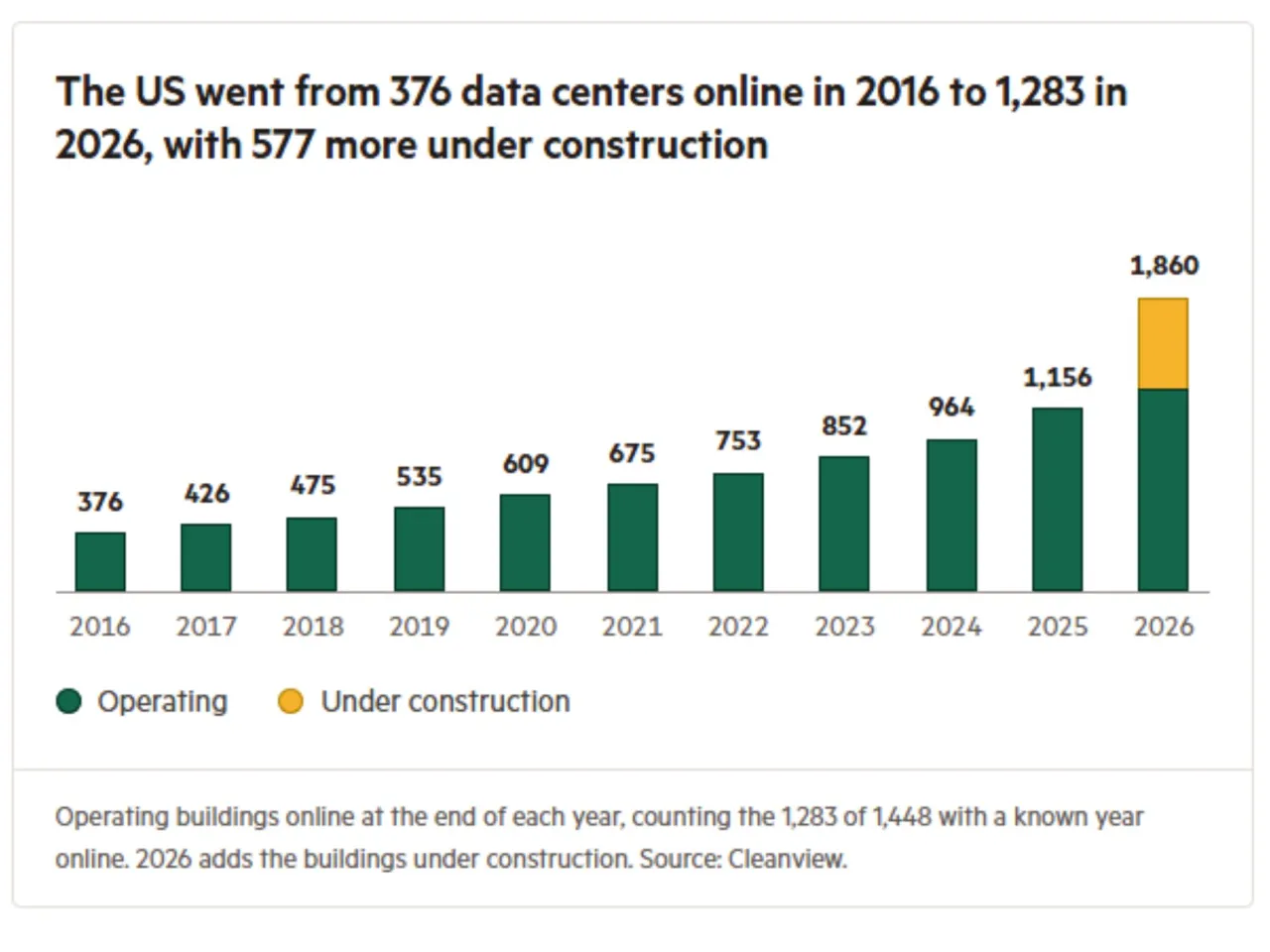
In 2025, the US had 1,156 data centers in operation. As 2026 comes to a close, there are 1,860 running or under construction, making the electricity estimates in this study somewhat obsolete already.
Cleanview
By the time those new data centers are switched on, any questions about their health impacts and energy demands will be too late. For hyperscale facilities yet to be built, the right time to ask critical questions about their widespread costs is right now.
The research was published in the journal Nature Sustainability.
Source: Scimex

