


While modern people may regard trains as a quaint 19th century technology, even in an advanced industrial country such as the United States, passengers took 29.9 million train trips last year alone; in Russia, the number of trips was 1.1 billion, and in China, it was 5 billion.
The economic impact is equally massive, with a total global value in 2025 of $US343.8 billion, an amount guaranteed to rise as the world embraces high-speed rail transit. So, if some supervillain wanted to wreak havoc, destroying railroads would be any easy way to do it.
But what if, instead of being a person, that supervillain were global warming? As heat waves increase in temperature and frequency, the summer sun is heating rails so much that they’re surpassing 60 °C (140 °F). When trains ride along bulging rails, passengers and cargo risk utter disaster.
Until recently, the only way to cool heated rails was spraying water on them, which requires expensive installation of sprinklers and constant, massive water use – two non-starters in dry, low-income countries.
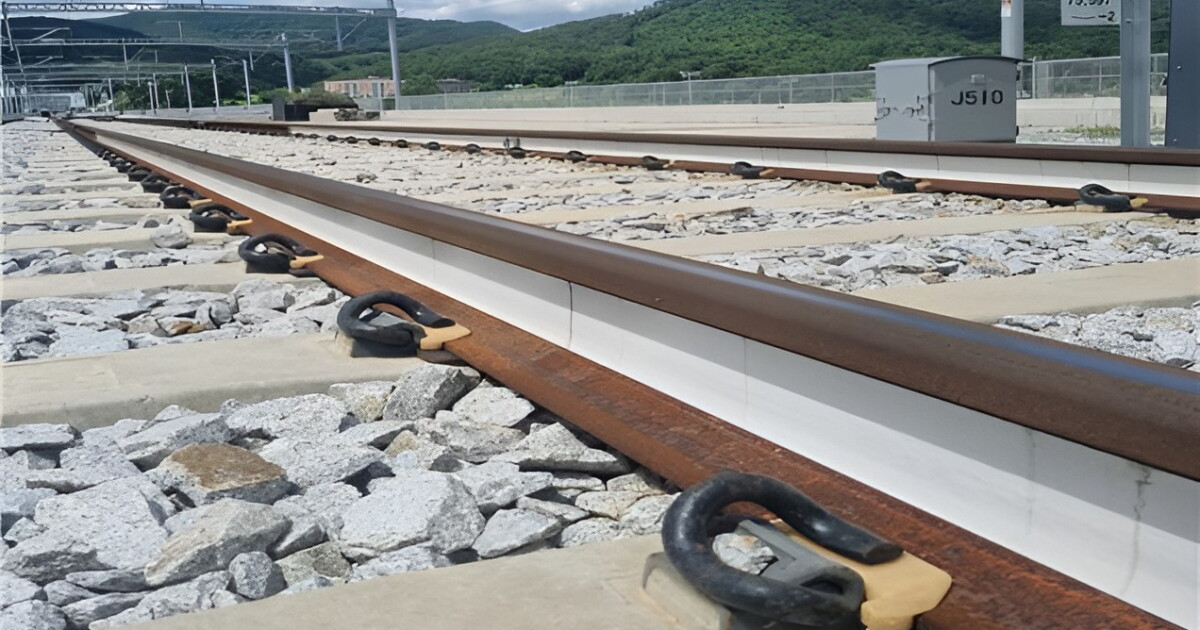
That’s why a fascinating invention from the Korean Railroad Research Institute offers such hope for increased safety – a heat-shielding textile, magnetically mounted on rails.
With its multiple fiberglass and magnetic layers, the textile blocks more than 85% of punishing solar heat. In summer 2024 tests on Korea’s Gwangju Line, and summer 2025 tests on the Jungbu Inland High-Speed Line, the Korea Testing & Research Institute certified that the KRRI textile reduced rail temperatures by up to 10.9 °C (19.62 ºF).
Even better, the heat-shielding textile keeps costs low as a “set-it-and-forget” technology.
National Research Council of Science & Technology
According to its designers, it’s failure-proof for up to 10 years, whether on conventional or high-speed rails. High-speed safety is especially important in Korea, where Korean Train eXpress (KTX) trains travel at 300 km/h (206 mph) while generating opposing winds. To support train safety even against 238 km/h (148 mph) wind speeds – 150% stronger than winds generated by high-speed trains – the textile’s magnetic latch employs a dual fastening mechanism.
“This is a demand-driven research outcome that allows the public to use railways with confidence even during extreme summer heat,” says KRRI President Sagong Myung. “In an era where climate crisis directly translates into national risk, we will further advance this technology to ensure safe railway operations and expand its application to overseas markets.”
KRRI’s system requires only two technicians to deliver and install it at a rate of 2 km (1.375 mi) per hour; furthermore, KRRI cleans it during seasonal use and will retrieve it at the end of each summer using only one piece of equipment.
“This technology goes beyond simply lowering rail temperatures – it presents a new paradigm for protecting railway safety in the era of climate crisis,” says KRRI Principal Investigator and Chief Researcher Kang Dong-hoon. “We plan to expand its application beyond railways to various fields that require heat mitigation, such as building exteriors and roadside facilities.”
For its results, KRRI’s heat-shield received attention at the 2025 Seoul International Invention Exhibition, with its patent winning the Grand Prize, and its automated equipment patent winning the Silver Prize.
Source: National Research Council of Science & Technology via AlphaGalileo

