


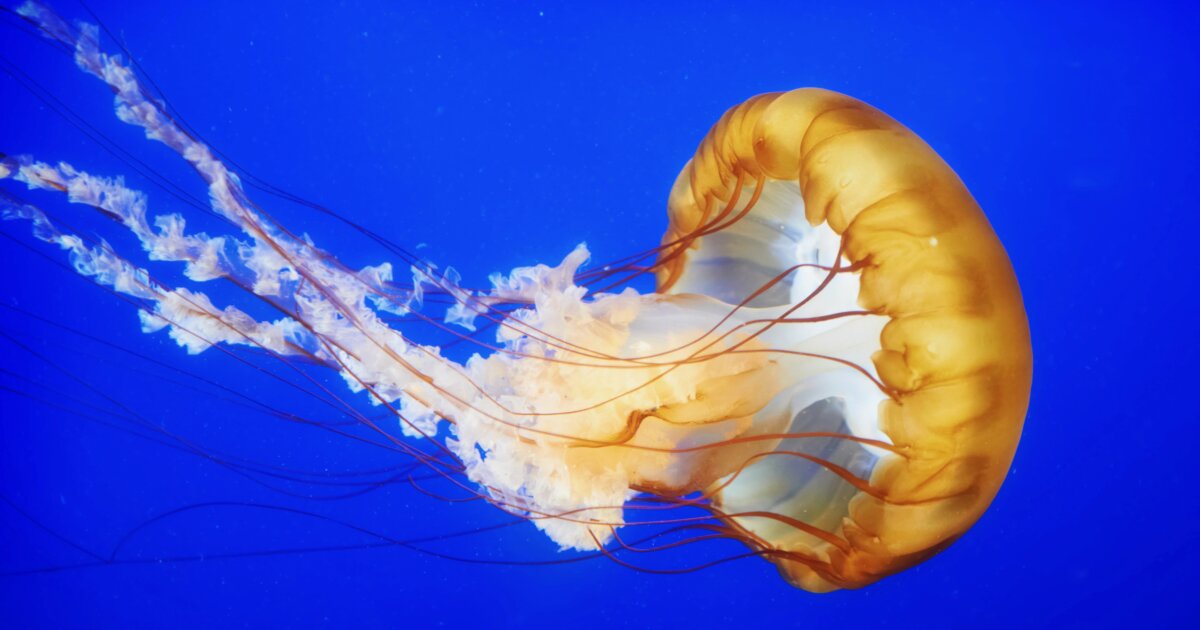
There are a few things more painful than going to the beach on a hard-earned vacation, only to get stung by a jellyfish. The horror! Thankfully, this occurrence may soon be a thing of the past. Researchers from the Universitat Politècnica de València (UPV) and the University of Alicante have developed an anti-jellyfish buoy that prevents the animal from reaching swimming areas.
The floating electronic device generates electromagnetic fields that temporarily paralyze jellyfish within range by targeting their pulsating locomotion.
“Jellyfish move by pulsating, contracting their bell to create a flow of water that allows them to move. By generating electromagnetic fields, it is possible to reduce the number of pulsations in jellyfish, and even paralyze them, thereby reducing their ability to move and maintain their position,” explains Jaime Lloret, coordinator of the team from UPV’s Research Institute for Integrated Management of Coastal Areas, that designed and tested the device.
Jellyfish stings are incredibly common, with an estimated 150 million stings occurring globally every year. While the vast majority are accidental and cause only mild irritation or localized pain, some species can deliver severe, life-threatening reactions. The sting of the Australian box jellyfish has been described as being lashed with a whip dipped in burning acid, and is powerful enough to kill an adult in as little as two minutes! Try peeing on that (a completely useless myth, by the way).
Depositphotos
All of these incidents occur on or near shore, where humans and jellyfish inadvertently encounter each other. The researchers’ device aims to solve the stinging problem by physically preventing this meeting (unfortunately no images of it are available at this time).
Each buoy comprises three main parts: the floating buoy housing the core electronic transmitters and sustainable power sources; a weighted chain that extends vertically downward and is anchored by a bottom weight to keep the system stable; and submerged coils positioned at multiple depth layers along the chain to broadcast wave fields across the water column. When a buoy is activated, it creates a 200 to 300-meter (656 to 984-ft)-long virtual barrier that extends downward along the chain.
Unlike physical barriers, which affect all forms of wildlife, the device specifically targets only jellyfish, immobilizing them as they approach. Interestingly, the researchers say the technology is absolutely harmless to jellyfish and to the surrounding marine ecosystem, serving only as an immediate deterrent. Their full mobility is restored once currents carry them out of range.
“The system is completely harmless and, once outside the device’s range, they can move about as normal,” adds César Bordehore, scientific coordinator of the Marine Research Laboratory at the University of Alicante.

Depositphotos
To create a complete system, the buoy is equipped with sensors for temperature, turbidity, chlorophyll, and oxygen levels. The main electronic systems are powered by power packs integrated into the buoy’s watertight top chamber. The device uses clean energy harvesting, typically combining solar panels and wave-energy mechanics, to continuously recharge its internal power sources without requiring any external fuel or cables.
According to the researchers, each buoy can cover a maximum of 300 meters. Multiple buoys can be used to create even longer barriers. The buoys are also modular, allowing for modular depth layers; the exact radius and volume of the field depend on how many wave-emitting coils are stacked vertically. Another advantage of the device is its ease of maintenance. It doesn’t trap algae or debris, and the placement of all main components in the floating buoy makes access and repair easy.
The researchers envision their use in public and private beaches; in industrial facilities such as desalination and power plants to prevent jellyfish from clogging water intake pipes; and in aquaculture to protect commercial fish pens and marine farming setups from swarm damage.
The public beaches application has one stark limitation. Jellyfish are also passive drifters, meaning that they are often unintentionally carried towards shore by powerful ocean currents. Since the device targets the voluntary pulsating movement of the Ocean dwellers, they are useless in this situation. The waves will carry the paralyzed bodies to the shore, and even dead jellyfish have been known to sting. The researchers indirectly acknowledge this limitation by recommending a hybrid solution: combining these buoys with existing perimeter nets to fortify heavily infested tourist coasts.
The project is still in the prototype and laboratory phase, with all successful trials demonstrating the temporary paralysis effect occurring exclusively inside controlled aquarium tanks. The team is seeking commercial partners or companies willing to fund and build the first outdoor units.

