


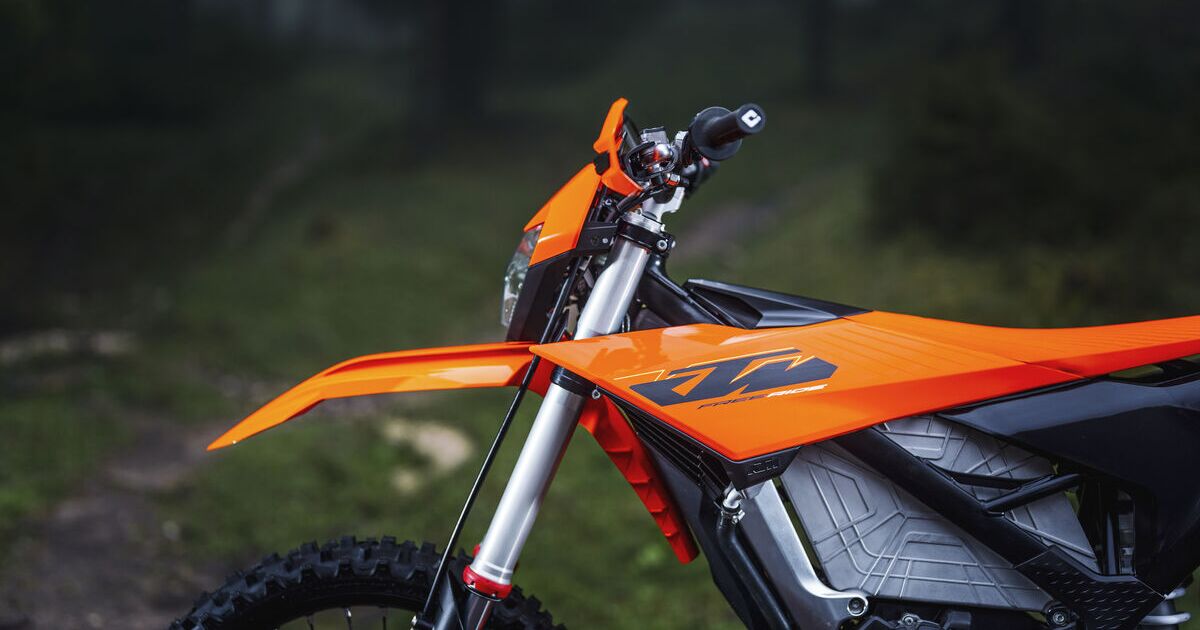
It’s been 12 years since KTM first introduced the Freeride E as a proper off-road electric. Come to think of it, KTM can actually be considered one of the pioneers in the electric revolution.
Now, the Freeride E finally becomes fully road-legal in all 50 US states. It gives the electric market another capable street-legal option to choose from, a move that might just prove crucial for KTM as it continues to rebuild following its financial restructuring.
First things first. This isn’t just a paint-scheme update; almost everything on the 2027 Freeride E has been tweaked, revised, or updated. And since it’s an electric, let’s start with the battery.
KTM
It now gets a bigger 5.5-kWh MX50 lithium-ion battery pack – that’s a 1.5-kWh battery capacity increase over its predecessor. It’s still swappable, meaning you can carry spares and virtually eliminate the need to charge every few hours.
Range is said to be up to three hours on a full charge, but considering it’s an enduro, that time could shrink based on how hard you push the Freeride E. Charging takes as little as 1.5 hours with a 3.3-kW charger, which increases to 8 hours with a 660-W unit. KTM says the Freeride E’s battery can endure up to 1,000 charging cycles before losing about 20% of its efficiency.
Even the motor gets a small boost in power, which now produces 26 horsepower and 27.2 lb.ft (37 Nm) of torque. Top speed is listed as 59 mph (95 km/h). Now that may seem paltry, but considering the Freeride isn’t meant to munch miles on the freeway, but rather take on trails and the dirt, I don’t see anything wrong with that number.
The chrome-molybdenum steel frame now comes with an aluminum and glass-fiber reinforced nylon subframe, which helps keep the weight down. The motorcycle tips the scales at just under 247 lb (112 kg), of which 64 pounds (29 kg) is from the battery alone. Best of luck trying to flat foot the thing, considering its 35.8-inch (910 mm) seat height though.

KTM
The Freeride E comes with a fully-adjustable WP XACT and XPLOR suspension system to soak up terrain flying under the 21/18-inch aluminum wheels. The package is completed with Braketec brakes and Michelin Enduro Medium tires.
The electronic package isn’t over-stuffed – it’s only fitted with things you’d need on an enduro. That includes a functional “rollover” sensor and adjustable traction control.
We don’t yet know what it’s going to be priced at in the States. As for the UK, KTM has slapped on a MSRP of £8,999, with the bike arriving at dealers from late April.
Now the new Freeride E is essentially nudging its way to some very competitive territory. It produces a fraction of the power of the world’s fastest street-legal enduro – the Stark Varg EX does85 hp compared to this bike’s 25 hp.

KTM
But put the two side by side, and it becomes obvious that KTM and Stark aren’t even chasing the same kind of rider. The Freeride E, especially now that it’s street-legal, feels like a bike designed for short hops, trails, maybe even a cheeky commute. It’s light, unintimidating, and at last usable in a way it always should’ve been.
The Stark Varg EX, on the other hand, is what happens when you remove restraint from the equation entirely. It’s faster, more powerful, and inherently more demanding. This isn’t something you casually swing a leg over after work. It’s closer to a full-blown race bike that just happens to take on any trail you can throw its way.
And that’s why I think the Freeride’s update matters. Because while everyone’s busy chasing bigger numbers and more performance, KTM has quietly gone the other way – offering something simpler, more usable, and arguably more relevant to how most people actually ride. The Varg might win the spec-sheet war by a landslide, but the Freeride’s the one you might actually end up riding more often.
Yet, its newfound street-legal status feels less like a revolution and more like KTM finally catching up with what the bike always should’ve been. For years, the Freeride sat in this odd limbo – perfectly capable of short commutes and urban hops, but officially only limited to private trails and parks. At least in the USA.

KTM
For other regions, like Europe, KTM at least offered road-going street-legal variants (the SM), leaving American riders to either look the other way or jump through registration hoops just to make it usable beyond the trail. That’s what makes the 2027 update significant.
And that brings me to the biggest question I have had since this announcement was made: why did it take this long? Electric dirt bikes have always been flexible, quiet, compact, and unintimidating. But big brands have been slow to lean into it where it matters most. That’s given smaller manufacturers the chance to come into the fray.
The Freeride E going fully street-legal in the US isn’t just a product update; it’s KTM acknowledging that riders don’t want separate machines for trails and tarmac anymore. They want one bike that does both. And finally, this one can.
Source: KTM

