


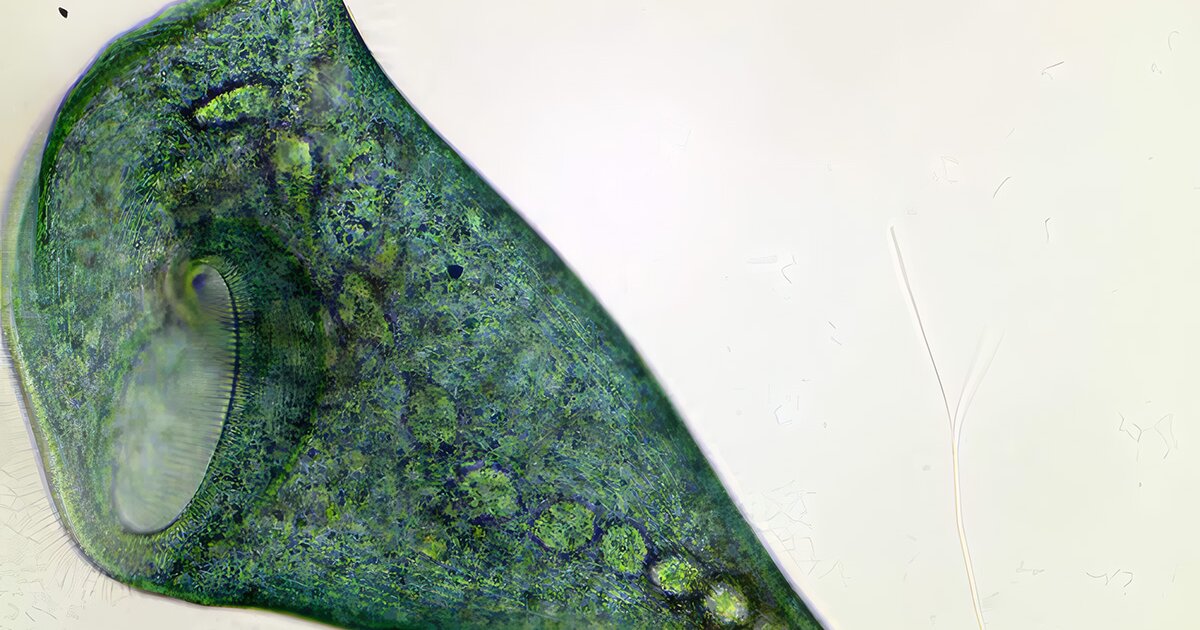
For decades, scientists believed that associative learning – understanding that two events are linked to each other, like a stimulus and a response – required at least some form of neural machinery. But now, a tiny unicellular creature without a trace of gray matter and living at the bottom of ponds may upend this long-held assumption.
A new study, yet to be peer-reviewed and published in a journal, has shown that even single-celled organisms that completely lack a brain or a nervous system are capable of learning.
“This surprised me because we had no prior evidence for associative learning in this organism (and evidence from other unicellular organisms was controversial), so we had no way of knowing if it would work,” said Samuel Gershman, a cognitive neuroscientist at Harvard University, in an email to Refractor.
Stentor coeruleus is a trumpet-shaped protozoan about 0.04 inches (1 mm) long. At one end of their body, they have an anchor called a holdfast to attach to the pond surface; the other end has cilia to filter feed. When it senses any disturbances nearby, such as an approaching predator, it contracts its body into a sphere-like shape.
Image courtesy of the researchers
To investigate how this creature learns, Gershman and his colleagues collected a few dozen S. coeruleus cells in petri dishes and left them to settle for several hours before the experiment. The team then used a custom device to deliver precise taps to the bottom of the dishes containing the cells.
In response to these taps, most of the S. coeruleus cells contracted at first, but as the taps continued, fewer cells responded. This shows that the cells had habituated to the stimulus and no longer treated it as a threat.
Next, the team introduced what it called the pairing protocol. Cells received a weak tap (which produced only a modest contraction response), followed by a strong tap one second later. This pairing protocol of taps was repeated every 45 seconds (the time S. coeruleus takes to extend again after contracting).
After the first 10 trials of this pair of taps, the cells immediately contracted to the weak tap, but this response gradually weakened with repeated trials. “This suggests that individual cells can implement non-trivial learning algorithms,” Gershman said.

These findings potentially change how we think about the evolutionary history of learning. The advanced forms of learning exhibited there have an ancient origin and may predate complex nervous systems, the scientist told us. “Did associative learning first emerge in multicellular organisms with brains? Maybe not,” he added.
“The many similarities between these cells and the neurons in our brains hint at the possibility that our brains might still use some of the same learning mechanisms that first evolved in single cells,” Gershman concluded.
The study has been published in BioRxiv.

