


Some companies build a desalination plant and call it a day; others build a data center, while others, still, build power generation facilities. One project wants to build all three … into one facility … offshore … on a movable ship.
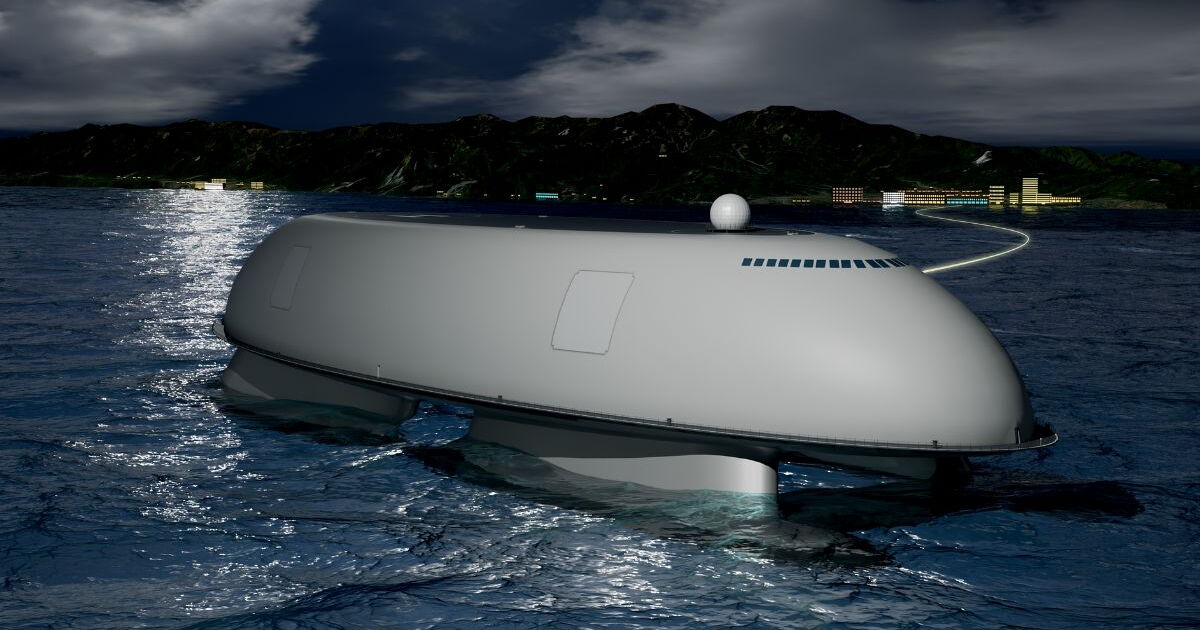
Introducing the Blue Economy VITAL 100 MW Kraaken, a proposed infrastructure platform developed by marine engineering firm InMar Technologies and energy systems developer OptiFuel Systems under their Optimal Transit maritime technology partnership.
The concept combines offshore power generation, a desalination facility, and an AI data center into one large floating vessel that can sail away when required. According to Optimal Transit, an onboard plant would generate up to 40 MW of continuous electricity, which would be sent ashore, enough to power roughly 32,000 homes 24/7. Another system would produce 30 million liters (7.9 million gal) of fresh water every day, enough for an estimated 150,000 people. On top of all these, the vessel would retain 60 MW of capacity for AI-grade data-center computing.
It would require no land, no grid connection, and, according to Optimal Transit, no conventional fuel for those operations.
The Blue Economy VITAL 100 MW Kraaken is the latest configuration of a concept Optimal Transit unveiled in July, primarily as a self-powered floating AI data center, with 10-, 20-, 50-, and 100-MW variants. Virtually all of its available output was intended to be absorbed by racks of GPUs. The new VITAL configuration uses the same basic 100-MW power system, hull, and mooring infrastructure, but splits the output between compute and utility services for nearby coastal habitats or disaster areas.
Now, you probably have a lot of questions about this wonder project, but let’s start with the most obvious. Where is the proposed 100 MW of electricity supposed to come from?
At the heart of both versions is Optimal Transit’s patented Digital Ocean Thermal (DOT) engine. Fundamentally, DOT is an extensively modified Ocean Thermal Energy Conversion (OTEC) system. OTEC exploits the temperature difference between warm surface seawater and much colder water hundreds of meters below. In a closed-cycle system, the warm water heats a low-boiling-point working fluid, such as ammonia, until it vaporizes. The vapor drives a turbine that generates electricity. Deep cold seawater condenses it back into a liquid, and the cycle starts again.
Kraaken adds an interesting second heat source: its own computers, repurposing the waste heat that other offshore data center concepts, such as China’s “world’s first” underwater data center, release into the surrounding ocean.
Optimal Transit
Optimal Transit’s published diagram shows warm seawater entering at around 25 °C (77 °F) and heating ammonia in an evaporator. Meanwhile, liquid-cooled servers aboard the ship send their waste heat, at roughly 45 °C (113 °F), through an integrated thermal bus to what the company calls an AHEB, which further heats, or “supercharges,” the ammonia vapor before it reaches the turbine. After expansion, 5 °C (41 °F) deep seawater cools the ammonia in a condenser, and a pump returns the liquid ammonia.
The company additionally refers to a multi-stage Rankine cycle, enthalpy recovery, supercharging, and green-ammonia synthesis as parts of DOT. More specifically, its diagram claims the architecture can reduce turbine size by around 70%, cut the size of the cold-water pumps and condenser by 70%, reduce warm-water pumping and evaporator costs by 40%, ammonia pumping costs by 40%, and cold-water pipe size by 70%. Impressive, albeit yet-to-be-demonstrated thermoelectric power generation.
What is particularly clever about the Blue Economy VITAL is that the same thermal infrastructure also performs other heavyweight tasks, including desalination.
It would produce fresh water using vacuum-flash desalination. At sufficiently low pressure, warm seawater boils at a temperature far below the usual 100 °C (212 °F). The resulting vapor leaves its salt behind and can then be condensed into fresh water using the available cold-water stream. It is an established concept closely related to open-cycle OTEC, in which fresh water can be produced as part of the thermal process.
Kraaken therefore attempts to squeeze electricity, cooling, and fresh water from essentially the same hot-and-cold thermal infrastructure.
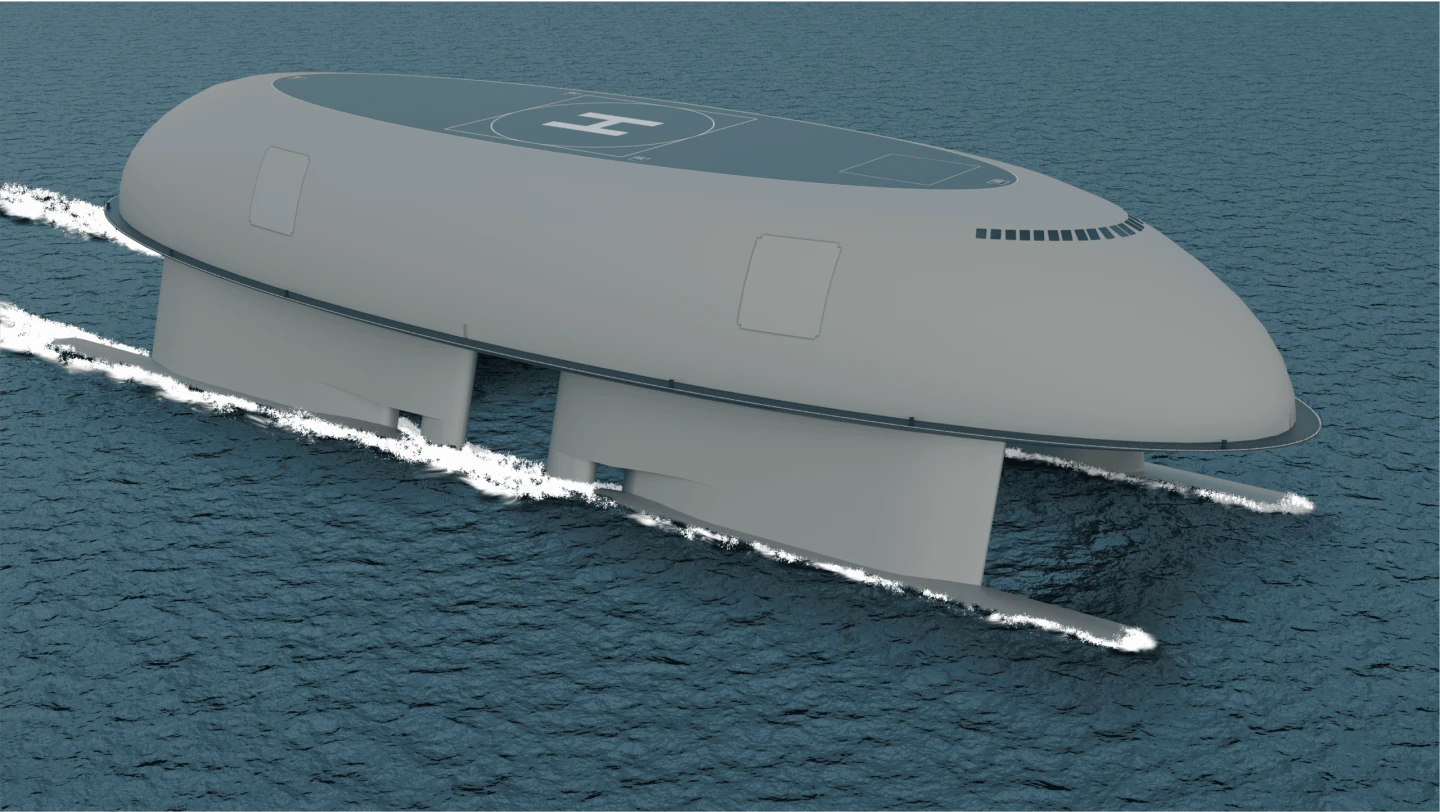
Now, you would expect such a facility to be anchored in place to the seafloor. Not the Kraaken. It’s itself a ship that uses a Small Waterplane Area Twin Hull (SWATH) design. Rather than putting most of its buoyancy at the wave-tossed surface, a SWATH vessel places much of it in two submerged hulls connected to the upper structure by relatively narrow struts.
Optimal Transit
The original 100-MW Kraaken concept is a roughly 300-ft (91-m), 50,000-long-ton vessel, while the smaller 10/20-MW design measures around 250 ft (76 m). The modular data-center hardware is liquid-cooled and replaceable, allowing newer generations of GPUs and servers to move aboard without replacing the long-life ship underneath. This is one reason the creators call the ship scalable.
So, how do the promised utilities, electricity and fresh water, as well as the data connection, reach land? The entire system is connected to the shore through a quick-disconnect umbilical system, “quick-disconnect” being a particularly interesting word. Should a major storm threaten, Optimal Transit says Kraaken could detach from its mooring within hours, move away under its own propulsion, and return to reconnect once conditions improve. The earlier design specifies speeds approaching 16 knots (18 mph/30 km/h). It could similarly leave altogether if its contract ends, political conditions change, or a disaster zone needs it more.
Optimal Transit envisions deploying the vessels off islands and in poorly served coastal regions, industrial areas, and disaster zones. It also proposes clustering five VITAL vessels within a 2-mile (3-km) offshore area to create what it calls a “Sovereign Power Park.” Such a cluster is claimed to provide around 200 MW of electricity to shore, 40 million gallons (151 million liters) of fresh water per day, and 300 MW of data-center capacity.
Next question: how much would the whole thing cost? Optimal Transit puts an all-in VITAL vessel at about US$587 million, roughly the same amount as or less than the price of Jeff Bezos’s data-center-less, non-freshwater-producing luxury yacht. The developers estimate that separately building a 40-MW power station, a 7.9-million-gallon-per-day desalination plant, and a 60-MW AI data-center shell on land would cost a combined $750 million to $1.33 billion. By the company’s calculations, that makes Kraaken about 44% to 78% of the cost, while taking around three years to deploy rather than six to 10.
Now for the reality checks. First, there is an important distinction between Kraaken’s components being based on established technology and Kraaken itself being established technology. There’s currently no 100-MW Kraaken bobbing offshore, powering 32,000 homes, at least for now. In its July announcement, Optimal Transit said Series A funding would fund ABS-ready engineering drawings and comprehensive digital-twin validation of DOT. Production plans depend on a proposed Series B raise in 2027.
Secondly, 100 MW is a formidable number for ocean thermal power. While the physics of OTEC is well understood, the small ocean temperature difference makes it inherently low-efficiency. A 2026 study modeling a 100-MW-net OTEC plant obtained a thermal efficiency of just 3.75% at its best-performing 700-m cold-water depth. This translates into astonishing quantities of seawater. The US National Oceanic and Atmospheric Administration (NOAA) estimates that a conventional 100-MW OTEC plant could move 10 to 20 billion gallons (38–76 billion liters) of seawater every day, with a cold-water pipe around 33 ft (10 m) across reaching approximately 3,300 ft (1,000 m) deep. The deployment of that pipe remains one of OTEC’s major engineering challenges.
Optimal Transit specifically claims DOT can slash that cold-water pipe by 70%, which, if demonstrated, would be a very big deal. However, it also raises an obvious question for a vessel designed to disconnect and sail away from a hurricane. Exactly how does its deep-water intake connect, disconnect, and survive that process? The public material doesn’t yet provide enough engineering detail to answer it.
There are smaller accounting questions, too. The advertised 40 MW of exported electricity plus 60 MW for compute already add up to the full 100 MW, while desalination, seawater pumping, and the ship’s own auxiliary systems also need energy. The company describes the figure in terms of net output but hasn’t publicly provided a detailed power balance showing exactly how it accounts for all those parasitic loads.
Optimal Transit also says DOT could operate from equatorial to Arctic waters. Traditional OTEC is overwhelmingly associated with tropical waters because NOAA says a year-round temperature difference of more than 20 °C (36 °F) is desirable. How DOT maintains useful output where that ocean temperature gradient doesn’t exist is another detail we’d like to see explained.
Now, none of these limitations make Kraaken impossible. Its technologies – Rankine-cycle power generation, ammonia working fluids, waste-heat recovery, vacuum desalination, SWATH vessels, liquid-cooled data centers and offshore umbilicals – are hardly science fiction. However, the extraordinary part is putting it all together, delivering 100 MW net, fitting the system aboard a movable ship, and doing it for $587 million.
Source: Optimal Transit

