


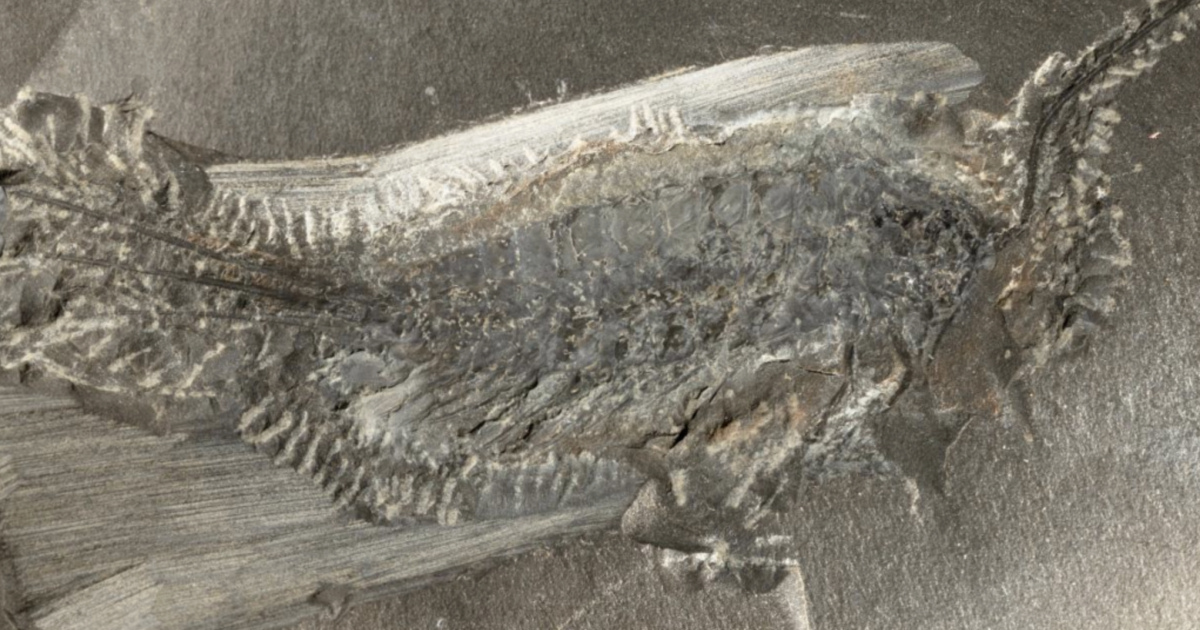
By now, most of us have some knowledge that life on land involved transitioning from the water and evolving the physiological means to do so. But a new study has found reliable evidence that this formative process involved more diverse species also making the transition. And it could change how we think of this period of evolution.
Researchers from the Nanjing Institute of Geology and Palaeontology of the Chinese Academy of Sciences, along with researchers from the UK, the US and Spain, have uncovered something remarkable on its own – a 324-million-old fossilized insect sporting 24 legs – but that’s only part of the story.
Originally unearthed in Texas, this fossil – simply named Chosha praecursor (gen. et sp) – had been classified as a type of ancient crustacean. This was largely because its identifying features – segmented abdominal appendages, for example – ticked the boxes for crustacean morphology.
However, the crucial insect features were somehow dismissed.
Now, in this new study, the international team examined the curious fossil under cross-polarized light, allowing more of its structure to be visible. This new perspective changed everything we knew about C. praecursor.
Suddenly, scientists could observe features specific to modern-day insect body plans, like three distinct thoracic segments and three pairs of legs. Basically, the insect’s biological blueprint that exists to this day.
But this discovery was only part of the picture. Aside from the standard three pairs of legs, this specimen had an abdomen that sprouted another nine pairs of appendages. But these limbs weren’t legs as such, but appeared to be built to use in water.
Basically, this small insect appeared to preserve a transitional stage as its lineage gradually adapted from aquatic life to living on land.
“This discovery serves as an evolutionary bridge between aquatic and terrestrial life forms,” says Cai Chenyang, from the Nanjing Institute. “Around 320 million years ago, ancient insects at the water-land interface were progressively evolving new body structures suited to breathing and moving on land.”
The scientists also identified that the fossil in question appears to be an adult female, 3.2 cm (1.3 in) in length – or around 5 cm (2 in) with tail extended.
The team notes that since the fossil was located in an area that would have once been where water and land met, the insect’s transitional habitat played a key role in its evolution. Why these evolutionary changes occurred in nature is complex, pieced together by what we know of our ancient planet: Water temperature and oxygen shifts, resource scarcity, the prize of finding a new niche to dominate, just to name a few hypotheses.
Once this aquatic animal was able to live out of water, its 18 appendages were lost over generations. Even though insects evolve more rapidly than many animals, I believe it’s worth appreciating this remarkable transformation. Over millions of years, evolution tinkered with the biological instructions that assembled these animals, just as it has shaped the body plans of every animal, including us. And the six-legged body plan that emerged may be one of nature’s biggest success stories. Why? Because insects are the most species-rich group of animals we know of – and hundreds of millions of years later, those six legs remain a defining feature.
“There are more than a million described species in the class of insects (Ectognatha), which together with the less expansive Entognatha (around 5,000 species) comprise the Hexapods, or everything that has six legs,” scientists wrote in this 2019 paper. “They outnumber all other species known to science, such that any project aiming to account for all eukaryotic species, like the Earth BioGenome Project, will have to spend most of its time with insects.”
While this particular fossil places it transition onto land later than vertebrates (around 385 million years ago, during the Devonian), earlier evidence suggests invertebrates were around 50 million years ahead of fish walking out of the water. These new findings are a fascinating reminder that species can have little in common and still be connected by convergent evolution.
And the transition of life from water to land appears to be a more complex, diverse and intriguing period of evolution than we’ve long thought.
This also brings me to another point. I may not be an entomologist, but I am acutely aware that these animals are not popular subjects and this excellent research won’t get attention like a gadget built to kill insects will. And to be fair, the insects we commonly interact with tend to bite us, get into our food or have no concept of personal space.
There’s evolutionary evidence that explains why we don’t see insects as animals with lives of value. Studying insects is also very challenging – that is, if scientists even manage to get funding to do so. As this paper explains, the problem is us – but it’s not our fault, either. However, there are some really exciting areas of study, like paleoentomology – where insect fossils help us understand the history of life on Earth.
If you made it this far, I’d love to hear from you in the comments, whether you’re an insect enthusiast, entomologist or a regular who never wants to hear about bugs again.
The research was published in the journal Nature.
Source: China Daily

