


In 2025, data centers consumed 485 TWh of electricity. Thirty percent of that, more than the entire annual power consumption of Sweden, went to cooling. Scientists have developed a 3D-printed copper-plate cooling tech that can slash this figure by over 90%!
The technology combines a mathematical algorithm with 3D printing to create pure copper cooling plates that dramatically outperform conventional cold plates used in direct-to-chip cooling systems. According to the researchers from the University of Illinois Urbana-Champaign, applying the technology across an entire data center could reduce cooling-related electricity consumption from roughly 30% to just 1.1%.
The AI boom has driven data center electricity consumption to staggering levels, to the point that companies are considering building data centers in space to gain more direct access to solar energy! What makes AI’s power demand more striking is that one-third of this power has absolutely nothing to do with computation. It all goes to cooling the hardware. A single NVIDIA GB200 chip runs at 1,200 watts, consuming 28.8 watt-hours of electricity daily. That’s roughly equivalent to the average daily consumption of a US household, calculated from the total yearly consumption. One chip. But that’s not even our pain point.
Due to a phenomenon known as Joule heating – an unavoidable consequence of how they operate at a fundamental level – chips dissipate almost exactly the amount of power they consume as heat. Therefore that GB200 chip also dissipates 1,200 watts of heat. Over an hour, that’s enough energy to theoretically boil over 50 cups of water. Again, one chip.
Now imagine thousands to hundreds of thousands of these chips stacked in racks, as they are in large AI data centers. Without intervention, xAI’s Colossus 1 data center with its 220,000 GPUs and 300 MW consumption would generate enough heat to raise the temperature of the 785,000-sq-ft space to 1200 °C (2192 ºF) in one hour, hotter than molten lava. This is why cooling is a crucial, non-negotiable aspect of running data centers. Cooling systems require electricity.
“Cooling is the bottleneck in computer-chip design,” says Behnood Bazmi, mechanical engineer and the paper’s first author. “By bridging the gap between computational design and manufacturing capability, our approach provides a pathway for more energy-efficient liquid cooling of chips and other electronics.”
Traditionally, data centers have relied on air cooling to prevent computer chips from overheating. In these systems, metal heat sinks are mounted directly onto CPUs and GPUs, allowing heat to spread out across thin metal fins while powerful fans blow air across them. This method consumes large amounts of electricity because facilities must power several large air-handling units. Additionally, modern AI accelerators are generating heat at levels that conventional air cooling is increasingly struggling to handle efficiently.
As a result, newer systems are shifting toward liquid-based direct-to-chip cooling, in which a metal “cold plate” is mounted directly onto the processor and coolant flows through microscopic internal channels within the plate. Heat from the chip transfers to the metal plate and is then carried away by the circulating liquid far more efficiently than air can.
Conventional cold plates already exist commercially, but their internal fins and fluid channels are typically designed around manufacturing simplicity rather than maximum thermal performance, often using relatively simple rectangular or cylindrical geometries and materials such as aluminum alloys or stainless steel.
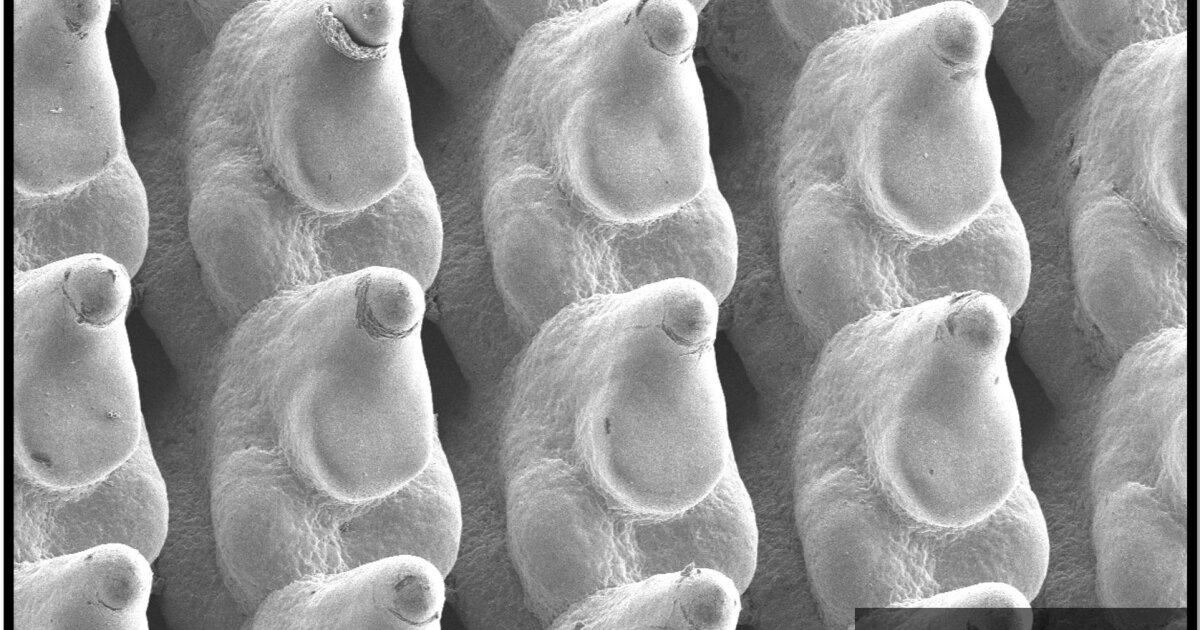
The researchers’ solution addressed two critical aspects of existing technologies: material and fin design. In a technique known as topology optimization, the researchers used a mathematical optimization algorithm to redesign the tiny internal fin structures from the conventional rectangular or cylindrical geometries into far more complex, jagged, and pointed shapes that maximize heat transfer and thermal performance, while minimizing the pumping effort required to move coolant through the plate.
Because the intricate geometries they arrived at would be difficult to manufacture conventionally, the team used an advanced additive manufacturing technique, electrochemical additive manufacturing (ECAM), to build the structures layer by layer. They selected pure copper, a material prized for its exceptionally high thermal conductivity but notoriously difficult to fabricate into highly detailed forms using traditional 3D printing methods. Another reason for the ECAM route.
“ECAM can manufacture pure copper parts with very fine detail – down to 30 to 50 micrometers, less than the width of a human hair,” says Nenad Miljkovic. senior author and mechanical engineer.
The researchers reported that their optimized copper cold plates delivered up to 32% better cooling performance than conventional cold plates in liquid cooling, while also reducing pressure drop by as much as 68%, meaning significantly less energy was required to pump coolant through the system. Together, these achievements translate to significant energy savings.
At the data-center scale where air-cooling still dominates, the team estimated that a 1 GW facility using conventional air cooling could require roughly 550 MW of additional power dedicated to cooling infrastructure alone. By contrast, their optimized liquid-cooling approach would reduce that cooling overhead to around 11 MW. In other words, cooling could drop from roughly 30–35% of a data center’s total energy consumption to close to 1.1%, a stark reduction of over 95%, while still dissipating the extreme heat generated by modern AI hardware.
If those projections can be replicated at real hyperscale, the implications for data center efficiency could be enormous. The researchers’ figures would translate to a Power Usage Effectiveness (PUE) of roughly 1.011, meaning nearly every watt drawn from the grid would go directly to computation rather than to cooling overhead. This figure assumes other support infrastructure consumption to be negligible. For context, a perfect data center would have a PUE of exactly 1.0, a theoretical ideal where no energy whatsoever is wasted on cooling, pumps, lighting, or other supporting infrastructure.
Many of the world’s most advanced hyperscale facilities typically operate at around 1.1 to 1.3. Reaching something close to 1.01 at AI-scale compute densities would therefore represent an extraordinarily efficient facility, approaching the practical limits of modern thermal engineering. That said, the researchers’ full data center energy figures remain modeled projections rather than demonstrated results from a live gigawatt-scale deployment. Still, if the technology scales as suggested, it could significantly reduce one of the largest hidden energy costs in the AI boom.
The researchers believe their approach, encompassing design optimization and manufacturing techniques, could be adapted for a wide range of cooling applications across electronics and beyond.
Source: Cell Press via EurekAlert

