


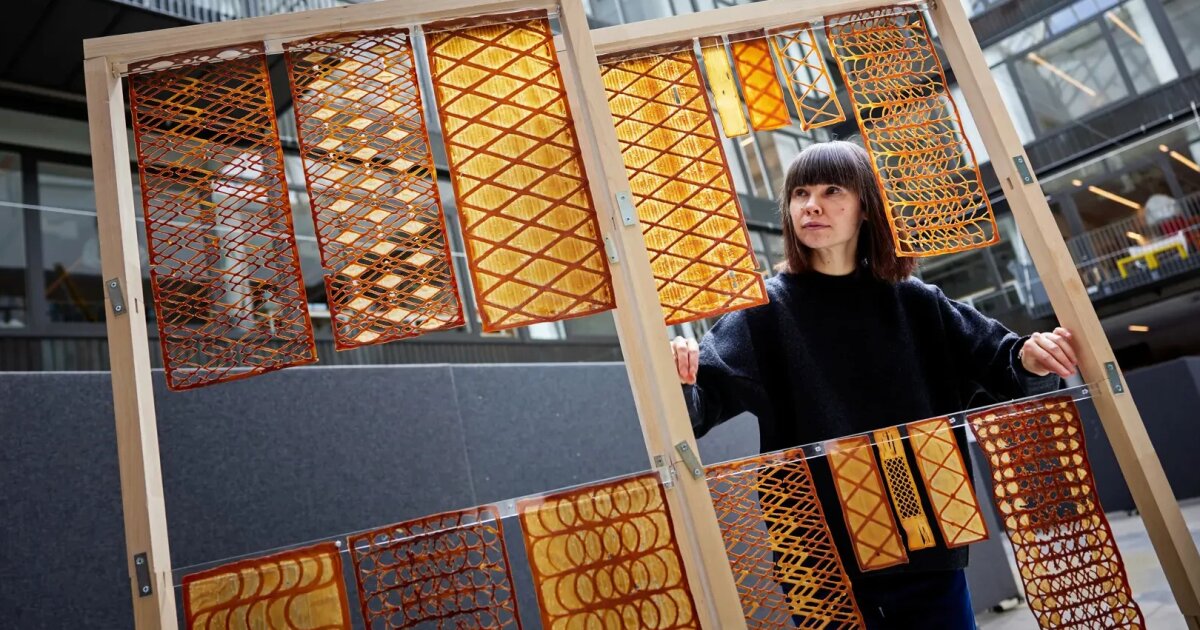
A research team at Chalmers University of Technology in Sweden has come up with a new bio-derived material made from yeast. It can be used with 3D-printing technology to produce a construction material which can be modified specifically for the architectural and interior design field.
Currently, building materials such as plaster, plastic or synthetic fabrics are typically made from non-renewable or fossil-based sources. They’re often used for building components such as sunlight protective screens, room dividers or wall structures.
Traditional construction materials are engineered to be long-lasting and durable, but also contribute a large amount to global emissions and consumption of resources in their production. By contrast, the yeast-based material is biodegradable, sustainable and zero-waste, according to the research team.
Chalmers University of Technology
“I’ve always been interested in the combination of architecture and living materials, and essentially this research is about creating an architectural material made entirely from organic, renewable ingredients,” says Prof. Malgorzata Zboinska, leader of the study. “By combining biomaterials with digital manufacturing, we can take a novel approach to both the design and production of architectural components.”
The yeast is deactivated by heating before mixing to stabilize the material. It is not used for fermentation as is typically the case, but instead acts as a binder for all the other ingredients.
“Yeast grows exponentially. It does not require strictly controlled environments and is not particularly sensitive to contamination. Because it consists of single-celled organisms, we can produce a more homogeneous, predictable material,” explains Zboinska.

Chalmers University of Technology
The material also contains cellulose wood fibers for tensile strength and structure, alginate derived from brown seaweed for dimensional stability necessary for 3D printing, plant glycerols for plastic flexibility, and water. When all these ingredients are combined with the yeast and heated, they produce a gummy hydrogel that is moldable.
“3D printing makes it possible to create complex shapes without producing waste. We can design and manufacture the material directly – with a high degree of control over its shape, texture and material distribution,” says Yagmur Bektas, a doctoral student at the Department of Architecture and Civil Engineering at Chalmers, and co-author of the study.
The resulting jelly-like mass is then 3D-printed via air pressure and left to air dry at room temperature to form its final shape – all without the need for energy-intensive heating or extra implements.

Chalmers University of Technology
With minor formula tweaks, architectural components can be produced with an array of colors that can range from yellow to brown tones by adding natural pigments or colorful yeast strains. Different levels of material transparency can also be achieved including pattern designs and texture finishes.
Further research is required before the material can be extensively incorporated into building construction, since crucial attributes such as strength, fire safety and moisture tolerance need to be studied. The scientists also need to explore the ability to scale up manufacturing, and to design stronger structures.

Chalmers University of Technology
“The future of architectural ELMs, or Engineered Living Materials, is very exciting, with great potential to customize them to perform a variety of functions,” says Zboinska. “This could, for example, involve self-healing materials or materials that purify the air by neutralizing harmful substances and pollutants. What we have achieved so far is an important first step towards establishing a completely new type of architectural material. You could say that we are laying the foundations for future developments that combine sustainability, functionality and design in entirely new ways.”
Source: Chalmers University

