


Remember that “dancing pencils” game schoolchildren played, where they passed two pencils through a small rubber band, twisted them repeatedly, and then let go to make the pencils jump around as the band unraveled? Turns out they were onto some serious futuristic robotics, as scientists are now applying a roughly related principle to facilitate movement in robots.
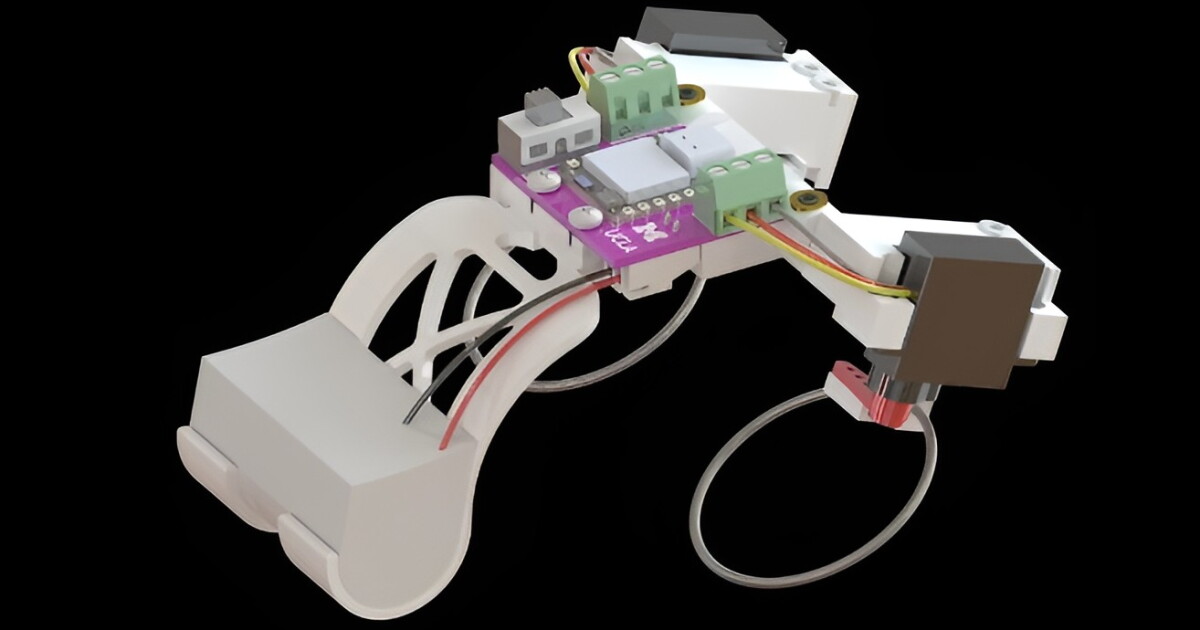
Researchers at the UCLA Samueli School of Engineering and the University of Michigan have built a frog-like robot that moves using flexible rods that repeatedly snap between shapes. Small motors load the rods with energy, which they then release in sudden bursts to propel the machine. The robot can hop across grass and sand, climb small steps, and, with fins attached, even swim.
For small robots, getting around can be quite demanding.
Grass, uneven ground, tiny puddles, and random objects can become major obstacles when the machine is barely taller than them. Jumping is a simple yet effective option to navigate obstructions; however, it requires a strong push delivered very quickly, and producing that burst with the small motors that typically power tiny robots is nearly impossible. These motors usually provide steady, continuous kinetic energy and not bursts of energy.
Now, engineers already use springs to get around this problem: a motor gradually loads the spring, storing the motor’s kinetic energy as potential energy that can then be released quickly to launch the robot. Flexible beams and shells that snap between shapes have also been used to produce movement. However, controlling this behavior in a three-dimensional structure can be tricky, as it may snap forcefully or deform gradually depending on its shape and how it is loaded, producing little of the sudden push needed for a jump.
The UCLA-Michigan team set out to determine exactly what makes the difference, so they could achieve and replicate the desired result every time. The researchers first used computer models to predict how elastic rods respond to different combinations of bending and twisting. They then used a robotic arm to deform physical rods, and test those predictions. This allowed them to map the conditions that produce a sharp snap, and use those findings to design the robot’s limbs.
Dezhong Tong/University of Michigan/UCLA
To build the limbs, the team bent straight Nitinol rods into helical shapes, somewhat like sections of a coiled spring. They fixed one end to a holder, with the other connected to a small servo motor. As the motor rotates the end, the rod deforms and stores elastic energy. Eventually, it reaches a point where its current shape becomes unstable and abruptly flips into another configuration.
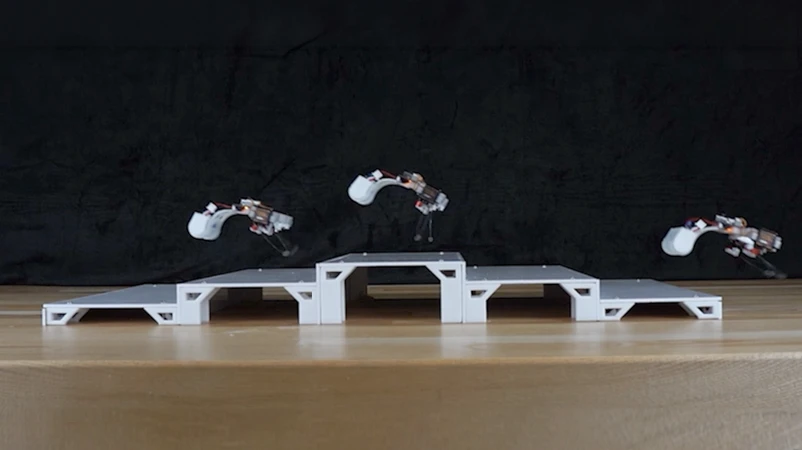
This rapid movement pushes against the ground, sending the robot upward and forward. The motor then reverses to reset the limb, with much of the reset taking place while the robot is airborne. Once the robot lands, it can prepare for another hop. A simple explanation of the underlying, pretty straightforward physics is as follows: a relatively small motor provides steady kinetic energy over a period. This energy stream isn’t enough to create a sudden burst of motion; however, if you store enough of it and release it all at the same time, you get the energy burst needed to propel the robot.
Another important aspect of the work was balancing snap strength against reset time. Some configurations released more energy but required larger motor rotations between jumps. The team ended up with a design that allowed a strong push and a quick enough recovery for repeated hopping.
Dezhong Tong/University of Michigan/UCLA
To test the system’s ability to get an entire machine moving, the researchers built an 11-cm-long (4.3-in), 98.2-g (3.5-oz) robot with two snapping rear limbs. As detailed in their study published in Science Advances, they then compared it with a version fitted with rigid legs on wood, cloth, acrylic, leather, grass, and sand. Both robots had equal-power motors, with one providing steady, continuous motion in the rigid legs and the other intermittently storing energy and releasing it in snaps.
The snapping robot moved faster on every surface, reaching 3.21 body lengths per second on wood. Across all six surfaces, it averaged 2.46 body lengths per second, compared with 0.79 for the rigid-legged version. The difference was especially obvious on cloth and grass, where the rigid-legged robot nearly stalled.
The prototype also climbed small steps and performed repeated backflips. Fitted with thin flexible fins, it swam at about half a body length per second and could steer around obstacles, including during tests with wind disturbances. Moving the two limbs at different rates allowed it to steer. On land, the researchers remotely guided it through a sandbox containing rocks and used light sensors to demonstrate autonomous steering toward a light source.
Tiny robots can hop or swim.
So, in what practical scenarios is a jumping robot beneficial? For starters, small robots that can hop over debris and paddle through water using the same limbs are useful in inspections and search-and-rescue operations in debris-heavy sites. Rather than getting stuck or trying to figure out a way to navigate around an obstacle, the robot can simply leap over it and continue on its merry way.
Navigation aside, the mechanism also gives engineers a way to produce powerful movements without fitting a larger motor. “The broader opportunity is to let the mechanics of the robot do some of the work that would otherwise require larger motors or more complicated control,” says Huang. This could be useful, for example, in a fast-closing robotic gripper.
For now, the robot remains a research prototype with basic navigation demonstrations. Also, the team only measured its speed advantage against its rigid-legged version. To prove its mettle, the robot would have to beat other spring-powered jumping robots. The researchers believe the design rules could eventually support robots just a few millimeters wide, since the snapping behavior depends on the rod’s geometry.
Source: UCLA

