


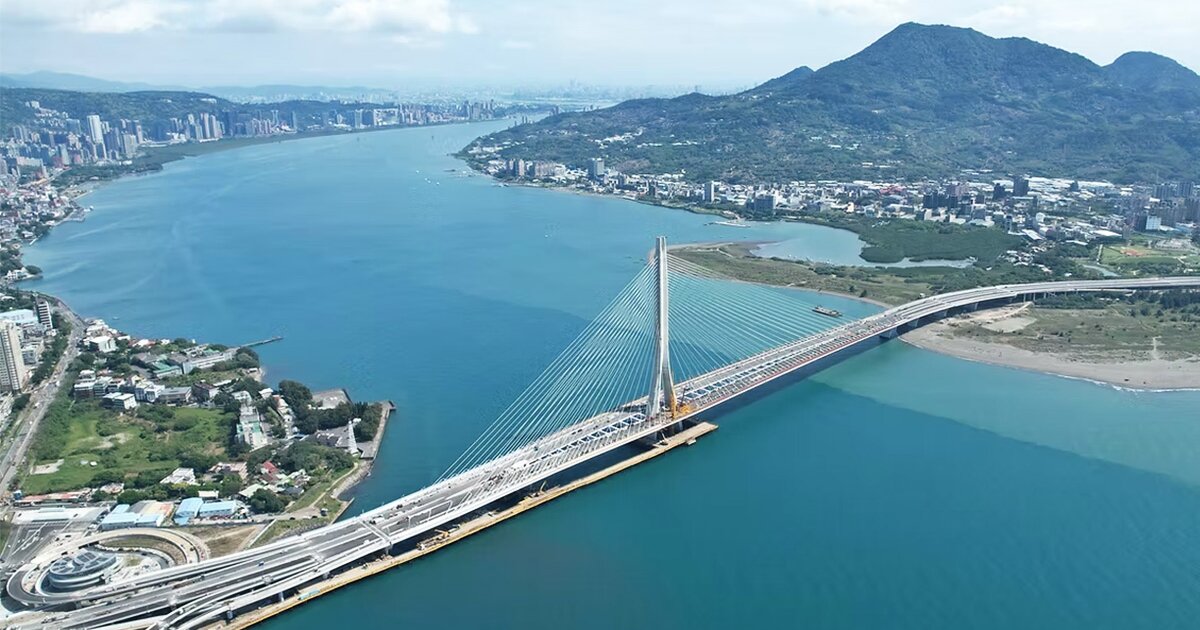
This week, Taiwan cut the red ribbon on a giant infrastructure project its own construction team once deemed “impossible:” the 3,000-ft-long Danjiang Bridge.
The structure features a single-tower asymmetric cable-stayed design courtesy of Zaha Hadid Architects (ZHA), and is the longest of its kind in the world. Its form is said to minimize its visual impact and impedance of sunset views over the Tamsui River from popular spots nearby – and it’s engineered to withstand severe earthquakes too.
This bridge spans the mouth of the Tamsui River near northern Taiwan, and connects the capital of Taipei with Bali, Indonesia. ZHA noted that it would shave off 25 minutes of travel time between the two as commuters crossed the river.
Zaha Hadid Architects
The lone mast stands 656 ft (200 m) tall with a span of 1,476 ft (450 m), and the use of a single mast in this design minimizes disruption to the riverbed and the estuary’s aquatic ecosystem.

Northern Region New Construction Branch Office, Highway Bureau, MOTC Taiwan
The main roadway is roughly 233 ft (71 m) wide, with pedestrian and cycling pathways, as well as a lane for motor vehicles that’s now open, and a light rail line set to be operational later on.

Northern Region New Construction Branch Office, Highway Bureau, MOTC Taiwan
Capable of resisting earthquakes of magnitude 7 or above – a crucial feature given Taiwan’s location on active tectonic plates – the Danjiang Bridge incorporates a complex seismic support system that manages forces that act on it in vertical and horizontal directions.

Northern Region New Construction Branch Office, Highway Bureau, MOTC Taiwan
Vertical seismic forces are transferred directly to the foundation via pier supports and cable stays, while longitudinal and lateral horizontal forces are absorbed and dissipated using specialized hydraulic dampers, friction pendulum bearings, and synthetic rubber pads.

Northern Region New Construction Branch Office, Highway Bureau, MOTC Taiwan
Construction began in 2019 and was slated to conclude by 2024 – but the project faced numerous setbacks, including challenging weather conditions and labor shortages, which delayed its opening by two years. The build was budgeted at roughly US$400 million, though I imagine the prolonged construction might have bumped up the cost. At any rate, it looks worth it.
Source: Highway Bureau, MOTC ROC via Business Wire

