


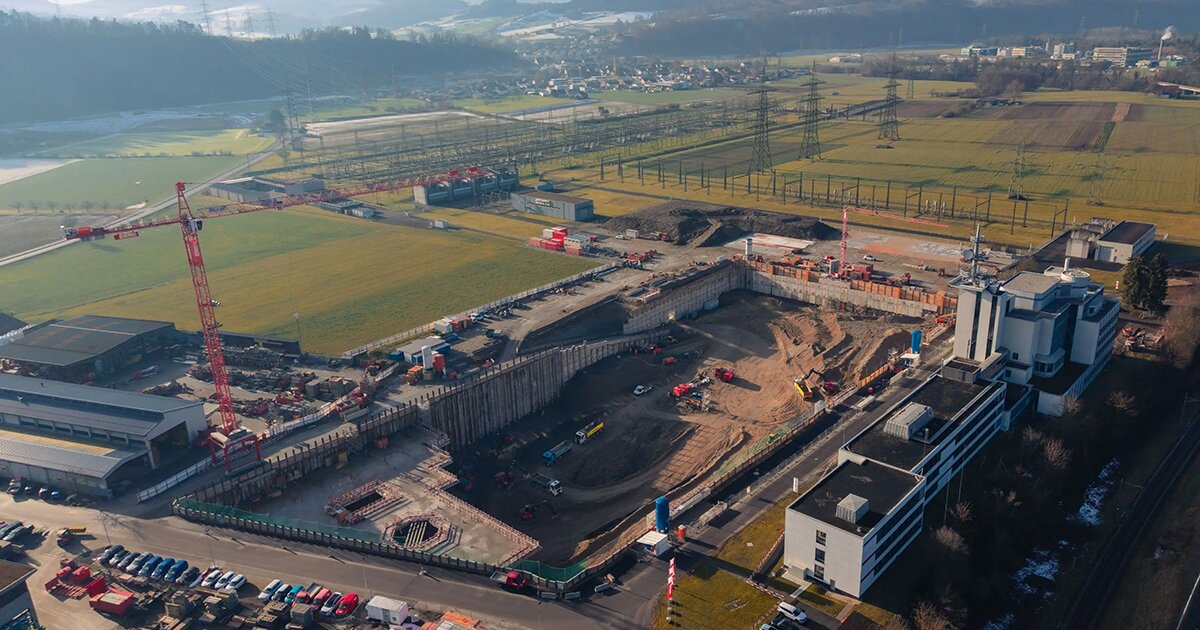
In northern Switzerland, a construction team is hard at work excavating a hole in the ground that will end up being over 88 ft (27 m) deep, and spanning the length of two soccer pitches. This pit will be home to Switzerland’s first redox flow battery for storing clean energy – and it’ll be the most powerful of its kind in the world.
The idea is to utilize a storage technology that’s nearly 150 years old to prevent blackouts, and help stabilize Swiss and European power grids in times of fluctuating demand. It’s being built by Swiss energy company FlexBase, and the project is set to cost over a billion dollars.
“We will be able to inject or absorb up to 1.2 gigawatt-hours (GWh) of electricity in a few milliseconds,” FlexBase co-founder Marcel Aumer told Swiss public broadcaster RTS earlier this month.
FlexBase
That’s equivalent to the output of the Leibstadt nuclear power plant located in the same region, near the German border. The giant battery will be fed with excess energy generated by windmills.
The tech theoretically dates back to 1879, and was modernized through NASA research between the 1950s and 70s. While lithium-ion batteries are more common and have improved and become more affordable, they’re mostly suitable for short-term energy storage. Redox flow batteries are a better choice for long-term, grid-scale storage – and FlexBase says the various components needed for them, like tanks, membranes, cell stacks and pumps, have become cheaper as the industry has matured in recent years.
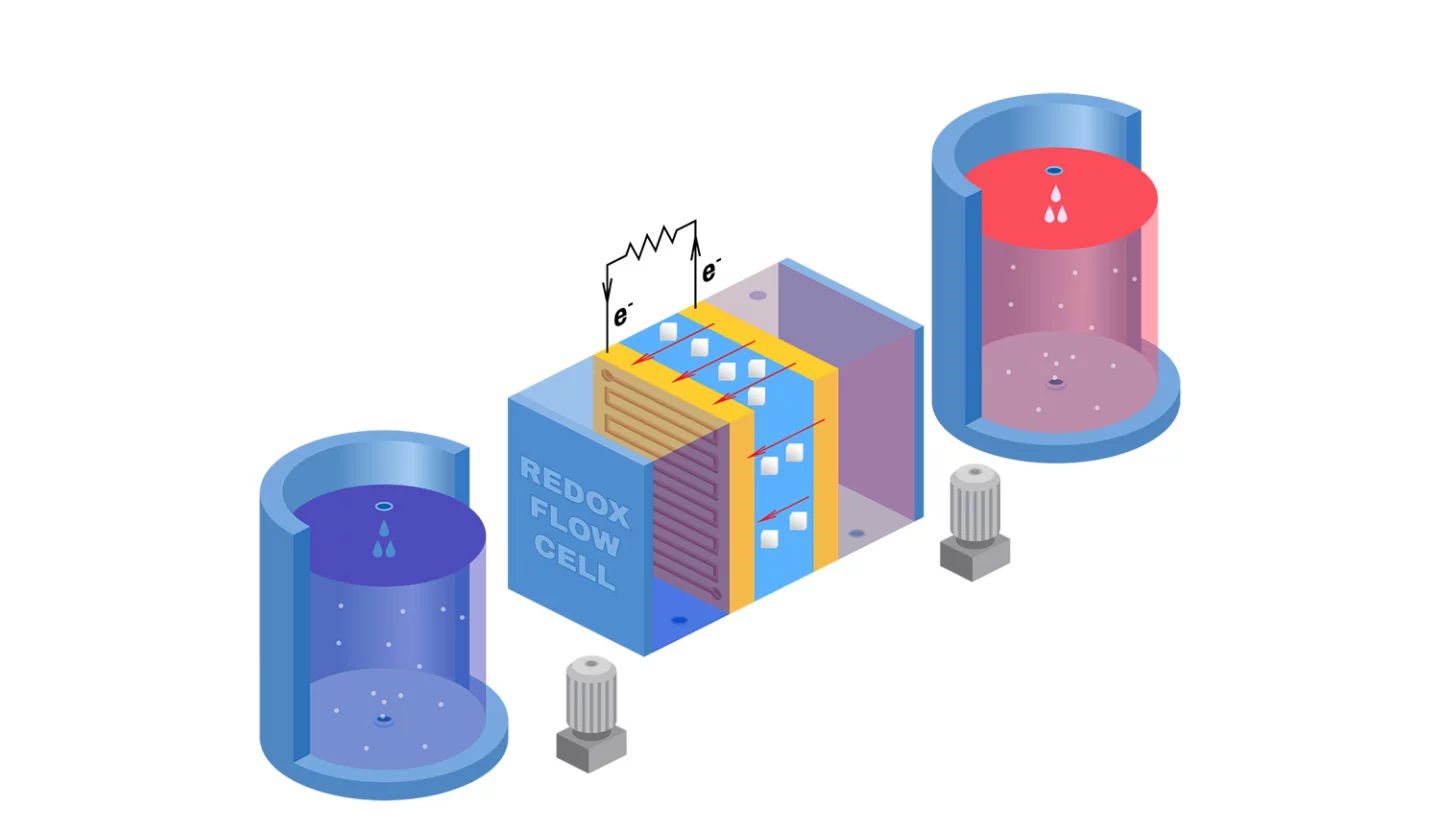
A redox flow battery works by storing energy in liquid electrolytes. Two chemical components that are high in water content are stored in large tanks, and pumped through a cell with a membrane separating them. When the battery is charging, ions transfer through the membrane from the positive to the negative side – changing the oxidation state and storing energy indefinitely. The opposite reaction occurs when it’s discharging, and these charge cycles are inert.
FlexBase
This makes the life of the battery practically limitless. Plus, it’s non-flammable, and almost completely recyclable at the end of its service life.
The Swiss battery has a capacity of 2.1 GWh, which is estimated to be enough to supply 210,000 households with power for an entire day. Beyond preventing outages, this one will also be tasked with meeting high demand from AI data centers in the area. It’s significantly higher in capacity than China’s 700-MWh Xinhua Ushi project, which is currently the largest operational redox flow battery. Japan and Germany are big on this technology too.
FlexBase
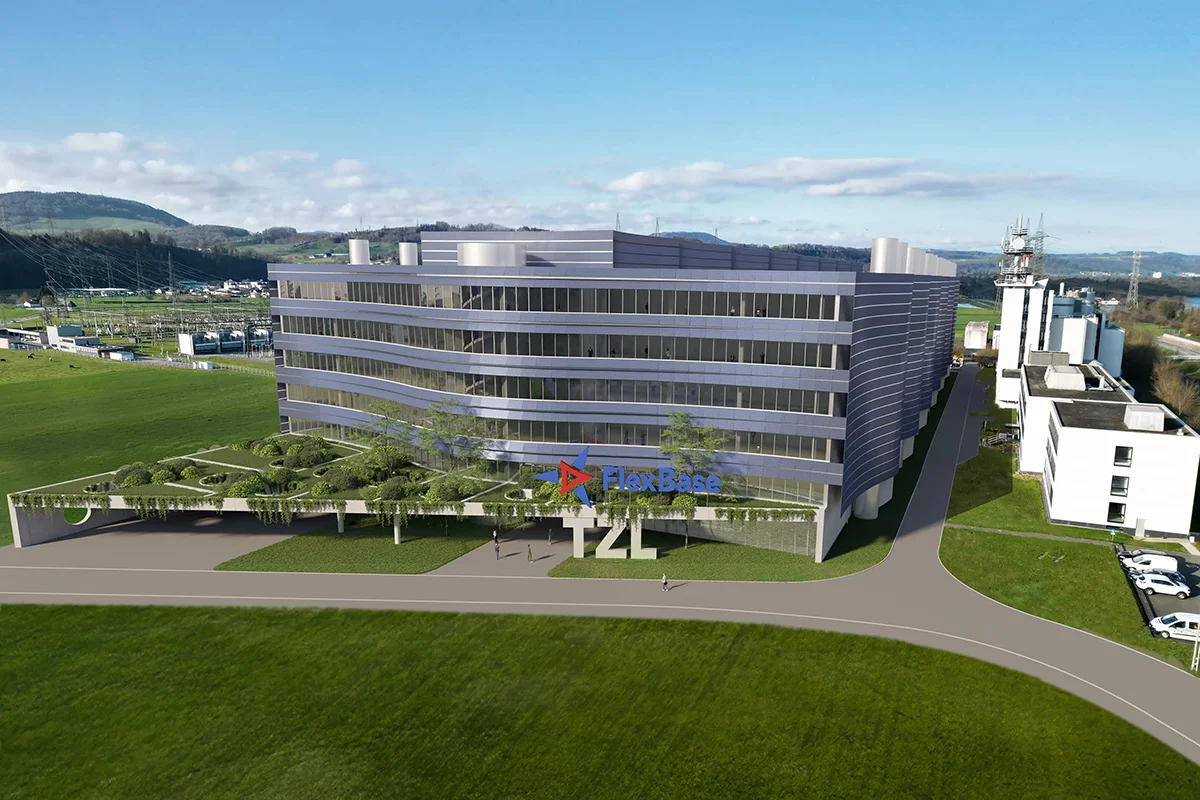
FlexBase hopes to get this battery up and running in 2029, at which point it’ll be part of a 215,000-sq-ft (~20,000-sq-m) technology complex which will also house a data center, labs, and offices.

