


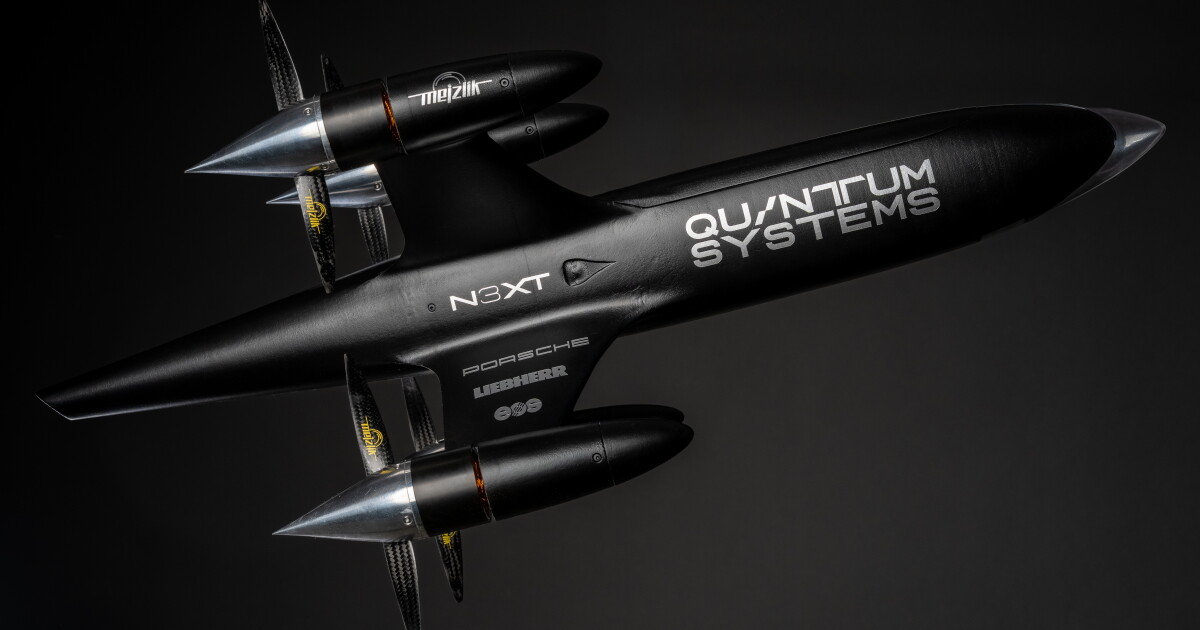
A four-rotor drone built by N3XT, the experimental arm of German company Quantum Systems, has reportedly reached 699 km/h (434 mph) in level flight. That speed makes it the fastest battery-powered drone ever recorded.
The company claims the flight took place during an internal test on June 26, and that formal certification from Guinness World Records is still weeks away. The Apex Recordhunter, as the prototype is called, beat the previous official record of roughly 657.59 km/h (408.7 mph) for an electric aircraft.
That speed isn’t just for show. Quantum Systems plans to channel the technology straight into a new line of interceptor drones. On a battlefield where seconds decide who lives, it could be the difference between stopping an incoming attack drone and letting it reach its target.
Quantum Systems
“For more than a year, this project meant early mornings, late nights, setbacks, breakthroughs, sacrifices, and an unwavering belief that we could push the limits of what’s possible,” said Quantum’s senior prototype engineer, Robert Gardemin, who worked on the project. “699 km/h is an incredible milestone, but it’s only the beginning. We will be back very soon to go even faster and make it official.”
The record claim, however, isn’t uncontested. Two Australian hobbyists running the YouTube channel Drone Pro Hub, Aidan Kelly and Ben Biggs, clocked their own Blackbird drone at an unofficial 730 km/h (453.6 mph) – though they admit a tailwind inflated that number. Once the wind is subtracted, their real airspeed drops to about 674 km/h (418.8 mph), with an official pass average of 685 km/h (425.6 mph). Either way, both projects sit in a similar speed bracket, competing informally for bragging rights before any official body weighs in.
Electric speed, though, still trails combustion-powered military drones by a wide margin. The Northrop Grumman X-47B, a jet-powered experimental aircraft, has approached Mach 0.9 – about 1,100 km/h (683.5 mph) – while the stealth reconnaissance drone RQ-170 Sentinel can reportedly hit around 925 km/h (574.8 mph), or Mach 0.75. Those drones burn fuel rather than run on batteries, which trades top speed for the range and payload capacity that matter more in sustained combat operations.
According to a statement provided by the company, Apex itself is not a weapon. It’s a technology demonstrator built by the same engineering team developing Quantum Systems’ interceptor program, and the two platforms share underlying know-how rather than hardware.
The actual combat-ready systems come from WIY Drones, a Kyiv-based company operating separately within the same group through a joint venture called Quantum WIY Industries. WIY is preparing to test two purpose-built interceptors of its own: the Strila, a first-person-view (FPV) drone capable of carrying a 0.5-kg (1.1-lb) payload, and the Spys, pitched as the fastest anti-aircraft FPV interceptor in existence. Both are aimed at intercepting the kamikaze drones Russia has increasingly used against Ukrainian targets.
In demonstrations this week, WIY showed off updated versions of both: the Spys reportedly hit speeds of up to 600 km/h (373 mph), fast enough to chase down jet-powered Shahed-type attack drones, while the upgraded Strila 2 LR topped out at 310 km/h (193 mph), trading some speed for a 30-minute flight time. Neither result has been certified as an official speed record, but both mark concrete performance benchmarks for drones built to intercept Russia’s fastest attack drones.
That work is already backed by real money. Quantum Systems has taken a financial stake in the venture and secured an order for 15,000 Strila units for Ukraine’s National Guard, a step meant to turn a single battle-tested drone into a full-fledged defense system.
Behind that expansion is the same engineering logic that produced Apex in the first place. These companies are showing how quickly civilian speed records and military applications are blurring together. The Apex project also shows just how far battery electric propulsion can be pushed when the goal isn’t carrying passengers but squeezing every bit of performance out of aerodynamics and materials.
Source: Quantum Systems

