


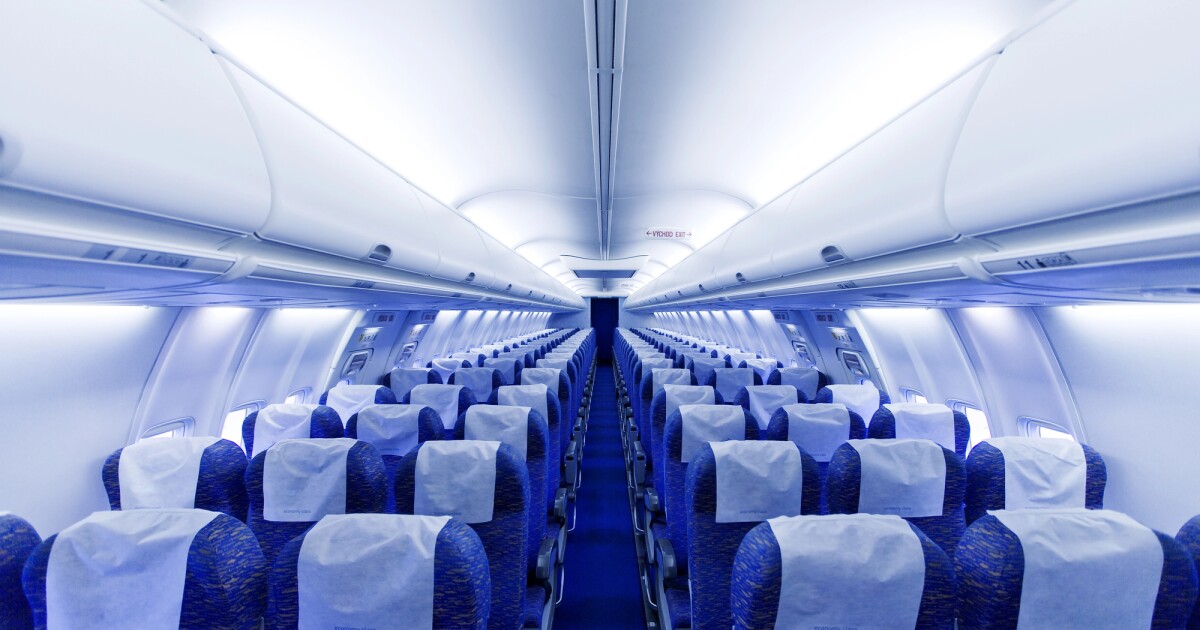
Ever fly Economy and felt like you were being tortured by the seat? It turns out that you’re not being fussy, the seats really are horrible from an ergonomic point of view, which is why you’re suffering. Oh, and that might be by design.
A few days ago, I was taking a flight home that required me to change planes twice and cool my heels in three airports before I got home. After dealing with terminals that seem to be designed for marathon walkers, dreary architecture, boring gift shops, and airport cafes that I suspect are in a conspiracy to sell overpriced, inedible fried food, I found that all this was heaven compared to the seats in Economy class.
Economy seats have a notorious reputation for being uncomfortable, but my experience revealed this isn’t the case – they aren’t uncomfortable, they’re excruciating.
On the final leg, I boarded a 21-minute flight to my home, so I was only on the plane for a little more than an hour. That’s like saying “only” being on the rack for a while with very unsympathetic men turning the crank.
The experience was pure agony. Within minutes my legs were screaming in pain. By the time we took off my back was providing harmony. Then my shoulders kicked in as the back-up singers handled the doo-wop of misery. By the time we touched down, I had my head leaning against the fuselage as I shed tears normally associated with putting too much English mustard on a chop.
So far, this is a story that millions of travelers can nod along to in sympathy, if not PTSD and survivor’s guilt. Then something odd happened. Since I’d landed at a small regional airport, I was in my car in less than 20 minutes and noticed something.
My seat was comfortable – really comfortable.
More to the point, it stayed comfortable as I drove out of the carpark and I reflected that I had happily sat in that seat for up to eight hours at a time with perfect satisfaction except for being a bit on the stiff side when I reached my destination. So I came to a conclusion. It wasn’t the length of time I was in the seat that was the problem, it was the seat itself.
The fact is that airline seats aren’t just small and getting smaller, and they don’t just lack legroom that is also shrinking. They are ergonomic nightmares.
Why this is so is based on a number of factors, including official priorities, trade-offs, and what many suspect is Pavlovian manipulation.
The problem with airline seats is that they simply do not provide the average human body with the support or cushioning it needs, nor do they allow the sitter to move in even the small ways needed to reduce fatigue. The result is that the skeleton is compressed, the muscles are stressed and, after even a small period, the whole body is generally worn out. And this fatigue simply reinforces the cycle. Worse, poor design has even proven dangerous in cases of passengers developing poor circulation and issues like Deep Vein Thrombosis (DVT) on long flights.
The problem with the economy torture machine … Sorry, “seat” boils down to a number of areas. Airline seats are, by design, very light, simple, and almost entirely rigid with only an insultingly small freedom to recline about two or three inches (5 or 8 cm) at most. They are also designed to be cheap to build and maintain, be as small as possible, and sit so close together that a Hobbit would find the leg room inadequate.
The end product is a rigid frame of aluminum alloy or titanium or carbon composites, with thin foam padding for the seat pan and back. All in all, a set of technical failures as far as human comfort is concerned.
Because of its S-shape, the lower back requires considerable support, which the flat seat contour cannot provide. This forces the lumbar spine into a flexed position, which significantly increases the compressive load on the intervertebral discs. No wonder constant compressive stress is the primary cause of back pain during flights.
The seat pan is a particular offender because it does not provide proper support for the thighs. This promotes pelvic tuck, rolling the pelvis backward and flattening the lumbar curve, compounding the problem of poor lumbar support as well as a feeling of pain and numbness in the legs.
The minimal back structure of the seat provides poor lumbar and thoracic support, forcing a more upright seating position, which can cause back pain during prolonged sitting. Worse, there’s no way to adjust the seat, so it’s a case of one-size-fits-nobody.
Then there are the cushions themselves, which are very thin and very uniform in composition. Not to mention that the material is prone to break down under repeated compression. In order to be comfortable, the cushion must distribute the body weight evenly over the maximum surface area of the buttocks and thighs, maintaining pressure below critical levels (typically less than 70 mm Hg) to prevent restricted capillary blood flow. Instead, the Economy seat puts pressure on the bonny prominences of the hip and restricts blood circulation.
Then there’s the front edge of the seat, which should be slightly rounded or “waterfalled” to avoid compressing the nerves and blood vessels behind the knee. No chance here. The pitch is completely inadequate and often poorly designed, with stiff seat pans causing the front edge to create a high-pressure ridge under the thighs. This can impede venous return, leading to swelling, discomfort, and increased risk of DVT.
And don’t get me started on sheer size. In the 1970s, when flying was still civilized, the distance between seats was 34 to 35 inches (86 to 89 cm). Today, it’s as low as 28 in (71 cm) on ultra-economy planes. The seat width 50 years ago was 18 to 19 in (46 to 48 cm). Now it’s as low as 16.1 in (41 cm).
Seating
But why?
Leaving aside pure sadism (though I am not ruling it out), there are logical explanations.
One is the standing aerospace engineering incentive to make aircraft components as light, strong, and compact as possible. If it can be done, it will be.
In addition, there’s the role of government regulation, which places an absolute premium on safety. Seats must be solid, fire resistant, and able to withstand crash shocks as high as 16 g. Comfort doesn’t get a look in as far as the FAA is concerned, so no nice cushions. Also, the powers that be want aircraft to be easy to evacuate in an emergency. That means seat space must be sacrificed if it means wider aisles and bigger doors.
So, where my car seat can have multi-layer, multi-density foam, a sculptured seat and back, more legroom, better lumbar support, head support, lateral support, deep recline, and the ability to adjust the ergonomics to fit the individual, my plane seat is a highly engineered symphony of despair.
The biggest culprit, however, is economics. Ever since airlines went from fixed prices and an emphasis on service to cheap tickets and no frills, there’s been a race to the bottom as companies try to push as many seats into a given sized plane as possible. Gone are the days when an airliner would have a lounge or even a piano bar. Now it’s just seats and more seats with Economy Class bringing in the bread and butter while First Class makes the lowest revenue overall, and Business does extremely well regarding costs against income per square foot.
This puts huge pressure on airlines with razor-thin profit margins to maximize seat count. An aircraft cabin has a fixed volume. Every inch of seat pitch or width added to one seat must be taken from another seat, reducing the total revenue-generating capacity. Since fuel is a major cost, any weight reduction has a tangible, immediate financial return.
In other words, engineering, safety, regulations, and the bottom line intersect in a Venn diagram where passenger comfort loses out on the priorities list.
However, in the complex world of airline economics, companies are keen on pushing as many customers as possible out of those Economy seats into Business Class, where they can make more per seat.
Though no one in the industry has said it out loud, this produces a lot of incentive to make people buy those more expensive tickets. Free drinks and peanuts may not be enough, though, so some like the travel journalist Arthur Frommer have voiced the suspicion that some of the discomfort might not be all a trade-off but rather a deliberate attempt to boost Business Class sales by making Economy just uncomfortable enough to make people want an upgrade rather than suffer the tortures of the damned.
If true, it explains a lot and I’ve lost my faith in humanity.
Vink
Yet it’s not all doom and sore backs, designers like Dr. Peter Vink of Delft University of Technology (TU Delft), Netherlands are coming up with ways to make the cheap seats more tolerable.
One way is to use 3D scanning and CAD modeling to learn more about human body shapes and use this new knowledge to come up with a human-contoured seat pan and backrest. Another is to use advanced cushioning materials, including variable density foams or replacing cushions with a lightweight netted backrest and a seat pan constructed with a human-contoured 3D spacer fabric.
More ambitious ideas include seats that passively adapt to the occupant’s center of gravity, systems that allow greater recline in less space, or even integrated massage functions. Vink has also proposed more radical cabin concepts, particularly for blended-wing aircraft, where passengers might rotate through different seating positions, socialize in shared spaces, or even visit onboard buffets – giving them the simplest and most effective remedy for prolonged sitting – going for a walk.
One can only hope.

