


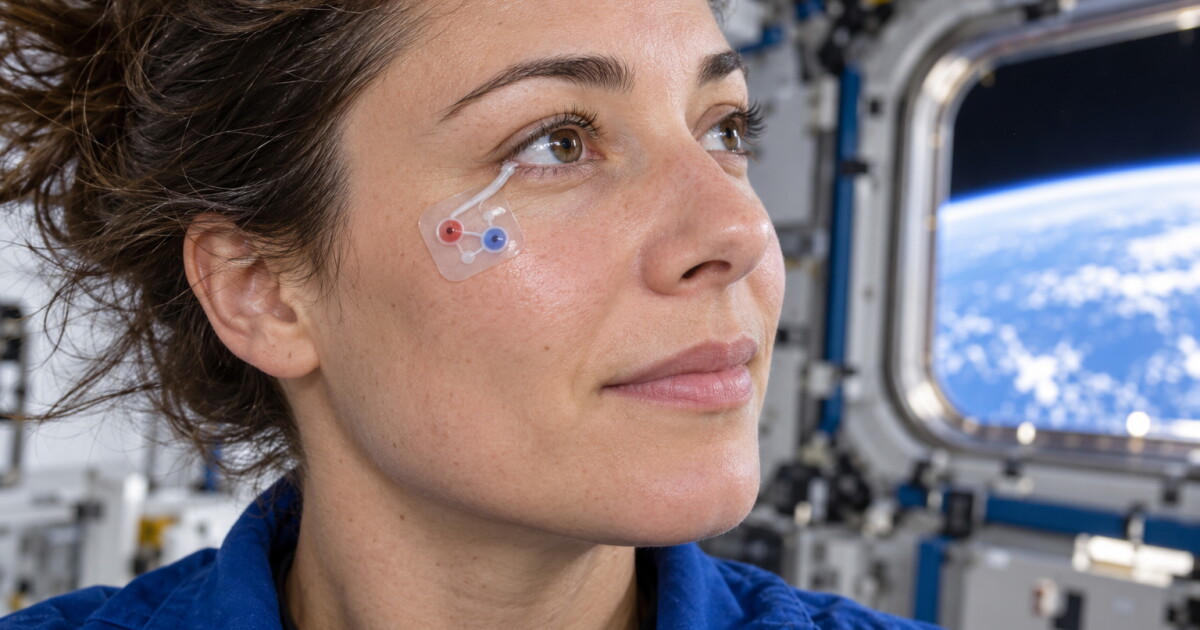
It’s already notoriously difficult trying to get eyedrops into your own eye – now, try to imagine doing so in the zero-gravity environment of outer space. That’s why scientists have designed a facial patch that does the job … and it could also be utilized right here on Earth.
The self-instillation microfluidic eyedrop patch (SIMP) was developed by researchers at the Korea Advanced Institute of Science and Technology (KAIST) working with colleagues from Seoul National University Bundang Hospital.
It’s composed mainly of a flexible biocompatible polymer, and is adhered to the face beside the eye via a medical adhesive.
KAIST
Within the device are three chambers that are interconnected via microchannels. One of these chambers contains a disc of fabric that is pre-wetted with water, one contains a foaming agent made up of ascorbic acid (vitamin C) and sodium bicarbonate (the main component of baking soda), and one contains a drop of eye medication.
When the user presses their finger on the part of the patch that contains the wet fabric, the pressure squeezes the water out of the material, down one of the microfluidic channels, and into the foaming agent chamber. There, it causes the vitamin C and sodium bicarbonate to foam up and produce carbon dioxide gas.
While a filter holds the foam back, the gas passes through another channel into the eyedrop chamber, where the pressure exerted by it pushes the medication down a final microfluidic channel that leads directly into the corner of the patient’s eye.

KAIST
In tests conducted on human volunteers, the SIMP patch was found to deliver medication at a level similar to that of the conventional eyedrop method. And while it has been tested in various orientations relative to Earth’s gravity, it has yet to be evaluated in actual zero-gravity environments.
That said, along with its use by astronauts, the technology is also aimed at people such as those with Parkinson’s disease, whose hand tremors currently make traditional eyedrop application nearly impossible.
A paper on the research, which was led by KAIST’s Prof. Ki-Hun Jeong, was recently published in the journal Sensors and Actuators B: Chemical.
Source: KAIST

