


James Sutherland contributed to this report.
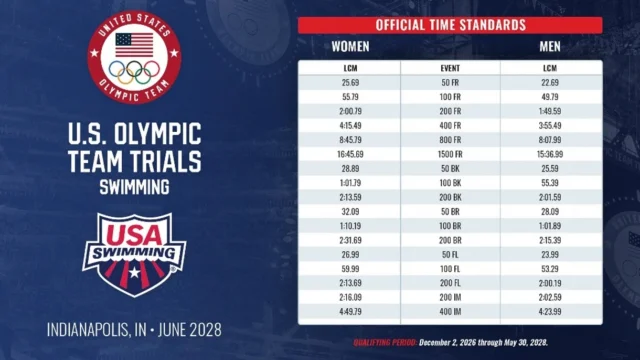
USA Swimming has announced the qualifying standards for the 2028 US Olympic Swimming Trials, June 9-17, 2028, at Lucas Oil Stadium in Indianapolis, Indiana.
2028 US Olympic Trials Qualifying Times:

Courtesy of USA Swimming
According to USA Swimming, the qualifying period will begin December 2, 2026, and run for about a year and a half, concluding on May 30, 20208.
Greg Meehan, the USA Swimming National Team Executive Director and Head Coach, noted that these standards now put the 2028 Olympic Games in focus, helping build excitement for a home Games in two years.
“The release of the Trials standards is an exciting moment for our sport because it makes the dream of becoming a U.S. Olympian feel real,” Meehan said in a press release from USA Swimming. “For athletes and coaches across the country, these times bring a new level of focus, excitement and anticipation as we continue the journey toward 2028.”
USA Swimming used a predictive model that analyzes 15 years of results and “event-specific performance trends” to set the qualifying standards. USA Swimming hopes these standards will produce a qualifying field similar to 2024.
The 2028 US Olympic Trials is targeting an athlete attendance of about 1000-1100, similar to the 2024 Olympic Trials. However, there is an area of uncertainty with the inclusion of the 50s stroke.
Patrick Murphy, USA Swimming’s Managing Director of Technology and Data, noted that the intent is to keep the meet competitive with these times while still fostering opportunities to represent the United States on the Olympic Stage.
“Our approach combines historical performance data with projected improvements across each event,” Murphy said in USA Swimming’s press release. “The goal is to maintain a highly competitive meet while providing meaningful opportunities for athletes to qualify and pursue a place on the Olympic Team.”
The 2028 standards also feature 50s of stroke, which are a new addition to the Olympic program for 2028.
Selection for the stroke 50s for the Olympics is a somewhat complicated procedure. Below is a bit of explanation on the stroke 50s selection from SwimSwam’s James Sutherland in September report on LA28’s swimming qualifying standards.
As for the stroke 50s, the document confirms the proposed qualifying process reported three months ago, where the top six finishers in the event at a select World Cup stop in October 2027 will automatically earn entry into the Games.
By the sounds of it, one of the World Cup stops will be used as the qualifying meet for the men’s and women’s 50 back, one for the 50 breast for both genders, and the other for the 50 fly.
Directly from the Document – Stroke 50 Qualification
- At each of the three World Cup 2027 stops, competitions in two of the new events will be held:
- The six athletes who finish in the first six places in the final of each new event will be offered a direct qualification place to compete in that new event at the LA28 Olympic Games.
- If two or more athletes are tied for sixth place, each of the tied athletes will be offered a direct qualification place to compete in that new event at the LA28 Olympic Games.
- The competition rules for the new events held at the World Cup 2027 will be set out and published by World Aquatics in a separate document.
An athlete who earns one of the six spots in a stroke 50 events must have their spot confirmed by their National Olympic Committee with World Aquatics in order to compete in LA. If an NOC declines, withdraws or fails to respond in time, the swimmer ranked #1 in the world will take their spot. If the world #1 has already qualified, the swimmer who finished 7th in the World Cup final will qualify.
In addition to the six who qualified at the World Cup, any other swimmers already qualified for the Olympics in another event, or as a relay-only swimmer, can enter a stroke 50 event in Los Angeles, provided they’ve met the minimum time standard (see below) and their nation does not exceed the two-per-country rule.

