


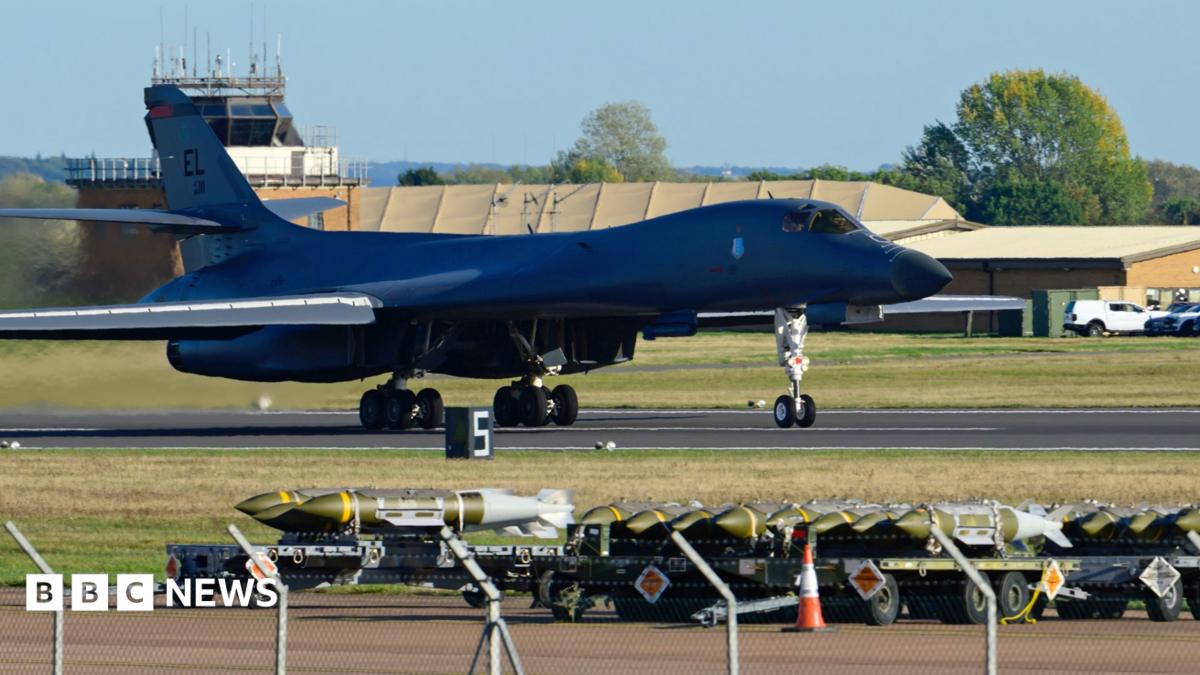
RAF Fairford, nearby the village of Whelford in the Cotswolds, has been used as a forward operating location by the USAF for decades.
In recent months, the US has flown B-1 and B-52 bombers from the base for the Middle East, after the UK approved a US request to use it for defensive strikes on Iran.
The withdrawal of the bombers comes as the US tries to recover from the damage inflicted on its aircraft by Iranian precision strikes.
It is technically possible for the US to conduct precision strikes directly from the US without a UK base – like in Operation Midnight Hammer last year.
But the removal of the bombers from RAF Fairford will remove a foothold for the country outside of continental Europe.
Ezra Cohen, who served as a defence official under Trump’s first administration, said the decision to move the planes out of RAF Fairford was a “prudent decision”.
He told BBC Radio 4’s Today programme: “These are very, very unique platforms that aren’t being produced any more, and we have a limited number of them. The B-1 bomber is a strategic asset, and we’re going to take steps to protect it, from all sorts of threats.”
Cohen added that the consequences of the decision “raises the cost of striking Iran”, because military aircraft will now either have to fly from the US or from another base in Europe.
In July, Iran said “any base used for aggression against Iranian territory constitutes a legitimate target for our forces”.
Days after the incident, and before the arrest of the sixth man, US Secretary of State Marco Rubio said on Fox News that it “clearly involve[d] the hands of a foreign actor”.
Rubio did not provide further details – saying at the time he was limited on what he could say on air.
US President Donald Trump separately said he was “surprised” the five men had been released on bail.
“We know everything about them, we would not have released them,” he said, adding that the UK had worked with the US “very closely” on this.
Many B-1 bombers flown from the UK were armed with precision-guided “bunker busting” bombs, with thicker casings to penetrate hardened or buried targets such as weapons stores.
They also carried air-to-surface missiles used against more heavily defended targets deeper inside Iran.
Each bombing mission, depending on the location of the target, would likely have taken around 12 to 15 hours in total there and back, with air-to-air refuelling both ways.
The Pentagon has stressed its bombing aircraft remain able to conduct missions “anywhere, anytime”, including through “operations that launch and recover from the continental United States”.
RAF Fairford base was occupied by USAF Strategic Air Command during the Cold War and later the first Gulf War in 1991.
The base remains owned by the Ministry of Defence but is operated by the USAF under agreements between the UK and US governments.
The base regularly hosts deployments of long-range American aircraft, including B-52 bombers and U-2 reconnaissance aircraft, and has played a role in recent operations linked to tensions in the Middle East.
B-52 bombers were most recently used in March following a decision by former UK prime minister Sir Keir Starmer to allow the US to use UK bases – including RAF Fairford – for “defensive” strikes on Iranian capabilities.
Conflict was sparked across the Middle East after the US and Israel launched wide-ranging strikes on Iran on 28 February.
Iran responded by launching attacks on Israel and US-allied states in the Gulf.
Additional reporting by Chris Partridge.

