


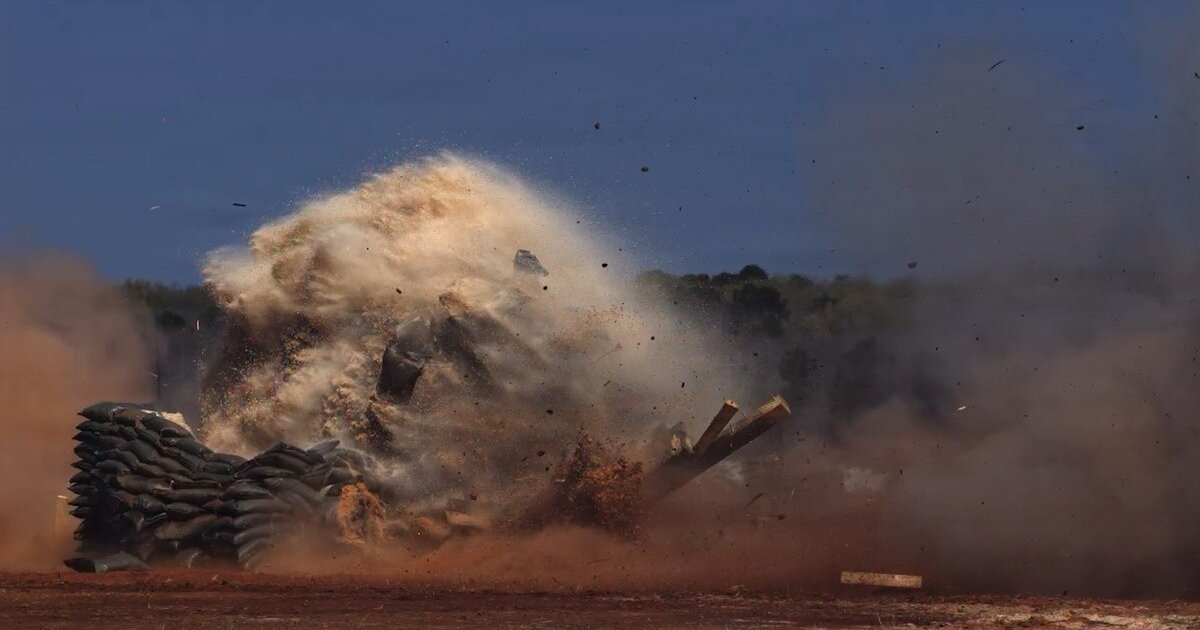
One of the biggest hitters in the conventional arsenal merged with drone technology, as the US Army tested a bunker-buster warhead combined with an expendable Unmanned Aerial Vehicle (UAV) for field testing at Redstone Arsenal in Alabama.
Bunker busters are a classic example of using brute force to overcome a seemingly impossible obstacle. There is something audacious about responding to the challenge of an impregnable fortress with what amounts to the arms equivalent of “hold my beer.”
The idea is to deal with a heavily armored or deeply buried target by dropping a bomb that is hard enough and heavy enough to plunge through yards of earth and stone to deliver a staggering blast comparable to a seismic event. The concept dates back to the trebuchet of medieval times and entered the popular imagination during the 1991 Gulf War, when Coalition forces neutralized Iraqi underground installations using improvised bombs that consisted of surplus 8-in howitzer gun barrels packed with high explosives and dropped from high altitude.
BRAKER
Since then, there have been many iterations of the concept, with the Bunker Rupture and Kinetic Explosive Round (BRAKER) warhead the latest example. It also takes advantage of the rapid advances in drone technology seen in recent years and reflects a growing emphasis on accelerated development, with the BRAKER prototype going from concept to live-fire testing in just 14 days.
According to the Army, this speed was made possible through the use of 3D printing for the warhead housing and the Picatinny Common Lethality Integration Kit (CLIK), which serves as a universal interface for attaching lethal payloads to various drone platforms. This allowed the Army to successfully strike a surrogate bunker target on March 26, 2026.
Essentially, BRAKER is a lightweight, high-kinetic explosive warhead mounted on a low-cost, expendable, one-way attack drone. Managed by the DEVCOM Armaments Center and Project Manager Close Combat Systems (PM CCS), the aim is to create a highly lethal payload that can be integrated with off-the-shelf drones using a mix of 3D-printed and standard components, along with standardized power and signal connections between the drone and the munition.
US Army
In operation, it’s a high-explosive warhead that can be delivered right to the enemy’s doorstep or vulnerable point.
That said, some details about BRAKER remain unknown. One of the biggest questions is exactly how much punch the warhead delivers and by what mechanism. While the specifics are classified, given its size and weight, the most likely design is a shaped charge similar to those used to pierce tank armor.
“Our Picatinny team went from concept to live-fire in two weeks,” said Col. Vincent Morris, Project Manager Close Combat Systems. “BRAKER proves our ability to rapidly develop and safely deliver devastating effects from small unmanned aircraft systems. We are now creating the architecture with Picatinny Common Lethality Integration Kit and the small universal payload interface for industry to scale this critical warfighter advantage.”
Source: US Army

