


Dearborn, Michigan – Suehaila Amen’s voice trembles when she speaks about the plight of south Lebanon, where Israel is systematically wiping out entire villages. She struggles to hold back tears.
Amen, a prominent local activist, says the large Arab American community in Michigan is suffering from shock, pain and exhaustion after nearly three years of war, mass killings and destruction in Palestine and Lebanon.
Recommended Stories
list of 3 itemsend of list
“To say the community is hurting is really an understatement. Even in answering this question, I’m brought to tears because I lived there,” she said of Bint Jbail, one of the border towns in Lebanon that has been levelled by Israeli forces.
“This is my land too — my ancestral homeland. People are feeling like they are disregarded, that their lives don’t matter.”
In the middle of this despair, Amen said she has found a beacon of hope in the rise of politicians across the United States who are calling for an end to government support for Israel.
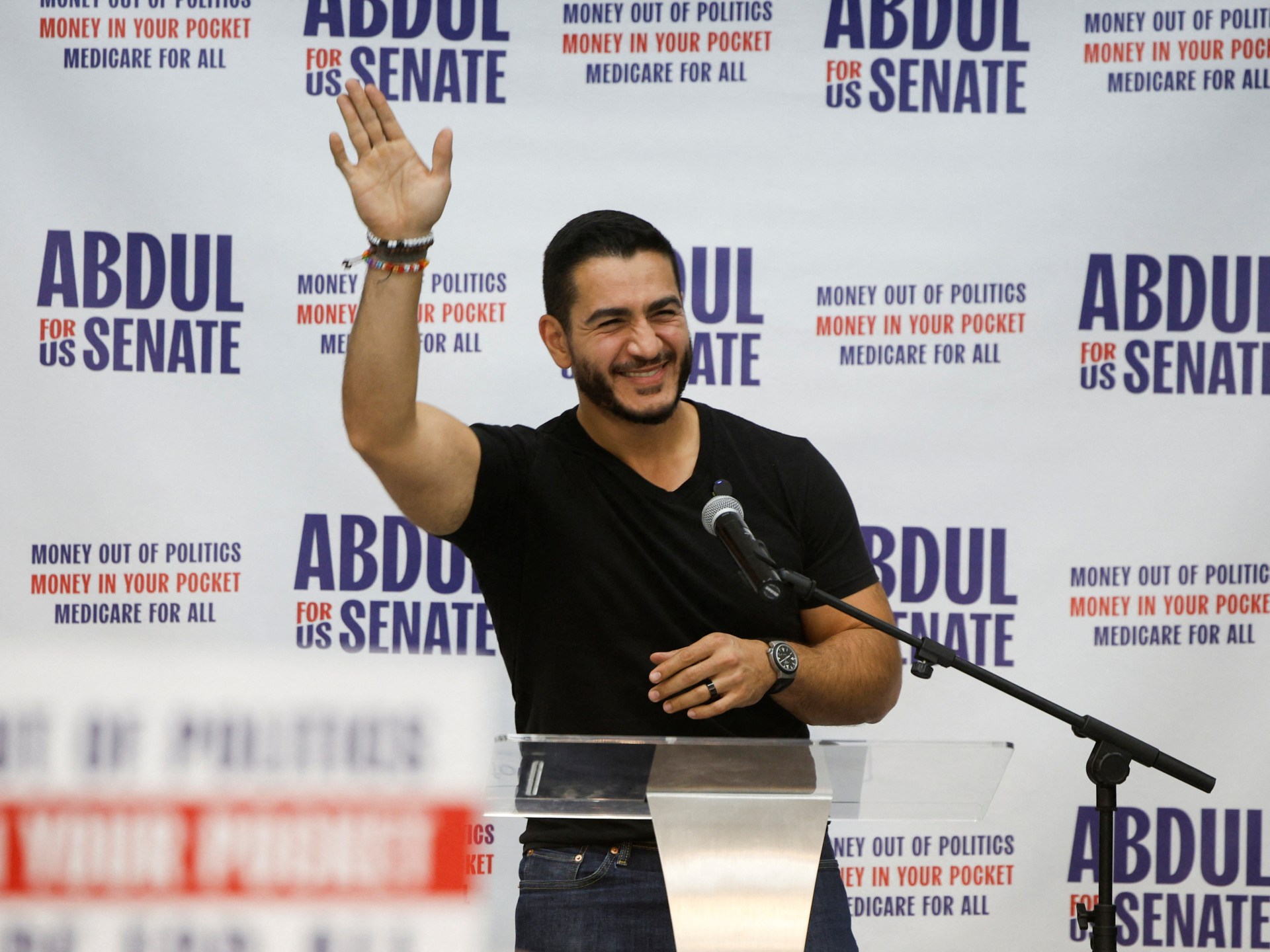
In Michigan, Abdul El-Sayed, a doctor and public health advocate, is running for the Senate on a pledge that he would seek to invest in local communities instead of foreign wars.
He has also been vocal in denouncing Israel’s war on Gaza, which he recognises as a genocide.
But El-Sayed, who is of Egyptian descent, has faced an avalanche of spending from pro-Israel groups — including the American Israel Public Affairs Committee (AIPAC) — that have backed his Democratic primary opponent, Congresswoman Haley Stevens, with more than $50m.
“It would be absolutely spectacular to watch the fall of that so-called empire that AIPAC thinks that they hold,” Amen said.
If El-Sayed won the Democratic nomination on Tuesday, she believes his victory would be “historic”.
“Abdul is the candidate that’s right for the state of Michigan and for this country,” she continued. “We want to show the world that not everybody is going to align with Israel’s interests, and that this is a country where candidates should be putting America first and should be putting their constituents first.”
‘Bint Jbail is not far away’
At a Friday night campaign rally for El-Sayed in Dearborn, a Detroit suburb known as the “capital of Arab America”, boos rang out each time AIPAC was mentioned.
During a speech, Abbas Alawieh, a candidate for Michigan’s state Senate, noted the significance of the venue hosting the event: the Bint Jebail Cultural Center.
“I grew up three minutes from here. Bint Jbail is the village that I’m from on my mom’s side. Bint Jbail is actively experiencing an ethnic cleansing by the Israeli military. They are going house by house and demolishing,” Alawieh said.
“They just demolished the school that my grandfather was a principal at for years and years, that my mom and my uncles went to. That is Bint Jbail. Bint Jbail is not far away. Bint Jbail is right here where you are sitting. The houses that are outside are of community members who have family on the other side.”
Alawieh, a former congressional staffer, stressed to the crowd that El-Sayed would answer to the people, not to lobbyist groups like AIPAC in the US Senate.
“We have the power to deliver our Medicare for All,” Alawieh said, referencing the plan for universal healthcare in the US.
Campaign volunteers stood up and clapped as his voice rose with emotion. “We have the power to deliver a future free of endless wars,” Alawieh continued. “It’s within our grasp. It starts right here in Michigan.”
In Dearborn, community leaders have been pushing people to tap into their political power in the face of perceived indifference from both major parties. Many are rallying around El-Sayed’s campaign.
Signs that read “Small business for Abdul” are a common sight in the storefronts that dot Dearborn’s streets.
While Congresswoman Stevens has accused El-Sayed of disproportionately focusing on foreign policy, he has framed his opposition to Israel’s wars as a domestic issue.
El-Sayed argues that the US has spent too much on conflicts that benefit Israel, including the war on Iran.
He believes those funds should instead be spent to address pressing issues at home in the US, including healthcare and affordable housing.
But for many Arab Americans in Michigan, foreign policy is as local and personal as it gets.
“I understand why people might be apathetic to the political system and how it’s unfolded, but I still think it is incumbent upon us to participate in the democratic process,” Dearborn Mayor Abdullah Hammoud told Al Jazeera.
“We have to take it into our hands. Drive out the vote, making sure that we’re electing candidates up and down the ticket who are there to fight for working families and who share a set of values that can be applied globally.”
Dearborn City Council Member Kamal Alsawafy echoed that assessment, saying that the US Senate race is significant because supporting El-Sayed means “protecting working families”.
“It means using our tax dollars where they should be used to fund and fix our crumbling roads, not sending our tax dollars to crumble somebody else’s home overseas,” Alsawafy told Al Jazeera.
“So it’s about priorities, and that’s why we’re trying to make the right decision and vote for Abdul El-Sayed.”
The candidates
El-Sayed served as the health director of Detroit before running unsuccessfully for governor in 2018. He later became a political pundit and vocal advocate for the “Medicare for All” campaign.
In 2023, he became the head of the Wayne County Department of Health. He left the post last year to launch his Senate bid.
Backed by Senator Bernie Sanders, Congresswoman Alexandria Ocasio-Cortez and other key progressives, he quickly occupied the leftward lane in the Democratic primary.
With US public opinion turning against Israel, the Michigan race has become a microcosm for the rift within the Democratic Party over the issue.
Stevens is staunchly pro-Israel. In 2024, she joined House Republicans in voting to ban the Department of State from citing the Palestinian death toll provided by health officials in Gaza. Earlier this month, she also voted against an effort to cut off funding for Israel.
“Israel comes to me in my dreams. I see Israel’s future. And I know that Israel will continue to exist for the Jewish people,” she said during a 2023 Hanukkah menorah lighting ceremony, a soundbite that has come to symbolise her devotion to the US ally.
Stevens has been endorsed by some of the top Democrats in Michigan and nationally, including Governor Gretchen Whitmer and Senate Minority Leader Chuck Schumer.
The election is one of the most publicised races this election cycle, pitting the pro-Israel Democratic establishment against rising progressives seeking a change in US policy.
AIPAC has broken primary records with its pro-Stevens spending, but Tuesday’s race is not the first time the group has backed the congresswoman.
In 2022, AIPAC spent millions to help Stevens defeat fellow Democrat Andy Levin, a progressive Jewish labour organiser, after redistricting resulted in the two Congress members competing for the same seat.
Stevens was first elected to the House of Representatives in 2018, beating a Republican incumbent. She has presented herself as a pragmatic legislator who gets things done, and in this year’s race, she has accused El-Sayed of being an online celebrity who pursues slogans, not results.
For his part, El-Sayed has questioned Stevens’s effectiveness, painting her as beholden to her donors, in contrast with his campaign that he says is driven by volunteers and people who want to make Michigan a better place.
The winner of the Democratic nomination on Tuesday will face former Congressman Mike Rogers, who is running unopposed in the Republican primary.
The Michigan race is essential for Democrats to regain control of the Senate in November’s midterm elections.
Accusations of bigotry
The contentious Senate primary is taking place amid a rise in anti-Arab racism and Islamophobia during the second term of President Donald Trump.
While such bigotry has mostly come from right-wing politicians, El-Sayed’s supporters have said that some Democrats are flirting with bigotry as they push back against the progressive candidate.
Earlier this week, Angie Smith, a local official in the Detroit suburb of Farmington, apologised after facing accusations of racism.
“Don’t come out speaking only Arabic. Don’t come out with your Arabic music on. Represent everyone,” Smith told the Michigan Chronicle.
AIPAC and some Stevens surrogates also pushed to portray El-Sayed as sexist for his criticism of the congresswoman, a campaign that his supporters say aims to play on stereotypes about Arab men.
Stevens has faced outrage for suggesting that El-Sayed is anti-Semitic. “Everyone in America understands you want to blame all of your problems on Jewish Americans,” she wrote in a social media post late on Thursday.
Congresswoman Hillary Scholten, a Democrat from western Michigan, hinted earlier this week that she would not back El-Sayed against Rogers, the Republican, if the progressive doctor proceeds to the general election. She said El-Sayed is enabling “anti-American sentiment” by campaigning with left-wing streamer Hasan Piker, an outspoken critic of US foreign policy.
On Friday, Congresswoman Ilhan Omar criticised Scholten’s remarks during the rally in Dearborn.
“There is nothing anti-American about believing healthcare is a human right. There’s nothing anti-American about believing housing should be affordable,” Omar said.
“There’s nothing anti-American about believing that government should work for working people instead of billionaires.”
With public opinion polls favouring El-Sayed to win against Stevens, the Republican Party is already pouncing on the race.
On Friday, the National Republican Senatorial Committee (NRSC) shared a video of El-Sayed simply stating his name in an apparent attempt to paint him as foreign.
“Michigan socialist finally introduces himself with his full name: Abdulrahman Mohamed El-Sayed,” the NRSC said in a social media post.
El-Sayed was born and raised in Michigan, and his name, Abdul, is a shortened version of Abdulrahman.
The candidate has dismissed bigotry-laced attacks, stressing that they will not affect his electability. As he campaigned throughout Michigan over the past months, he observed that voters were focused on his policies, not his religion and ethnicity.
“People don’t ask, ‘How do you pray?’ But I have been asked, ‘What do you pray for?’ People don’t care as much about my name; they care if I care to remember their name,” he said.
Hammoud, the Dearborn mayor, backed El-Sayed’s message, saying that the candidate has become accustomed to such attacks.
“What is important for us to do is to demonstrate that we have the ability to participate in all of the fabric that is the beauty of America,” he said.
“And so, we have to participate in public office, to run for campaigns to help support other candidates. That is the only way that you demonstrate that we are here and we’re a part of America, and it’s the most beautiful part of it.”

