


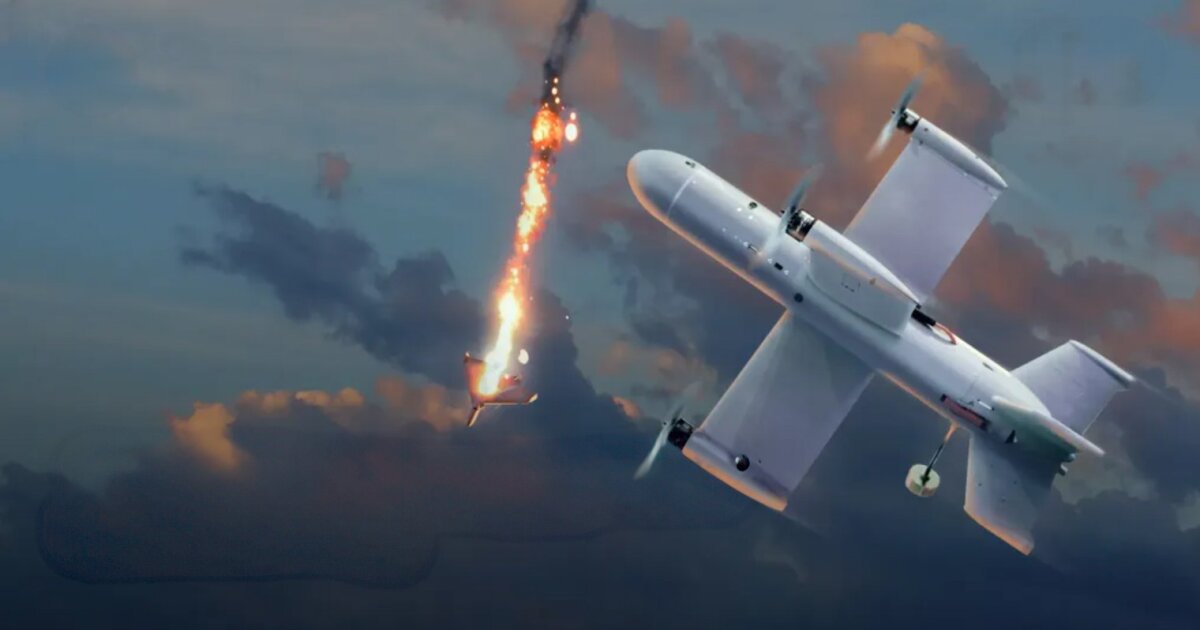
In only four years after the Russian invasion, Ukraine went from being a country knocked back on its heels and scrambling for military aid to emerging as a leading provider of battlefield-tested counter-drone expertise and exporter of anti-drone weapons systems. How did this happen? Let’s find out.
In February 2022, it looked as if Ukraine would fall in short order as the Russian forces poured over the border. So bad did things seem in those early days that US aid to Kyiv consisted mainly of offers to evacuate President Zelensky before the capital fell.
However, events took a very unexpected turn. Instead of being overrun, the Ukrainian forces regrouped, managed to form a defensive line, and even pushed back the Russians. And another unexpected thing happened. Instead of reaching some decisive crisis point, the conflict devolved into a deadlock – a war of attrition where neither side could achieve much more than small gains of territory in one place while suffering small losses of land in another.
In other words, the biggest European war of the 21st century was looking a lot like the First World War of the 20th century. Instead of the fast maneuvering of forces combined with air superiority that is typical of modern combat, the two forces were well locked into what were essentially fixed frontiers and trenches with neither side gaining dominance in the skies.
But the truly unexpected thing was what came next. Instead of simply being bogged down and hammering on each other’s positions, the reaction of both sides was to embrace military drones of various sizes to spy on or attack the enemy. This not only changed the nature of war in Ukraine, it also turned the conflict into a laboratory yielding results that the rest of the world is still trying to adapt to and learn from. And it isn’t just theoretical. It’s having real world repercussions in the Iran conflict and elsewhere.
It’s also turned Ukraine into one of, if not the, leaders in the field of anti-drone countermeasures. As of 2025, the global anti-drone market is valued at approximately US$3.11 billion, with North America maintaining a dominant 45.2% revenue share. While Ukraine accounts for roughly 5% to 8% of global spending in this sector, these figures underrepresent its true impact; due to lower domestic production costs and a high reliance on decentralized, low-cost electronic warfare systems, Ukraine’s volume of successful interceptions and active deployments far exceeds what its revenue share suggests.
Ukraine has become a major player in counter-drone technology, moving from a recipient of security assistance toward a provider of battlefield-tested counter-drone expertise and selected technologies, especially in the Middle East. However, wartime export controls still limit direct commercial exports. The Kyiv School of Economics (KSE) estimates Ukraine’s broader recovery and defense-sector development potential over the decade after hostilities cease at $690 billion.
According to President Zelensky, Ukraine is providing hardware and over 200 specialists to Saudi Arabia, the United Arab Emirates (UAE), Qatar, Kuwait, and Jordan. Their main job is to fill in the gaps left by other advanced Western systems like Patriot that are too expensive to deal with massed drone attacks. Along with this, the Ukrainian teams advise local forces on radar positioning, signal intelligence (SIGINT), and the coordination of “Mobile Fire Groups” to intercept drones at a fraction of the cost of traditional missiles.
In Europe, Ukraine is making direct hardware sales and helping to integrate Ukrainian combat logic into NATO systems. Customers include Lithuania, Poland, Germany, Britain, Italy, the Netherlands, Latvia, and Denmark. Other recipients or interested parties are Nigeria and Colombia. Even the Americans are using Ukraine’s Sky Map system at Prince Sultan Air Base in Saudi Arabia to protect US assets and in the training of American personnel.
Part of this Middle East push has been sparked by the conflict in Iran, though Ukraine is trying to keep its involvement at a distance, given the alliance between Iran and Russia.
“Ukraine has no plans to put boots on the ground in Iran,” President Zelensky said after an awards ceremony marking the Day of Ukrainian Volunteers. “The only Ukrainian personnel going there would be experts in anti-drone defense. These specialists can help our strategic partners defend their territory against Shahed drone attacks.”
The goods and services provided by Ukraine make for quite a list and it would be longer if it weren’t for Ukraine’s wartime export controls. Over the past few years, they have made developments in a number of fields – especially in electronic warfare and interceptor systems, along with expertise in analyzing and countering drone threats.
In electronic warfare and detection, Ukraine’s Proximus LLC builds the Bukovel-AD, which is a vehicle-mounted, multi-frequency jamming system designed for early drone detection and neutralization that can detect threats to a range of 43 miles (70 km) and can jam data links and GPS signals to 12 miles (20 km). There’s also the Piranha Tech SF-3 that’s an anti-drone gun for point defense against small drones on up to three simultaneous frequencies at a range of 1.8 miles (3 km).
Perhaps the most ambitious in this class is the aforementioned Sky Map networked command and control system. This is an AI-integrated C2 platform that combines data from over 10,000 passive acoustic and RF sensors to track “low and slow” loitering munitions and is currently deployed in Saudi Arabia to protect Saudi and American forces.
In terms of interceptors, Ukraine exports its Sting high-speed drone interceptor that’s designed to take out specialized quadcopters and fixed-wing drones. These can fly at up to 150 knots (174 mph, 280 km/h) at an altitude of 10,000 ft (3,000 m) and have a unit cost of only about $2,000 to $6,000. Meanwhile, there is also the Magura V7 interceptor variant that Ukraine has been exhibiting at export shows and the US is building under license. It is an autonomous boat that can launch aerial interceptors from rails or AI-guided turrets. According to its makers, it can carry out surface-to-air interception of Shahed-type drones over maritime transit corridors.
Along with this hardware, Ukraine also sends out instructors and advisors. This includes mobile fire group training to train local forces in the use of high-intensity searchlights, thermal optics, and heavy machine guns integrated with Ukrainian sensor data; advice on sealing technical air-defense gaps; and the establishment of production lines in Germany and Britain, with possible future expansion into Saudi Arabia and the UAE.
Currently, Ukraine operates under strict export controls, including a semi-open model where private firms with surplus capacity are allowed to export if they can obtain a security clearance.
Part of the success that Ukraine has enjoyed is that it has employed an unusual strategy for development of both drones and anti-drone measures. Instead of waiting for an approved design to emerge before production can begin, Ukraine begins production of a system and then relies on feedback to improve the system while production continues. It’s a method that allows for very fast transitions from design to finished product, even if the finished product is far from perfect.
In addition, Ukraine works on an economic shield model. That is, Ukraine may not make much money from its exports compared to America, but it can provide goods and services at much lower unit costs and higher outputs. As a result, customers aren’t faced with the limitations imposed by much more expensive systems or, at least, can supplement those systems cheaply.
Ukraine’s rise from a country begging for armaments to a supplier of advanced anti-drone technology is a remarkable one, even more so when one considers that it happened during a time of very nasty war.
However, it isn’t unprecedented. Necessity is the mother of invention, as the saying goes, and the existential problems that war presents often act as a stimulus to innovation. The British Army that came out of the First World War was unrecognizable to the one that went in as cavalry was replaced with tanks and aircraft went from toys to a revolution in arms. The Second World War and the Cold War caused similar bursts in invention, creating nuclear power, radar, wonder drugs, computers, satellites, microchips, Moon landings, GPS, and much more.
But all that progress came at a very high cost. Let’s hope that one day the books will finally balance.

