


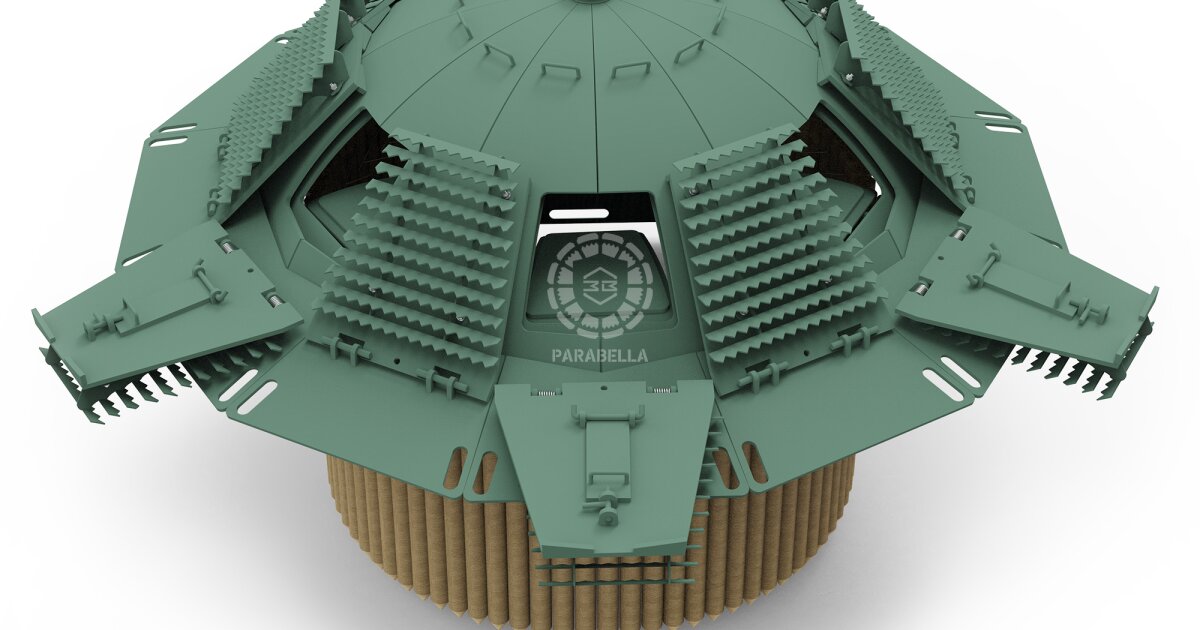
In what looks like a march to the past, at this year’s Eurosatory exhibition in Paris Ukrainian firm Parabella has shown off its eponymous portable pillbox military shelter designed to protect troops on the battlefield.
If, like me, you enjoy hiking across the English countryside, you’re likely to run across a concrete remnant of the Second World War – a pillbox. Hundreds of these were scattered along the coast and inland as part of the defenses against the feared German invasion.
Today, they’re all disused except by people like me who sometimes visit them as an alternative to sleeping in a leaky tent, and some have even become protected landmarks. But the war saw the height of the age of the pillbox.
Parabella
The pillbox in its modern form first appeared during the First World War as a way of protecting infantry from artillery barrages by shielding them inside reinforced concrete structures. By the Second World War, pillboxes had become standard defense fortifications. Some, like France’s Maginot Line, became border fortresses stretching for miles, while German coastal defenses sat on the cliffs of Normandy, requiring the Allies to take out with sea bombardments and direct infantry assaults.
However, by the 21st century, pillboxes were regarded as relics of the past with very little relevance in an age where air supremacy, lightning movement, maneuverability, and sudden strikes were the norm. But that changed with the Russian invasion of Ukraine in 2022.
As the Russian tanks rolled over the border, the expectation was that Ukraine would fall in a matter of days. What actually happened was that the Russian offensive ground to a halt, and over the past four years, the conflict has become a war of attrition with fixed battle lines – more like the Somme than the Iraq War.
Parabella
As a result, not only have there been innovations, like the rise of drone warfare, but the odd revival of tactics from a century ago. One of these has been the reintroduction and updating of the pillbox by replacing the reinforced concrete with sheets of steel alloy.
Sharing the same name as the company that makes it, the Parabella pillbox derives its name from a combination of the Latin saying “Si vis pacem, para bellum” and the English word “umbrella.” It consists of 16-mm armored steel panels that are bolted together into a 3.3-tonne dome with a diameter of 11 ft (3.2 m) and then set on pilings over a foxhole. Designed to accommodate up to 10 armed soldiers at a time the whole thing can be covered with more earth for concealment and camouflage. If needed, the dome can be dismantled and moved to a new location.
Another feature of the Parabella is that the panels are protected by a metal fence that can detonate rocket grenades before they make contact with the armor. The panels also have hinged doors, allowing them to open up to allow them to be used for reconnaissance or laying down sniper fire.
According to the company, the Parabella has already been tested under combat conditions and has been built to NATO specifications. It’s claimed to be resistant to small arms fire and projectiles up to 14.5-mm armor-piercing incendiary rounds, 152-mm high-explosive artillery shells, simultaneous detonation of two 120-mm landmines, drone strikes, and rocket-propelled grenades, including the RPG-7.
Source: Parabella

