


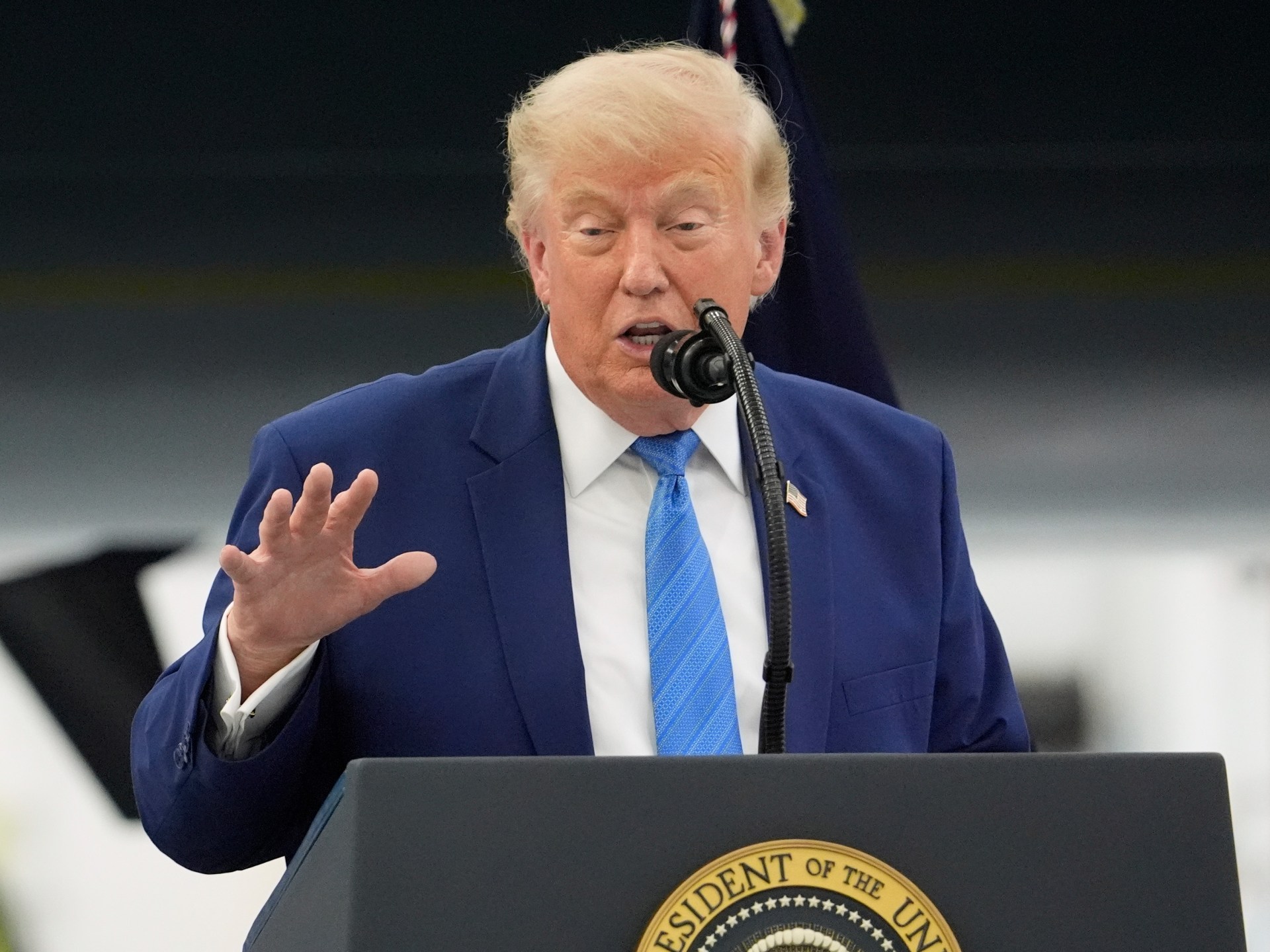
United States President Donald Trump has pledged there will be no tolls for passage through the Strait of Hormuz, unless they are collected by his own country.
Trump’s statement, made in a Saturday afternoon post on Truth Social, is the latest sign that a recently signed memorandum of understanding (MOU) may be unravelling.
Recommended Stories
list of 3 itemsend of list
“There will be NO TOLLS in the Hormuz Strait for 60 days during the Cease Fire Period, and there will be NO TOLLS after the 60 day period has expired,” Trump wrote, “unless they are imposed by and for the United States of America.”
Since the US and Israel launched a war against Iran on February 28, Iran has successfully used the Strait of Hormuz as a pressure point, closing the strategic waterway to traffic.
But under the terms of Wednesday’s ceasefire memorandum, the strait is suppose to re-open for an interim period of 60 days. During that time, Iran is barred from charging vessels for passage.
On Saturday, however, Iran’s joint military command said it had closed the Strait of Hormuz, citing a “clear breach” of memorandum’s commitments.
US Central Command, the agency that oversees military operations in the region, denied that report and maintained that the traffic continues to flow through the waterway.
The Strait of Hormuz has long been a flashpoint in the conflict between the US and Iran. Nearly 20 percent of the world’s oil and natural gas is transported through the strait, as well as around 30 percent of the global fertiliser trade.
Closure of the strait has caused global fuel costs to soar and has tested agricultural sectors across the world.
Trump had responded to Iran’s chokehold over the strait by imposing a US naval blockade on Iran’s ports in the region.
But that naval blockade was lifted under the terms of Wednesday’s memorandum. The deal also paused fighting on all fronts in the regional conflict, including in Lebanon.
The memorandum, though, was not intended as a long-term deal. It serves as a launching point for negotiations on key issues, including the future of Iran’s nuclear programme.
Several points of divergence also went unaddressed in the memorandum. Nowhere does the memo say that future tolls cannot be collected from the strait after the 60-day period expires.
Before the war, there was no charge for passage through the strait. Trump himself said in an interview with The New York Times that the waterway should remain “permanently toll-free”.
But he appeared to reverse course in Saturday’s post, once again floating the possibility that the US could extract tolls in the strait, while barring Iran from doing so.
No fees should be levied, Trump wrote, “unless they are imposed by and for the United States of America, should the deal not be completed”.
He explained that such a charge would compensate the US “for services rendered as the Guardian Angel to the countries of the Middle East for purposes of both past, present, and future reimbursement of costs”.
Trump used similar language in an interview with The New York Times earlier this week, floating the US becoming “the guardian of the Middle East” in exchange for 20 percent of its revenue.
Saturday’s post is not the first time Trump has mused about the US imposing tolls in the strait, either.
In April, for instance, he discussed the idea with reporters, saying, “What about us charging tolls? I’d rather do that than let them have them. Why shouldn’t we? We’re the winner. We won.”
There has been no indication that Trump’s plans have been officially presented to countries in the region, many of whom have struck a careful balance in their dealings with both the US and Iran during the war.
Iranian officials, meanwhile, have repeatedly said they will not rule out imposing tolls in the strait, framing the issue as a matter of sovereignty and regional negotiation. The strait sits between Iran and Oman.
Further discussions are expected on the matter in the coming weeks.
But such negotiations have been thrown into jeopardy amid ongoing Israeli military operations in Lebanon, which threaten to violate Wednesday’s ceasefire memorandum.
Iran claimed that Saturday’s closure of the strait was a result of new Israeli attacks in southern Lebanon, which killed dozens of people after the ceasefire was announced.
Iranian officials have also said that any upcoming talks should focus on proper implementation of the initial memorandum, and that the 60-day negotiating period stipulated in Wednesday’s deal would begin after that was settled.
Pakistan, a top mediator between the US and Iran, has said that follow-up talks are set to begin in Switzerland on Sunday.
Switzerland’s Foreign Ministry has confirmed that an Iranian delegation, led by parliamentary Speaker Mohammad Bagher Ghalibaf and Foreign Minister Abbas Araghchi, already arrived for the negotiations.
On the US side, Trump’s son-in-law Jared Kushner, special envoy Steve Witkoff and Vice President JD Vance are expected to attend.
Vance departed for Switzerland late Saturday.

