


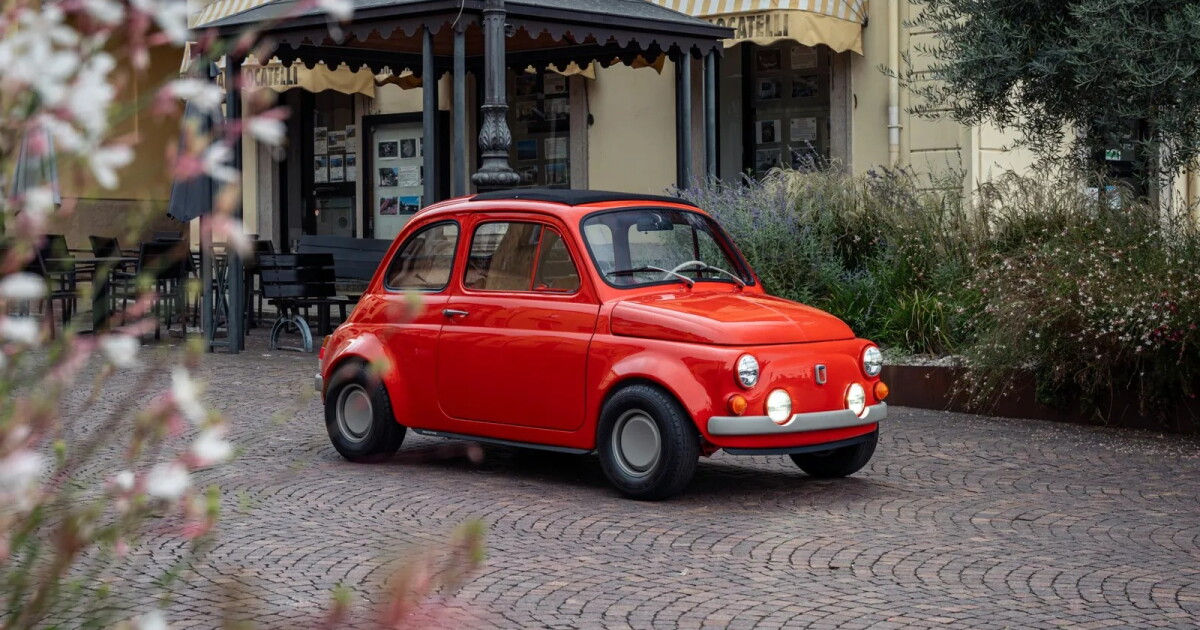
Few cars on Earth can make you smile before you’ve even turned the key. The original Fiat 500 is one of them. It’s tiny, cheerful, mechanically simple, and so thoroughly Italian that you can almost hear an accordion playing every time one rounds a corner.
Above all, it was built to be affordable. The original was never supposed to be a collector’s trophy or some six-figure garage queen. It was a people’s car through and through.
British automotive studio La Cinquecento thinks otherwise. The 500 Scattante is essentially a Fiat 500-based restomod that could go on to command around US$200,000. No, I haven’t lost my mind. This isn’t merely a Fiat 500 wearing a set of fancy wheels and a leather interior. La Cinquecento has comprehensively reworked the little Italian icon into something collectors will line up over.
Right then. The story actually starts with a 1973 Fiat 500 R that belonged to the family of La Cinquecento founder Max Kindersley. The car spent roughly 25 years sitting in a barn before Kindersley decided to bring it back to life.
La Cinquecento
That relatively innocent idea eventually snowballed into something considerably more ambitious, and ultimately became the basis for La Cinquecento itself. And the result is rather lovely.
The core silhouette remains unmistakably Fiat 500, but the body has been subtly widened and reworked. Milan-based design studio BorromeodeSilva was brought in to help shape the car, and it did, adding wider fenders, deeper side skirts, minimalist wheels and extra front lighting without wiping away the familiar proportions that made the original so charming.
There are some rally-inspired touches, too. Four round headlights give the little Fiat a surprisingly purposeful front fascia, while the wider stance gives it a whole lot more road presence.
Underneath the hood (or should I say trunk?) you’d find the original Fiat 500’s tiny engine replaced by an 802cc two-cylinder unit sourced from a Fiat 126. It remains at the rear, but gets twin-spark ignition and a comprehensively reworked electrical system.

La Cinquecento
La Cinquecento hasn’t published an official power figure yet, which is probably for the best, because this isn’t really a car being built around a giant dyno number. Instead, the company has gone after the things that actually matter when you’re driving a tiny vintage car in the modern world.
The suspension has been reworked. So have the brakes, steering, cooling and electrical systems. The chassis and running gear have all received attention, essentially turning what was once a gloriously basic little city car into something considerably more sophisticated underneath.
Interestingly, all that engineering doesn’t result in an ultra-featherweight. The Scattante is targeting a curb weight of around 1,433 lb (650 kg). That’s roughly 330 lb (150 kg) heavier than the 1973 Fiat 500 it’s based on.
That’s a pretty substantial increase for something this small, but it reflects just how much has changed beneath the bodywork.
The cabin follows the same philosophy. While still retaining the analog instrumentation, the simple controls, and the two-spoke steering wheel, La Cinquecento has upgraded seating with new bucket seats and a beautiful tan and beige color scheme.

La Cinquecento
Of course, there is one small problem with all of this: the price. While La Cinquecento hasn’t officially published a price for the 500 Scattante, reports around its launch have put the expected figure at approximately £150,000, or roughly $200,000.
That’s Porsche 911 money for … well … a Fiat 500. The company is currently taking enquiries for bespoke builds and asking interested customers to register for a build slot.
The restomod industry has developed a strange obsession with horsepower. Find an old Porsche, Jaguar or Mini, rip everything out, throw in a gigantic modern engine, carbon-fiber bodywork and enough computing power to launch a satellite, then ask half a million dollars for it.
The Scattante doesn’t really need 500 hp. It doesn’t need active aerodynamics. It doesn’t need a touchscreen the size of a kitchen television. What it needs is to remain a tiny, lightweight, slightly ridiculous Fiat 500 while being less terrifying to drive than a 50-year-old economy car has any right to be.

La Cinquecento
Here’s the thing: the Fiat 500 is one of the most recognizable silhouettes in automotive history. It was a car that was built to democratize motoring. The Scattante is doing almost the exact opposite: taking that humble little car and turning it into an intensely personal, limited-run collector’s object.
La Cinquecento plans to build only a handful of examples each year, with individual cars developed around their owners rather than churned out like conventional production vehicles. That’s quite a journey for a car that was essentially Italy’s answer to a shopping cart with an engine.
Source: La Cinquecento

