


I’ve covered a few AR helmets here before. And almost every time, I’ve seen someone comment: “Do we really need any more distractions on a motorcycle?” Swiss company Aegis Rider certainly doesn’t seem to think that way.
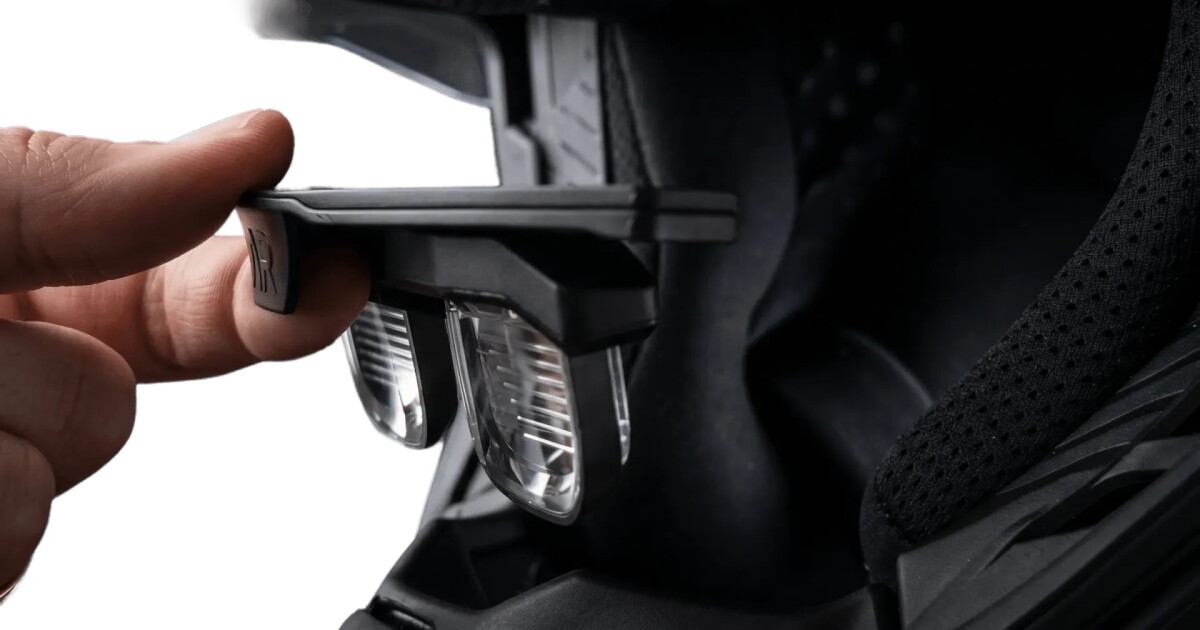
It’s just launched the Vision helmet, which combines the features of a head-up display. But instead of it being incorporated in the visor of the helmet as was the case with the Shoei x Eyelights AR helmet, it comes via a pair of drop-down glasses behind the visor.
Aegis Rider’s problem statement is something we’ve heard before, and that is motorcyclists having to look down to see any information, taking their eyes off the road. “Every glance down is a fraction of a second without the road,” says the company. “Speedometer, navigation, the phone on the bars: each one takes your eyes off the road for a moment, and on a motorcycle those moments matter more than in a car.”
Aegis Rider
An AR unit in front of your eyes negates that and helps you keep your vision firmly ahead. “Head-up displays promised to fix that,” the firm adds while also explaining why it chose a separate unit other than the visor to put the tech in. “The ones that exist for helmets are head-fixed: the image is glued to your visor and moves with every turn of your head, so it can sit right on top of the thing you are trying to see. Many riders tried one and took it off again. We started from a different question: what if the information stayed where it belongs, on the road, and only appeared when you look there?”
The Aegis Rider system uses spatial anchoring to keep its on-screen information positioned over the road ahead, even when the rider turns their head to look elsewhere. For instance, even if you find yourself checking cross traffic at an intersection, the display remains fixed relative to the motorcycle instead of swinging around with your gaze, helping keep the main field of vision unobstructed.
While riding, you’d find navigation guidance presented through three-dimensional arrows that appear at the junctions where a turn is required. But keeping these virtual graphics accurately positioned in the real world requires a fair amount of clever engineering, as you can imagine.
So how does this helmet do it? Cameras. A compact tracking camera is built into the helmet’s chin area, and uses image recognition and algorithms to calculate its position relative to the motorcycle.

Aegis Rider
Inertial sensors inside the helmet measure movement along three positional axes and rotation across three additional axes, allowing the system to track the rider’s head movements and orientation. The motorcycle’s own position is supplied by a sensor, which can be set up either through a smartphone secured in a fixed mount or Aegis Rider’s optional Pro-Box.
The augmented-reality display is housed in a glasses-like unit that attaches magnetically to the upper section of the helmet’s visor opening. Folks who wear prescription glasses can continue using their corrective lenses alongside the system. A built-in drop-down sun visor helps maintain visibility in bright conditions, while a dedicated night mode adapts the display for riding after dark.
Before the system can accurately overlay information onto the road, each motorcycle must be calibrated and registered in the app’s AR Vision Garage. The process takes around 10 minutes and allows the app to store configurations for up to five motorcycles, making it easier to switch between bikes without starting from scratch each time.

Aegis Rider
But AR isn’t the only party trick. The helmet also incorporates a forward-facing 1080p camera that records footage at 30 frames per second. So, it doubles up as a dashcam.
You can transfer clips over Wi-Fi through the accompanying app, with 128 GB of onboard storage providing space for up to 20 hours of recorded riding. A rear-facing camera is integrated into the system as well, with blind-spot object alerts planned for a future software update.
The helmet also includes an integrated communications system with built-in speakers and a microphone. Bluetooth 5.2 connectivity links it to a smartphone, allowing you to hear navigation instructions, listen to music, and take calls as well.
And just in case you were wondering, Aegis Rider has used the Nexx X.WST3 helmet to deploy this tech, with the electrical components required for the system installed at Nexx’s factory in Portugal. The helmet uses a carbon-fiber shell to help control weight and comes supplied with clear and dark visors, as well as a Pinlock anti-fog insert.

Aegis Rider
All the additional electronics do end up taking their toll. That’s because the complete assembly weighs approximately 4.4 lb (2 kg), making it heavier than many conventional motorcycle helmets.
The helmet does carry ECE 22.06 certification, while the additional Aegis Rider electronics are assessed under the Universal Accessories classification, using testing comparable to that applied to universal helmet intercom systems. The complete system is covered by a two-year warranty.
Prices start at £849, rising to £1,399 for the fully equipped version. That’s US$1,130 to US$1,863 by direct conversion. For now, the helmet is available exclusively in a matte-carbon finish.

Aegis Rider
Personally, I’d be hard-pressed to try the tech in the form of glasses. I’d much rather have it in the visor itself. But I do see the reasoning behind Aegis’ decision to go with glasses.
The bigger question, however, is how well the hardware will work in the real world. The display unit does look bulky, and I don’t see many riders wanting a pair of glasses sitting between their eyes and the helmet’s visor. Especially if you’re not used to it.
But then again, times are changing. Maybe, just maybe, this is how most future helmets would look.
Source: Aegis Rider

