


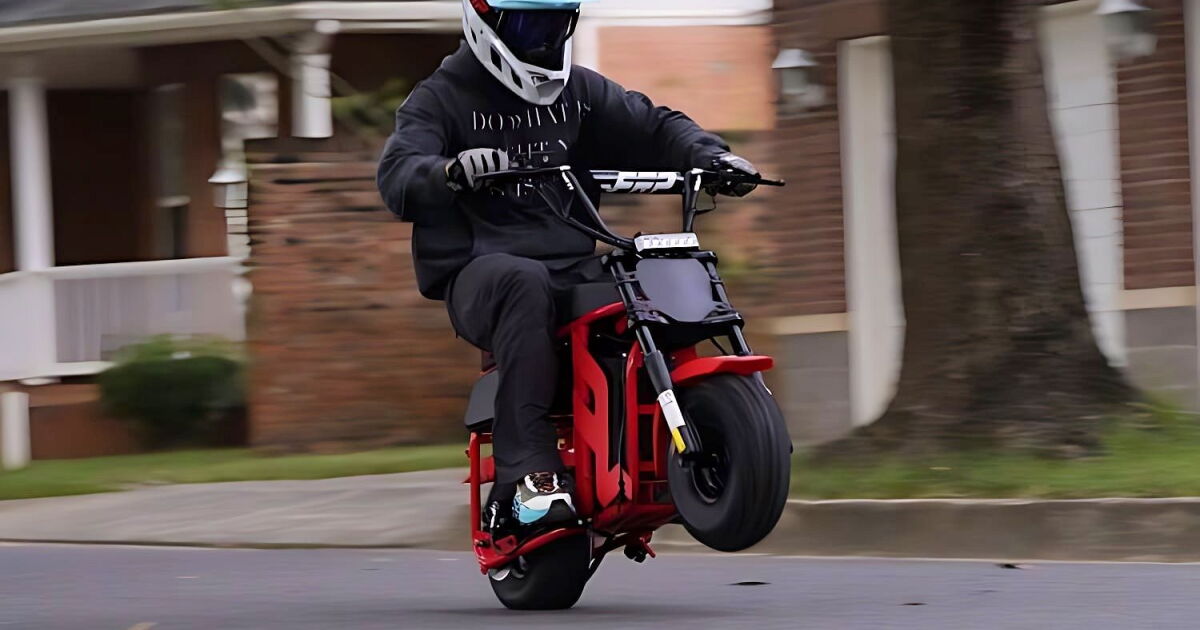
There was a time when popping a wheelie on a motorcycle required a lot of practice. And while we don’t advocate for riders doing motorcycle stunts on public roads, there’s no denying that getting a bike up on its rear wheel is one of those skills that still manages to put a grin on even the most experienced rider’s face.
But what if you could skip much of the learning curve and let the motorcycle do some of the hard work for you? That’s pretty much the idea behind the FRP M3, an electric mini bike that comes with a handy auto-wheelie assist feature. Yes, you read that right.
This pint-sized electric two-wheeler promises to help riders lift the front wheel off the ground without mastering as much throttle control and body positioning. And while it isn’t exactly a full-size motorcycle built for serious adventure or high-speed antics, the M3 looks like a rather entertaining way to introduce a little mischief into the world of electric two-wheelers.
FRP Moto
Power comes from a permanent-magnet synchronous electric motor rated at 4 hp, although it can briefly deliver a peak output of 5.5 hp for up to 17 seconds. Max torque is listed at 107 lb.ft (145 Nm). It’s fed by a removable 60-V battery pack, which FRP claims is good for a maximum range of 35 miles (56 km).
Recharging isn’t particularly quick, though, with a 3-A charger needing as much as nine hours to juice up the battery. The M3 has a claimed top speed of 55 mph (89 km/h).
The M3 gets five selectable riding modes, split between three conventional settings and two dedicated wheelie modes. Eco, Dynamic, and Sport progressively raise the speed limit to 15 (24 km/h), 30 (48 km/h), and 55 mph (89 km/h), respectively, while Wheelie and Wheelie Pro bring FRP’s Auto-Wheelie assist into play.
And that’s where things get interesting. Once you select either of the wheelie modes and lift the front wheel, the system takes over the job of maintaining the balance. A controller continuously adjusts motor output to keep the bike at the desired angle, while the throttle effectively switches roles from regulating speed to controlling wheelie height.

FRP Moto
You can set the lift angle anywhere between 20 and 45 degrees, allowing you to gradually build confidence rather than having to master the technique all at once. FRP says both wheelie modes limit speed to 10 mph (16 km/h) during regular riding, with the ceiling increasing to 20 mph (32 km/h) once the front wheel is airborne.
The system also has a safety cutoff: if the bike exceeds a lean angle of 58.5 degrees, the wheelie assist disengages and reduces motor assistance, allowing the front end to come back down. Braking, meanwhile, remains entirely under the rider’s control.
If you’re still worried about accidentally taking things too far, FRP offers an M3 Plus variant that adds a wheelie bar mounted near the forward footpeg position. Combined with the electronic assistance, it’s intended to provide an additional layer of protection against looping the bike backwards.
There’s also an auto-park function for added security when the bike is stationary. Beyond the electric drivetrain and wheelie assistance, the M3 gets a tubular frame with a relatively low 26-inch seat height (660 mm), wide wheels, and chunky 5.7-inch (140-mm) SunF tires.

FRP Moto
Up front, there’s a triple-clamp suspension setup, while stopping duties are handled by twin-piston hydraulic disc brakes. The bike also comes equipped with both USB-A and USB-C charging ports.
Despite its beefy proportions, the M3 weighs just 121 lb (55 kg) and can accommodate riders weighing up to 210 lb (95 kg). FRP is also planning smartphone app connectivity, with features such as geofencing and a remotely activated speed lock intended to give parents greater control over how and where younger riders use the bike.
FRP has priced the M3 at US$2,050 for the Basic version, while the M3 Plus, with its additional wheelie bar, commands a small premium at $2,150. That’s not exactly pocket change for a mini bike, particularly one with a modest 4-hp motor and a 35-mile range.
But then, you’re not really paying for outright performance here. You’re paying for a rather unusual bit of technology that attempts to make one of motorcycling’s most entertaining party tricks a little more accessible.

FRP Moto
That’s precisely what makes the M3 such an amusing little contraption. While traction control, cornering ABS, launch control, and increasingly clever electronics keep bikes planted firmly on two wheels, there’s now a company selling a mini electric bike that essentially uses technology to help you do the exact opposite.
I’m not entirely convinced that the world was desperately waiting for an electronic wheelie instructor, but I can’t deny the appeal. Just imagine explaining to your riding buddies that you didn’t learn to wheelie the old-fashioned way – your motorcycle taught you how to do it.
If nothing else, that’s one heck of a conversation starter.
Source: FRP Moto

