



The US Army has selected three vendors to boost the service’s night vision system into the 21st century by replacing the legacy system from over 20 years ago with the next-generation Binocular Night Observation Device (BiNOD).
Since entering service in 2000, the US military and NATO allies have relied heavily on the AN/PVS-14 monocular system as their primary night vision device, and its significance can’t be overstated.
It wasn’t that long ago that war effectively ended at sundown. The loss of light meant retreating to safe positions until daybreak. Night operations depended on a full moon, artillery illumination, a lot of shouting, or sending out small squads and scouts to inflict whatever damage they could – if they were lucky.
After the Second World War, night vision systems that amplified ambient light or operated in the infrared spectrum began to change things. Early systems, however, were expensive, heavy, temperamental, and suited mainly to reconnaissance or sniper roles. By the 1990s, night vision technology had become more practical, but high costs and complexity largely restricted their use to vehicle crews and specialized reconnaissance units.
Elbit America
Then in 2000 came the AN/PVS-14, which fundamentally shifted the paradigm. Compact and lightweight, the units were cheap enough (by military standards, at least) to be mass-produced and issued to ordinary soldiers as standard field equipment. Mounted on rifles or infantry helmets, they radically changed military strategy and tactics by effectively turning night into day and making combat a round-the-clock affair.
However, the system had its shortcomings. Though the AN/PVS-14 was so advanced at the time that its export or civilian sale was heavily restricted for security reasons, it was far from perfect. For one thing, the AN/PVS-14 was a monocular system using a single image tube. That meant users saw a flat, two-dimensional image with no real depth perception – a bit like looking through a toilet paper roll due to the limited field of view.
In addition, the Generation 3 system relied on light intensification and used a green phosphor display that offered relatively poor contrast. Worse, it could be visually confusing because the human eye interprets low-light conditions primarily through brightness differences rather than color. The green tint forced the brain to process color variations where it really wanted contrast information instead, leading to increased eye strain and fatigue.

L3Harris
Now, the US Army wants a major upgrade to its night vision capabilities. To achieve this, it has awarded contracts to three companies in line with government policy encouraging competition among defense contractors while also ensuring redundancy and sufficient production capacity to meet future needs. All three are firm-fixed-price contracts for the companies to develop, produce and test their respective Binocular Night Observation Devices.
The systems submitted by Elbit America, L3Harris, and Photonis all reflect a transition from monocular to binocular systems, providing a wider field of view, improved situational awareness, and proper depth perception – so less tripping over air pockets in the dark. They also share a move away from green phosphor displays in favor of white phosphor technology, producing black-and-white imagery that is less confusing to the eye, making the brain happy and resulting in less eye fatigue.
In addition, all three systems are designed so the eye tubes can rotate independently, allowing the wearer to flip one out of the way to preserve natural night vision in one eye while using intensified vision in the other.
When not in use, both tubes can be folded back against the helmet, lowering the center of gravity for greater comfort and reducing the risk of the device banging into door frames or vehicle hatches, which tends to make squad leaders rather cross. When a tube is flipped up on any of the systems, it automatically switches off to conserve power and avoid projecting a telltale glow. When the entire unit is flipped up, it powers down completely.
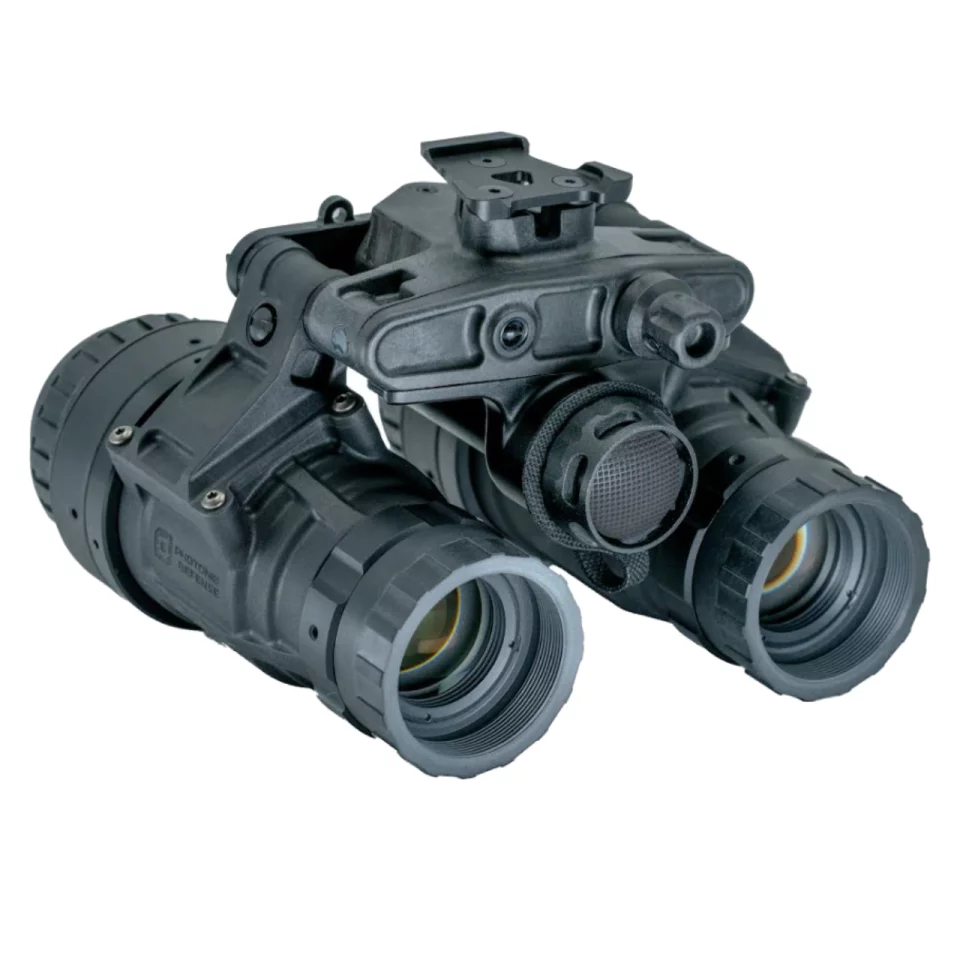
Photonis Defense
All of the BiNOD systems are water-resistant to depths of 66 ft (20 m) for at least two hours and can operate in temperatures ranging from -40 °C (-40 °F) to 49 °C (120 °F). They also use the same dovetail shoe, making them compatible with standard helmet mounts. In addition, the goggles can be adjusted to fit the operator’s interpupillary distance, while the diopters can be tuned for users requiring prescription lenses.
Elbit America’s BiNOD candidate features upgraded optics that provide sharper edge-to-edge clarity compared to the aging lens designs of the legacy fleet. Its light-amplification system has also been expanded to include optional thermal imaging and optical overlays. The architecture is modular, simplifying future upgrades. Ergonomics have also been improved, with the unit’s center of gravity better balanced to reduce eye and neck strain for infantry personnel who may need to wear the device for up to 10 hours a night.
The L3Harris NOVA system is also modular for easier upgrades and field repairs. Each eye tube can be removed using only four screws, greatly reducing downtime and minimizing the need for specialized tools. Inside the NOVA goggles is L3Harris’s proprietary unfilmed Gen 3 image intensifier technology. By removing the ion barrier film found in standard Gen 3 tubes, NOVA is claimed to achieve higher clarity and greater light sensitivity, particularly in near-total darkness. The design also incorporates an integrated IR illuminator for close-range tasks.
Meanwhile, the Photonis Defense Vyper Pro focuses on ultralight construction, replacing magnesium or aluminum alloy with a high-strength carbon-fiber-reinforced polymer housing for reduced weight and improved impact resistance. Unlike standard Gen 3 systems, the Vyper Pro features “out-of-band” capabilities, allowing operators to see a broader spectrum of light, including high-frequency infrared lasers and ultraviolet markers invisible to comparable systems. In addition, the Vyper includes an ultra-fast autogating power supply specifically designed for urban operations, where sudden flashes from muzzle blasts, explosions, or streetlights can cause traditional night vision devices to “bloom” or wash out.
With such a variety to choose from, the US Army will not only be well equipped for night operations, it might also have enough surplus capacity to start a nice little sideline in helping late-night pub goers find their lost keys.
Source: US Department of War

