


Mention Zeiss, and it’s likely to bring up planetarium projectors and advanced optical lenses, but aerospace products wouldn’t get much of a look-in. That is, until now, as New Atlas gets hands-on with Zeiss’s new holographic technology for aircraft.
Founded in 1846, Zeiss has long held a reputation for using scientific principles to develop high-quality optics for both consumer and specialized applications like periscopes, aerial survey cameras, and medical instruments. However, dedicated aircraft cockpit and cabin displays have historically been lacking in their lineup.
But for over 40 years, the company has been engaged in holographic optical elements (HOEs) with the goal of moving advanced holography from the laboratory to practical, real-world applications. At the recent Farnborough International Airshow, I had the opportunity to see the results of this research firsthand, try it out, and discuss it with Zeiss representatives. The results were surprising.
Instead of a crowded exhibition floor, I was fortunate enough to gain access to Zeiss’s chalet, which is one of the VIP venues companies set up to engage with important customers and the odd fortunate journalist on a one-on-one basis.
A company representative explained that what Zeiss was showcasing were micro-optical elements for aerospace applications. Unlike conventional optics that manipulate light using mirrors for reflection or lenses for refraction, these holographic micro-optical elements rely on lasers and diffraction.
Zeiss
These elements are so small that they can be applied to foils or a single piece of flat glass. Rather than acting as a simple surface for a projected image, the foil itself performs the actual holographic 3D optical redirection. The embedded microstructures are engineered to interact exclusively with specific laser wavelengths and incident angles emitted by a Picture Generation Unit (PGU). Ambient sunlight and external light pass through unhindered, preventing display washout.
I wasn’t given much in the way of specifics about the technology, which is highly proprietary, but the upshot is that this holographic system allows for drastic weight and size reductions, so things like video projection can be made to fit inside a car or an aircraft cabin.
The first example I was shown was a glowing 3D virtual button that looked real enough, except for the minor detail that it wasn’t there. It was simply a projection created by a foil with a micro-optical element behind a small pane of glass. This incorporated a motion sensor so I could activate the button without touching it. I was told this had a number of applications – the most obvious being opening a lavatory door without having to touch anything. As someone who has opened many a bog door with his elbow, I appreciated that.

David Szondy/New Atlas
We then moved to the main area of the chalet where there was a mock-up of a business jet passenger cabin and cockpit. I was told to sit in the passenger seat facing a glass cabin divider. In this divider was embedded foil with a micro-optical pattern designed to generate an image. Sitting down activated a program – an image of a flight attendant appeared on the glass and a voice said, “Ladies and gentlemen, welcome to Farnborough.”
A representative clarified that Zeiss isn’t an aircraft manufacturer or an aircraft interior manufacturer. Instead, they’re an optical company that provides technology that can be installed in existing designs and customized to meet the needs of specific clients. In addition, by being an independent technology provider, Zeiss tries to avoid competing with companies they may also be in partnership with.
They claimed that the reduction of the components meant that the laser projector can be placed in a variety of positions and that things like the glass cabin divider can carry a variety of announcements and information, from greetings to emergency instructions. This kind of cabin projection capability may seem redundant in an age where seatback screens are the norm, but this tech is designed for small aircraft like business jets where unobtrusive presentations by a discreet host are preferable to an aggressive and obvious infotainment interface.

Zeiss
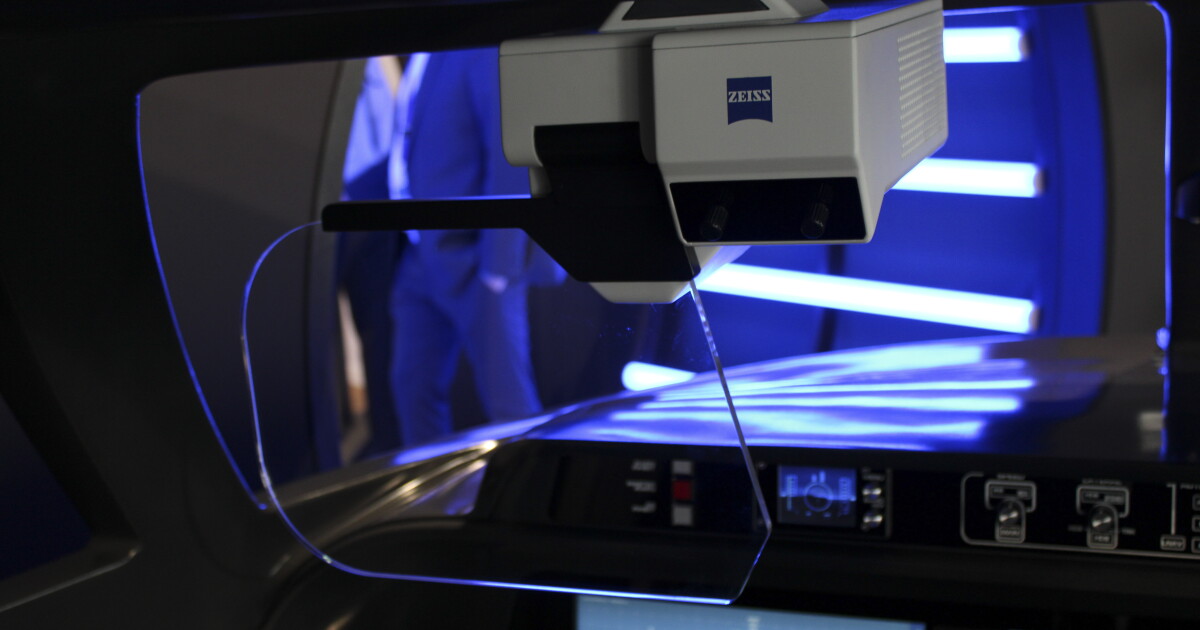
Reluctantly giving up my comfy executive cabin seat, I was directed forward to the cockpit mock-up, where another pane sat in front of the pilot’s seat like a fold-down visor. I was told that this was a fully integrated projection system for a Next-Generation Head-Up Display (HUD).
Such displays aren’t new. They can be traced back to reflector sights in World War II aircraft like the Spitfire, and they’re common in modern aircraft as a means to provide pilots with vital information without having to glance at the instrument panels. However, these tend to be limited to larger aircraft because of their bulky projection systems.
“Benchmarking this against an existing collimated system, those can only be integrated into large aircraft because the projection unit generating the image is far too big,” said a representative. “Here, we try to reduce the size of the projection optics using optical elements. This does not use a standard waveguide where light is directly coupled in with an entrance grating that transfers information to where you see the real image. We were also able to shrink down the size without compromising on the field of view. That’s the actual size of the combiner waveguide.”
He explained that, though the HUD had been in development for a year, it was still two months away from being ready for its debut, so I was allowed to try out the system using a VR headset that simulated the experience.
Getting the headset on was an experience in itself, since it was inside a sort of helmet apparatus, and helmets and I have never been good friends. Worse, with my appalling eyesight I need to wear my glasses at all times if I want to see anything anything other than a blur, so I had a bit of a struggle. But once cinched into place, the visor came to life.

David Szondy/New Atlas
I found myself in a 3D helicopter cockpit flying over the Alps. Directly in my forward field of view was a HUD with an impressively wide field of view. Beyond flight telemetry, it featured an Enhanced Flight Vision System (EFVS) overlay that allowed me to see through dense fog as if I had X-ray vision. The simulation concluded with a flight over a digital wind farm and a precise landing in whiteout conditions, followed by a brief moment of disorientation as I pulled off the helmet.
Suddenly, I was sitting in a 3D helicopter cockpit, which was obviously chosen to highlight the sort of aircraft the HUD system could be installed in. As I turned my head, I could see that I was “flying” over the Alps, while directly in front of me was the HUD with a surprisingly wide field of view despite the small size of the pane. This not only showed flight data but featured an Enhanced Flight Vision System (EFVS), which allowed me to see through fog like I had X-ray vision. This and similar features, were the result of consultation with pilots to ascertain their requirements.
The simulation ended with a flight over a digital wind farm and a precise landing, with the HUD providing navigation information despite the whiteout conditions. This was followed by a moment of disorientation as I removed the helmet.
According to the representative, a helicopter was chosen for the demonstration not only for the size of the aircraft but for the comparative difficulty of flying one.
After that, I was shown a more modest application of holographic technology. I was asked to look at a pane of glass on a shelf, which lit up. I saw a pair of images of myself, with one scanning my features and the other, supposedly, doing a security check before giving me clearance. Facial recognition technology isn’t new, but this was in real time and recorded a lot of detail by, apparently, using my eyes as a landmark for the scan.
I don’t know if it’s any better than the ones used by passport control, but it seemed a lot more intuitive and less confusing.
“Our main focus at the moment is business aviation,” the representative said. “Of course, shrinking the size also reduces weight, which makes it attractive for wide-body aircraft as well. If they can save a few kilograms – this system is five to six times lighter than a conventional system – it helps save fuel and money. For general aviation, we would likely need to develop a lower-cost solution, probably with a smaller field of view. While general aviation wasn’t our primary target initially, we are now evaluating those requirements. Primary focus remains business and commercial aviation.”

