


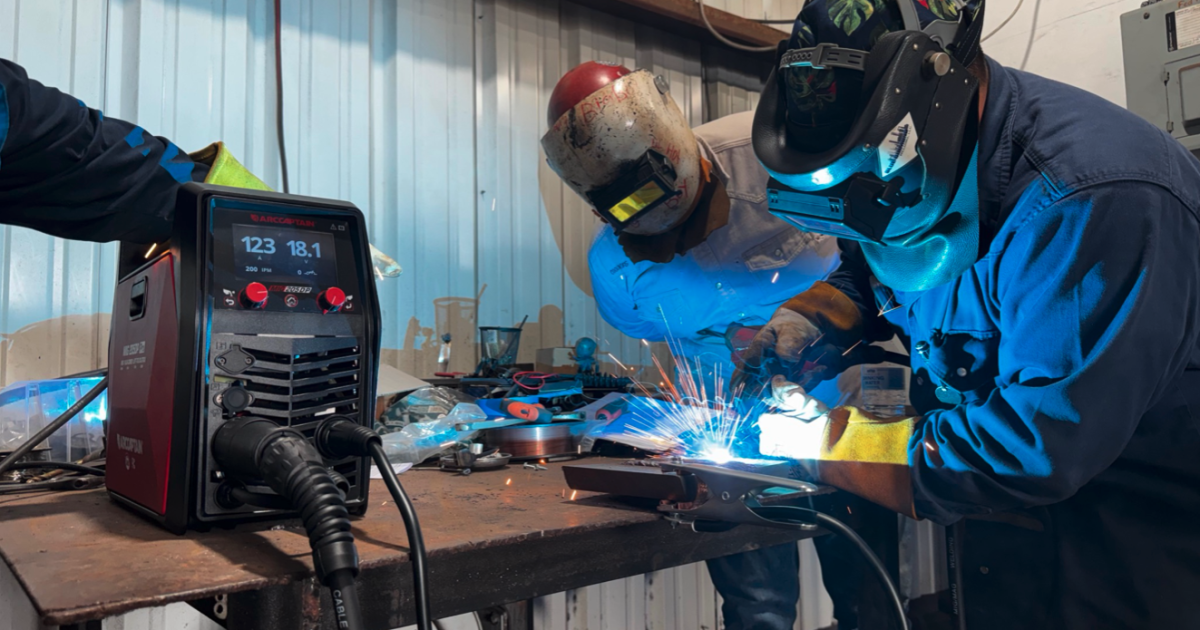
We put ArcCaptain’s hobbyist-to-light-industrial-grade double-pulse machine in front of experienced welders. Everybody liked the way it welded. The arguments started when we tried to tell it exactly how we wanted it to weld.
Before we get started, who am I and what am I doing besmirching the pages of New Atlas? I’m Hayden Landers, I run my own welding company, Mad Cow Industrial out of Rockport, Texas, and I’m writing this for you today because I was helping my good friend and New Atlas regular Joe Salas out with my opinion on this welder, when that big dumb woolly-headed loser went and cracked his skull and died on me.
I don’t really know what else to say about it, he was my best friend since the day I met him, such a good dude. We were late-night scooter brothers, our wives are joined at the hip and I loved talking technology with him, looking over his shoulder as he did his work for New Atlas. I learned a ton from him, and I wanted to finish this review because it was one of the last projects we did together out in the garage as the girls complained about us. This one’s for you, Joe, you asshole.
So… Welding. What is this thing? ArcCaptain says the MIG205DP Pro is “perfect for DIY, workshops, and industrial use” – I’d say it’s fair to call it a high-end home workshop welder, but you wouldn’t expect it to handle the punishment of South Texas industrial use.
ArcCaptain
Having said that, this thing does weld really well.
We had several experienced welders take turns with it, running MIG (wire feed, which lets you lay down a clean, smooth bead), Stick (the classic electrode rod process for heavy metal), Lift TIG (for clean work on stainless or carbon steel), and pulse work on 240 volts (which lets you lay down a thicker pancake-style weld, and works well with very thin metal). Nobody was standing around making excuses for a cheap little machine or saying it was good “for the money.” The arc was solid, it had plenty of power, and the final results were genuinely impressive for a home welder.
I’d say it does a better job than a Lincoln shop machine… About the same quality of weld as a Miller shop machine, and that’s about the best you can get in my opinion (at least this side of something like the Australian UNIMIG rig, which I’ve been trying to get hold of for about six months).
ArcCaptain rates the 205DP Pro for 205 amps (that’s hot, you’re cookin’ it at 205) on 240 V and a 60% duty cycle – meaning six solid minutes of continuous trigger time out of every 10 minutes at max output. We didn’t set up a stopwatch and try to turn the afternoon into a certification test – we just welded with it. A lot. Long enough that a couple of us expected thermal protection to eventually shut the party down. That never happened. Not once. Try that with anything off the shelf at Harbor Freight.
The display was one of the first things I liked. It’s bright, easy to read through the hood, and it puts the useful numbers right in front of you. Wire speed, voltage, settings, all the normal stuff is there. The live voltage reading while you’re actually welding is especially nice. You can see what the machine is doing under load instead of staring at the number you set before pulling the trigger.
Double Pulse MIG205DP Pro With LCD Display
But I don’t know how I’m going to feel about that screen after a few years of heat, grinding dust, vibration, humidity and whatever else gets thrown around a welding shop.
I guess ArcCaptain believes one good screen deserves another, because it also comes with a phone app, which will presumably rot on the third page of your home screen next to the apps for your coffee machine, your refrigerator and your water purifier. I’m gonna have my gloves on and sweaty hands when I’m welding, I don’t need this. The very fact that it’s got a phone app makes me think it’s unsuitable for serious work in the hot Texas sun. Give me three knobs and a MIG gun and let me make some money.
As a 21.6-lb (9.8-kg) welder that takes 1-kg and 5-kg spools, it’s well suited to hobbyists and farmers, but there are some things a production shop is going to want that simply aren’t here: it can’t take a 50-lb spool or a 300 amp MIG gun, for starters. Still, it checks more of the industrial boxes than I expected at this price point. The power is there. The duty cycle is there. Double pulse, single pulse, standard MIG, flux-core, Stick, Lift TIG and spool-gun capability are all packed into the same box.
MIG205DP PRO | Advanced MIG Welding, Aluminum Capability & More
For a serious hobbyist, small fab shop or somebody doing automotive work, there’s a pile of capability here. ArcCaptain also loaded it with 159 “synergic programs,” designed to help total rookies get started patching up gates and lawnmowers while keeping your dials in the green zone. But as more experienced welders, that’s where we started arguing with it.
The synergic system asks what you’re welding, what wire you’re running and how thick the material is, then it builds the settings around that. If you’re new, that’s a pretty good way to get in the ballpark without burning up a pile of material first. Pick the job, pull the trigger, and you’ve at least got somewhere sensible to start.
So don’t mind us old heads at the shop bickering about the forced ease of use you get with these training wheels. After you’ve welded for years, you don’t spend much time wondering what the menu thinks. You watch the puddle. You listen to the arc. You know what too hot or too cold looks like, and when the weld is doing what you want. Trying to work with this synergic supervision is like reading welding advice threads on Reddit.
But as long as we’re bickering, Pulse mode is where the software really starts weighing down a terrific piece of hardware.
The whole reason you’re pulse welding is control. You’re bouncing between peak and background current, so the puddle gets a chance to cool between pulses while you still move metal efficiently. On thinner material, that gives you a fighting chance at keeping heat and warpage under control without crawling along at a miserable pace.
ArcCaptain’s single- and double-pulse functions only operate in synergic mode. During one of our pulse tests, the weld was running hotter than we wanted. We wanted to pull the amperage down a little and settle the puddle where we wanted it. Simple enough, except the machine wouldn’t give us the exact adjustment we were after.

Sarah Landers / New Atlas
We ended up having to change the material thickness setting just to access a different amperage. Once we did that, we got closer to the pulse characteristics we wanted. The machine was physically capable of making the weld, we just had to work around the software.
Overall, pulse works well once you get it where you want it. Getting there is where experienced welders may start cursing at the menu.
That’s backwards to my mind. If I’m using pulse, it’s because I want more control over heat input and deposition… Getting less control of what you’re doing because of the software makes no sense.
We like our guns down at the shop, and maybe that’s the easiest way I can explain it. A factory zero setting on a scope will get you somewhere on a paper target. Good. Now give me the knobs so I can finish sighting the thing in. The presets on this welder are useful the same way. They can get you close, but close isn’t always where an experienced welder wants to stop.

Sarah Landers / New Atlas
I don’t think newer welders should live inside the presets forever either. They’ll help you get started and probably save some frustration on day one. Eventually you still have to learn to read a puddle. That’s welding. The machine can’t teach your eyes what a good weld looks like just because the display knows the material thickness.
If ArcCaptain gave pulse mode a proper manual or expert setting, most of our complaints would disappear. Leave all 159 presets in there. They’re useful. Just add a door for the guy who already knows what he wants and would like to turn the knob himself.
At the time of writing, ArcCaptain lists the bare MIG205DP Pro at US$599.99. For that price, the hardware is hard to argue with. You’re getting a 120/240-V multi-process machine with 205 amps available on 240 V, pulse and double pulse, a good display and enough duty cycle that we never found the end of it during a normal afternoon of shop use.

Sarah Landers / New Atlas
The day before Joe died, however, the MIG gun died – it stopped feeding MIG wire. These things happen, and the 205DP Pro ships with a 3-year warranty. Joe contacted the ArcCaptain team and they fired a new unit out, which now sits orphaned by his front door, like his three children. Love you brother, I’m just hating on you because I miss you.
The short version? I’d use this. The other guys at the shop were extremely impressed by the quality of the work it put out. I’m not gonna tell them the gun failed, because I really like this thing and I don’t wanna hear them bitch about it. Under the skin, it runs some of the highest-quality motors on the market – the same ones ESAB uses. So the hardware’s capable of hard use and high quality welds… We’d just like ArcCaptain to trust us a little more.
Source: ArcCaptain

