


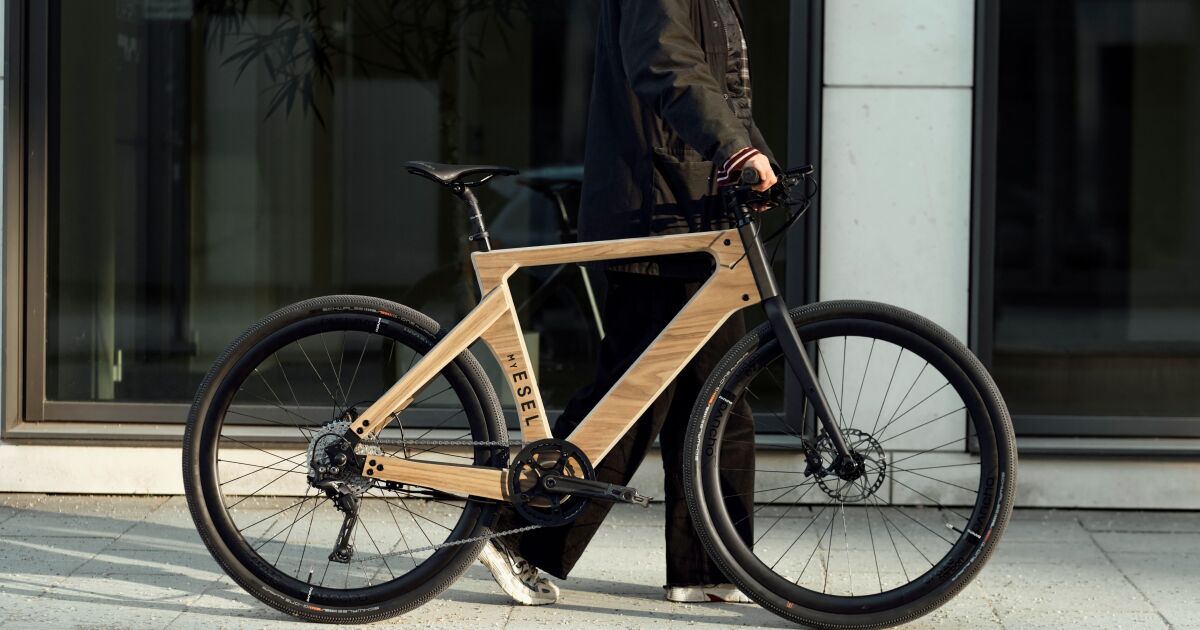
Austrian e-bike maker Esel is bringing its stunning ash wood frames to the city for the first time with the new eUrban. The model launches with three international design awards already on the shelf – including the German Design Award 2026 – and two builds aimed at riders who want something different from the carbon-and-aluminum mainstream.
The company was founded in 2016 in Traun, Upper Austria, by Christoph Fraundorfer, an architect standing 1.95 m (6.4 ft) tall who couldn’t find a bicycle that fit him. That architect’s instinct shaped a design built on the idea that structure, proportion, and purpose belong together, and the frame should answer all three at once. He turned to wood. The eUrban is esel’s clearest statement yet that it is done being a boutique curiosity and ready to compete.
Esel
The frame uses what Esel calls its Hollow Tec Wood Frame – a hollow ash structure CNC-machined for precision, then hand-laminated and pressed layer by layer. Apart from the appealing looks, the bike’s main selling point is vibration absorption. Ash wood damps the micro-vibrations of rough urban pavement in a way aluminum and steel can’t match without extra engineering. Riders who’ve used Esel bikes for daily commuting consistently describe the ride as unusually smooth and quiet.
The obvious concern is weather. Esel protects the frame from moisture and UV rays with a marine-grade multi-layer finish, the same type of coating used on boat hulls. Riders on previous models with the same build report no weather-related problems, as long as the surface remains intact. And unlike carbon fiber, which can crack suddenly and without warning, a wooden frame can be repaired and restored.

Esel
The repairability argument is a genuine lifecycle advantage, not merely a sentimental defense of craft. That said, some experienced cyclists have noted that the frame’s squared-off edges add unnecessary weight and that construction depends almost entirely on industrial adhesives rather than traditional wood joinery. Fair points for a product still finding its industrial stride.
The drivetrain of the eUrban is a 42-Nm (31-lb.ft), 36-V rear-hub motor, sitting inside the rear wheel to keep the frame clean. The standard battery is 350 Wh, with a 250-Wh option also available. Esel estimates around 80 km (50 miles) of range per charge of the standard battery and a full top-up in four hours.
The eUrban comes in two versions. The Basic weighs 18.5 kg (40.8 lb) and runs 28-inch aluminum wheels, a Shimano Deore 1×10 drivetrain, and an aluminum seatpost. The Performance trims that down to 16.5 kg (36.4 lb) via carbon wheels, a PRO Discover Carbon seatpost, and a Shimano Deore XT 1×11 groupset. The ash frame, motor, and geometry are identical across both, and each model variant shares componentry such as the carbon fork, Shimano MT410 two-piston hydraulic brakes, and Schwalbe G-ONE 45-662 tires.

Esel
With the Basic priced at €3,990 (about US$4,700) and the Performance at €4,990 (a little under US$6k), the eUrban competes against well-established high-end carbon and aluminum brands. The launch also marks a milestone for Esel, which recently rebranded from My Esel as part of a push toward the international premium market – one that now spans five categories: Road, Tour, Mountain, Gravel, and Urban.
Three design awards won’t move units on their own. But they confirm that Esel’s case for wood is being heard. A renewable, repairable, naturally dampening frame that can outlast carbon on the repair bench deserves a serious place in the materials conversation. The next test is whether enough buyers will pay nearly five thousand euros to sit on it.
Product page: eSel eUrban

