


For most people, it’s hard to fathom what true speed on a motorcycle actually feels like. Even most riders have never experienced velocities that might make them question their place in the world.
Road-legal bikes are bound by street limits. And even on a track, aboard a proper sportsbike, we’re still constrained by the machine, the environment, and, more than anything, our own skill.
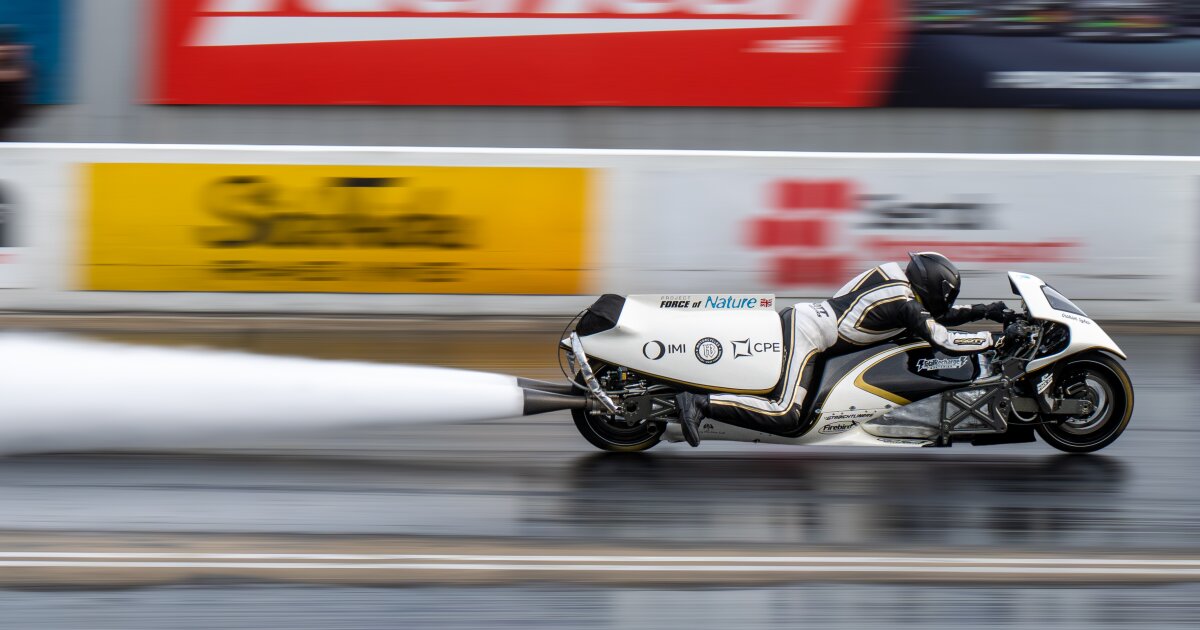
Which is why it’s almost impossible to imagine what it’s like to sit atop a steam-powered motorcycle that covers a quarter mile in just 5.503 seconds at 192.94 mph (310.5 km/h). That’s second only to Eric Teboul’srocket motorcycle at 4.97 seconds, edging out Larry McBride’s wheel-driven Top Fuel Motorcycle by just three thousandths of a second.
John Bearby
Over the eighth of a mile, the bike hit 209.93 mph (337.8 km/h) in 3.258 seconds, and reached 203.36 mph (327.2 km/h) at the 1,000-ft mark in 4.388 seconds. All of this unfolded at the Festival of Power at Santa Pod in the UK.
This isn’t a motorcycle built in some elite Italian factory. It has been painstakingly developed in a private workshop in Bedale, North Yorkshire. Back in 2023, the machine, aptly named Force of Natur, set a then-world-record standing 1/8-mile time for a steam-powered motorcycle.
So how does it even work?
The water that powers the bike is preheated before launch using a separate supply unit the team calls the “Mothership.” Either hydrogenated vegetable oil or kerosene is used as fuel and burned in six tubes fitted with internal turbulators, with hot gases fed in via a manifold. These tubes pass through a pressure vessel containing 120 liters (31.7 gal) of deionized, demineralized water, heated to around 260 °C (500 °F).

Force of Nature
Once the heating process is complete, the pressure vessel is disconnected from the Mothership. The bike is then rolled to the start line, where the rider triggers the system via a handlebar-mounted button. Two valves open, forcing the water through a nozzle where it accelerates to around 1.1 times the speed of sound.
As it exits, the liquid flashes instantly into steam, expanding at a ratio of 1,620:1. The system expels roughly 40 liters (10.5 gal) of water per second. According to 62-year-old creator Graham Sykes, the effect is akin to an “almighty sonic boom.”
Sykes and his wife Diane began the project around six years ago, and the bike is now in its fifth stage of development, with further refinements still underway.

Force of Nature
In its current form, Force of Nature features a longer chassis and revised riding position, helping Sykes better support himself under extreme loads. Despite a higher curb weight than previous versions, the increased power output allows for similarly brutal launches of around 6 gs.
The bike now wears extended, reshaped carbon bodywork and a reworked pressure vessel capable of holding 120 liters (31.7 gal) of heated water. Improved nitrogen-actuated valves provide a more consistent release, while the redesigned vessel enhances flow into the thruster tubes.
At the heart of the updated heating system is a 44-kW burner, paired with updated manifolds and repositioned tubes. Together, these changes reduce the time needed to reach operating conditions of 250–260 °C (482–500 °F) and pressures of 40–50 bar (580–725 psi).

Terry Robbins / Pod Wheels
As before, the system flashes liquid water into steam on exit, expanding at a ratio of 1,620:1 and ejecting about 40 liters per second – again producing what Sykes describes as an “almighty sonic boom.”
Don’t expect to see this technology in production motorcycles anytime soon, though. “The power is on or off,” Sykes explains. “You can’t moderate the flow rate of the valves. It’s 100% or nothing.” He acknowledges that a machine like this can never be made completely safe, and that risk can only be reduced through careful engineering.
And Sykes isn’t done yet.
“To say we were happy is an understatement,” he says. The next targets: a two-second 1/8-mile run, and a quarter mile under five seconds.
Sykes’ run at this year’s Festival of Power in British Santa Pod
“Looking at where we were last year with the, with the previous [smaller] bike and where we ended up, we’re right at the beginning of the learning curve again with this one,” Sykes told MCN. “I think that we can probably go 0.6 seconds quicker over the quarter mile. So, we should be able to run into the high fours. That’s the target we’re aiming for.”
Source: Force of Nature

