


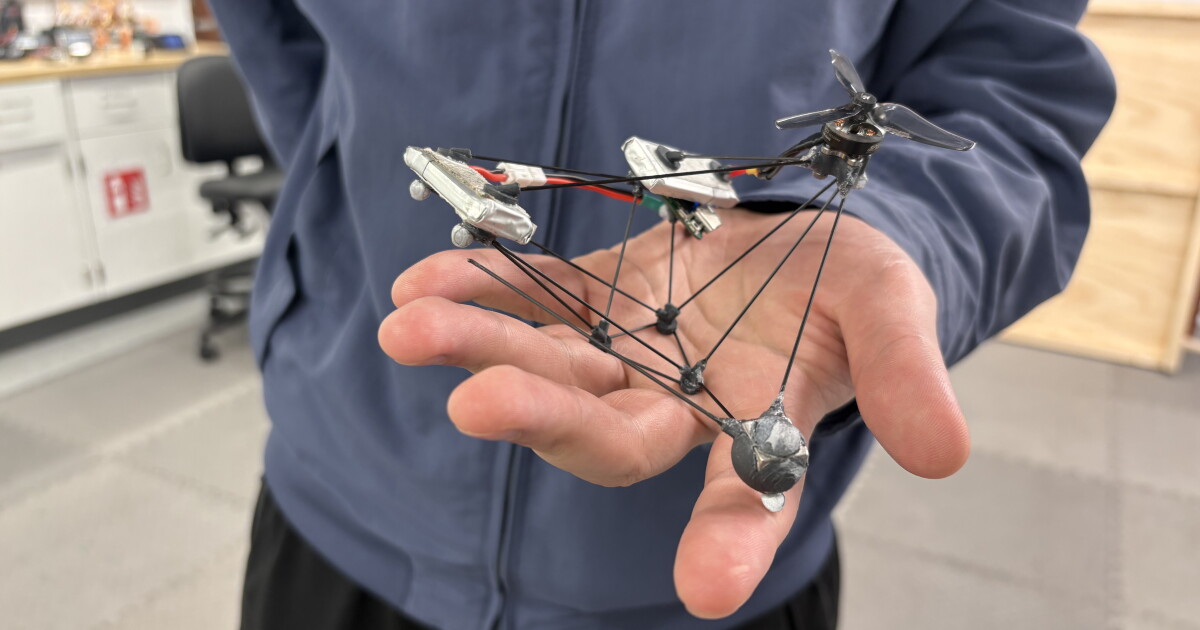
Engineers at Northwestern University have built a drone that vanishes without camouflage or transparent panels. Its trick is spinning so fast that your eyes simply give up trying to focus, a stealth edge that could turn surveillance into something almost invisible.
The aircraft, nicknamed Phantom Twist, rotates up to 25 times per second, a rate that outpaces how quickly our visual system can process sharp detail. Instead of true invisibility, the drone dissolves into a faint, ghostly blur that blends into whatever is behind it. The work, led by associate professor Michael Rubenstein, was presented on July 16 at the Robotics: Science and Systems 2026 conference in Sydney, Australia, under the title Computational Design of a Low-Visibility UAV Using Human-Aligned Perceptual Metric.
“Most efforts to hide drones focus on making them look like their surroundings,” says Rubenstein. “Instead, we asked whether we could design the drone itself around the way humans perceive motion. This idea of low visibility through persistent motion is something few people have explored.”
New drone nearly disappears in flight
That distinction matters because drones are increasingly used to watch wildlife, check aging infrastructure, or survey wetlands, but their mere presence changes the behavior of whatever they’re observing. Birds scatter, animals flee, people act differently. A drone that’s hard to spot could do the same job without that side effect.
Prior attempts at motion-based concealment offer useful context here. The Northwestern paper points to an earlier project nicknamed the Boomerang Drone, covered in a 2006 New York Times Magazine piece, which tried a similar high-speed rotation trick but couldn’t spin fast enough to fully exploit the blur effect, leaving it largely visible. The paper authors also trace the broader idea of active concealment back to the “Yehudi light,” a counter-illumination project developed by the National Defense Research Committee in 1944 to hide Allied sea-search aircraft from enemy view.
The Phantom Twist itself takes a very different shape from those earlier attempts. Rather than a typical quadcopter with four separate rotors, it runs on a single motor and a single propeller, with the propeller spinning one way while the rest of the drone’s body spins the opposite way. “For a typical quadrotor drone, the propellers are spinning, but the robot is stationary,” Rubenstein explains. “So, you still see its body. For our drone, the whole thing is rotating, so there are no stationary parts.”
Michael Rubenstein/Northwestern University
To reach that layout, the team’s computer model generated roughly 20,000 possible drone configurations capable of stable flight, then used artificial intelligence and optimization algorithms to repeatedly rearrange the motor, propeller, circuit board, counterweight, and batteries.
Each design was simulated spinning mid-flight and overlaid on 100 real-world backgrounds, then scored by a perceptual model built to mimic human vision, where a lower score meant better camouflage. The 500 best-scoring designs were run through the optimizer again to squeeze out further gains before a final version was built.
Emma Alexander, an assistant professor of computer science and one of the study’s co-authors, explains the underlying physics. “The human eye takes time to accumulate signals, roughly analogous to the exposure time of a camera,” she says. “When an object spins quickly, we perceive it as blurring out and losing distinct features. Because this new drone is almost entirely transparent, its few opaque components are visually averaged with the background for an overall appearance of a slight haze.” According to the paper’s visibility metric, the finished drone is about 10 times harder to spot than a standard quadcopter.

Michael Rubenstein/Northwestern University
But the spinning trick has real limits that make this drone far from being completely unnoticeable. The propeller still makes an audible whir that gives the drone away even when the eye can’t, and its support wires and rods remain partly visible.
The paper’s authors suggest future versions could lean on more transparent materials and quieter propulsion, edging the drone ever closer to true – and somewhat scary – invisibility. After all, the same trick making a drone less impactful on wildlife could just as easily help it sneak around for reasons that aren’t so friendly.
Source: Northwestern University

