


Analog cameras are nowhere near as efficient as biological eyes. If you’ve ever handled a single-lens reflex (SLR) camera, especially if it had a zoom lens attached, you know how heavy they are, and how tricky and time-consuming adjusting their focus can be.
While digital SLRs are faster, they still can’t switch focus as subtly and automatically as your own eyes do thousands of times per hour. Camera lenses are solid and bulky, and unlike your eyes, must be thrust forward and back to gain focus.
But thank nature for giving us soft, small, squishy eyes that can instantly switch from focusing on spiderwebs glittering in front of us to the sun shining gloriously on the horizon. But while that’s all well and good for us humans, would somebody please think of the robots?
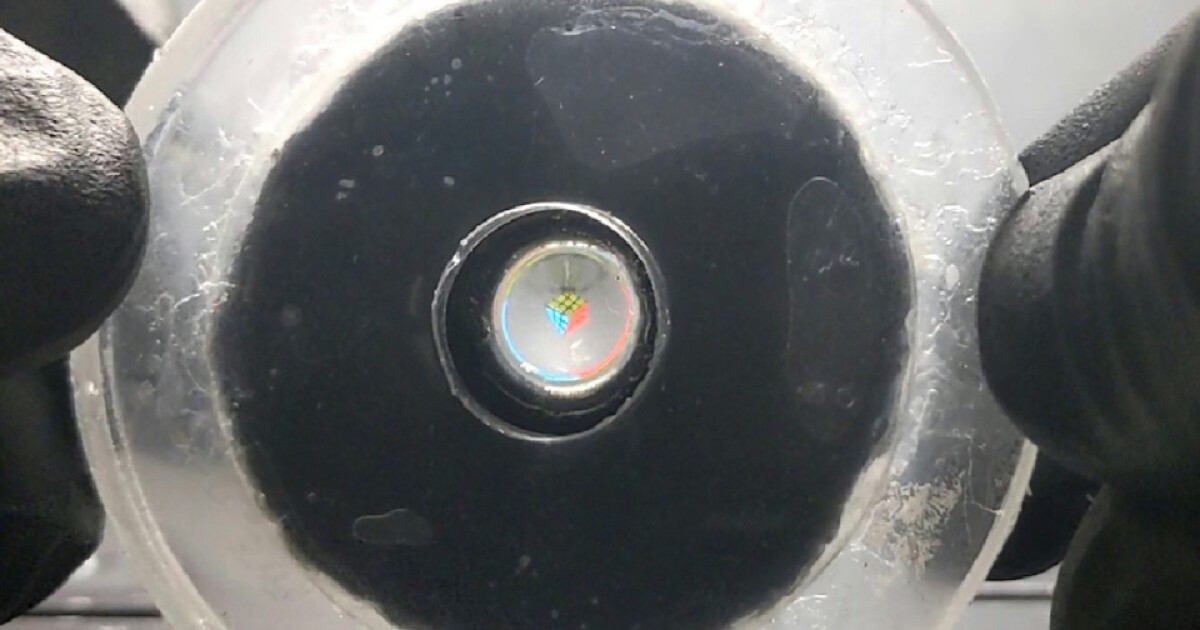
Whether they were driven to improve quality of vision for WALL-E or R2D2, Corey Zheng and Shu Jia at Georgia Tech have created a solution for them nonetheless: a photo-responsive hydrogel soft lens, or PHySL, which they describe in their Science Robotics paper “Bioinspired photoresponsive soft robotic lens.”
By ditching bulky, breakable lenses and gears for soft, hydrogel (water-based) polymers that can do the work of meat-muscles, the PHySL adapts itself to its required focal length the same way our eyes do – not by telescoping in and out, but by squishing and stretching. It was inspired by the ciliary muscles in the human eye.
Corey Zheng/Georgia Institute of Technology
Remarkably, the PHySL doesn’t need an electronic signal for adjustment, but responds to light itself, allowing fine control through the illumination of its different sections – or as Zheng and Jia write, by “leveraging a dynamic hydrogel actuator that autonomously harnesses optical energy,” the PHySL enables “substantial focal tuning through all-optical control.” By saying goodbye to the old rigid materials, the new system provides flexibility, durability, and greater safety, especially if it’s ever touching a living being.
But back to those poor little robots. Whereas the metallic bots and droids of Pixar and Star Wars fare fine with glass and polymer eyes, there’s a new generation of autonomous machines called soft robots, and along with a range of biomedical tools, some of them need to perform in nature or inside living creatures in ways that won’t inflict harm.
Because of their biomimetic design, PHySLs are soft, low-powered, and autonomous, ideal for surgical endoscopes, as well as Inspector Gadget-style grippers for moving delicate objects. And because of their pliability, soft robots can navigate environments that would otherwise block, damage, or destroy rigid robots.
Such design features with fleshily-soft materials are also ideal for wearable tech such as skin-like sensors and internal devices such as hydrogel-coated implants, because they can move and stretch without shattering and slicing their surroundings.
While grippers and propulsors (actuators) have long included soft smart materials, designers haven’t had as much success integrating them with optical systems, because traditional soft lenses often required liquid-filled pockets or actuators that couldn’t work without electronics. Adding those elements also adds complexity, risks damage to delicate surroundings, and requires inconvenient tethering. But through light-activation, PHySL dispenses with the need for electronics and all the associated hassles.
Building on their current success, Zheng and Jia plan to continue improving the PHySL by employing the latest advances in hydrogels that respond to light more quickly and with more powerful contractions, and are exploring how to apply such developments in cameras. They’ve even created a prototype electronics-free camera that integrates the PHySL with a custom-designed, light-activated, microfluidic chip, which they plan to use in soft robots for electronics-free vision.
If their system works, the squishy descendants of WALL-E and R2D2 can look forward to undersea adventures – or in their miniature versions á la Fantastic Voyage, adventures inside your own body.
Source: Georgia Tech

