


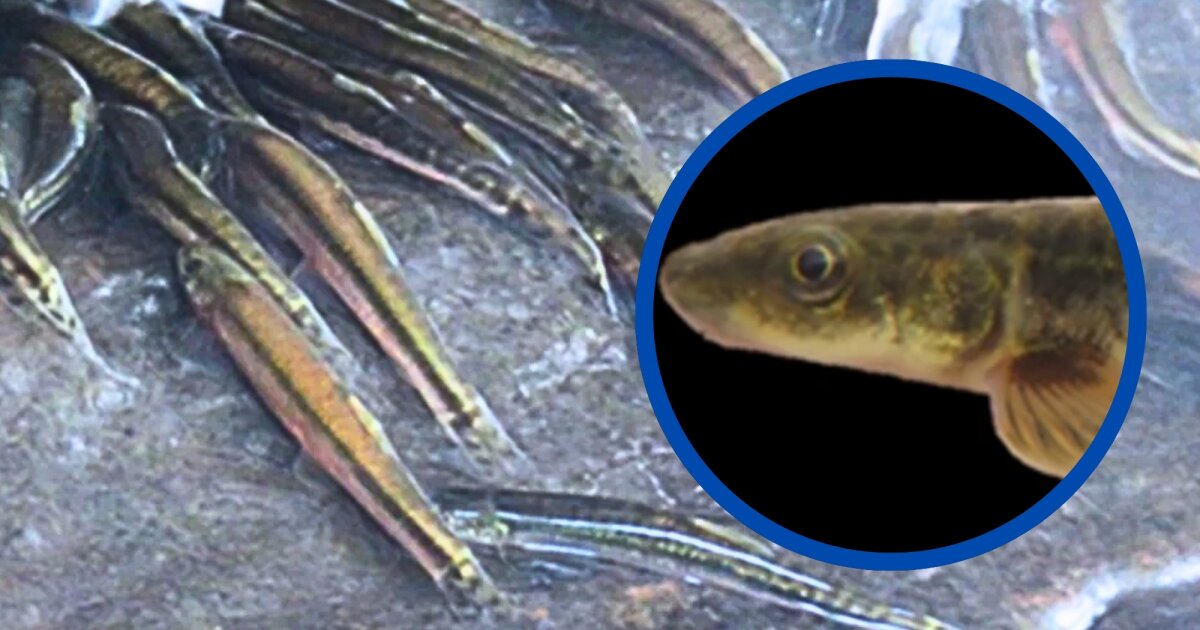
At the end of the rainy and beginning of the dry season, thousands of small fish, about 5 cm (2 inches) in length, begin scaling a near-vertical rock face soaked in waterfall splash.
They cling, rest, and cling again, till they work their way up a 15-m (50-ft) waterfall in the Democratic Republic of Congo.
Supplementary video 3 (Kiwele et al. Scientific Reports)
The ability of the shellear fish (Parakneria thysi) to scale falls has been observed before. But this is the first time that the behaviour is documented with cinematographic and photographic evidence (which you’ll have to see in the study).
“For me, the major surprise was going and seeing them performing this spectacle for the first time,” first author Pacifique Kiwele Mutambala from the University of Lubumbashi, tells Refractor.
Study co-author Emmanuel Vreven explains to us us that the fish population upstream and downstream are often genetically different, even if they are the same species. But there’s “no genetic difference between the downstream population and the upstream population, which was amazing,” Vrenen explains.
This split in behavior isn’t about bravery or laziness, but as the team soon uncovered, it’s a complex mix of biological need, resource drive and physical agility – something the larger fish don’t risk the journey for.
Kiwele and his colleagues observed migration in 2018, 2019, and 2020, and recorded the first visual proof of the feat. The team documented how the fish utilize the area surrounding the falling water, perpetually wet from spray – a space known as the splash zone.
This is a sweet spot for climbing, allowing the fish to breathe and stay humid while avoiding being washed down by the force of the fall.
To cling to the waterfall, fish use pectoral and pelvic fins, covered with tiny, unicellular hook-like projections, or unculi. When these unculi are pressed against the wet rock, the fish “grip” the wet surface. Then they propel themselves vertically using lateral undulatory movements (similar to swimming).
However, the progress is slow. A fish needs 30-to-60 seconds of active movement to climb the waterfall, followed by eight or nine rests along the way of up to 30 minutes. Overall, it takes around nine hours for a successful rock climb under these risky conditions.
Vreven observes that the phenomenon appears to be a non-breeding, partial migration. Only the smaller fish choose the path of most resistance to migrate upstream. The larger fish, which are most likely to be reproductively active, shy away from joining their peers as their size adds many levels of difficulty. Basically, it’s risk management.
And because the fish separate in this way, the team speculates that the genetic shift within the population is most likely because the adventure shellears can then seek out a larger “dating pool” on the other side.
In 2022, scientists also involved in this latest study described how genetic divergence in another Parakneria that morphological changes triggered by waterfall-climbing had actually created a new species. It’s an evolutionary act that doesn’t occur that often nor be easily observed in many populations, let alone underwater species.
The biologist says that the rainy season creates a lake-like or pool-like environment downstream, crowded with fish. As the base of the fall is more prone to predators, the fish who can have no interest to “FAFO” – something that’s more often talked about in human terms in 2026.
The relaxed competition for food might also drive this ambitious migration mission, adds Vreven.
The study has been published in the journal Scientific Reports.
Source: University of Lubumbashi via Phys.org
Fact-checked by Bronwyn Thompson

