


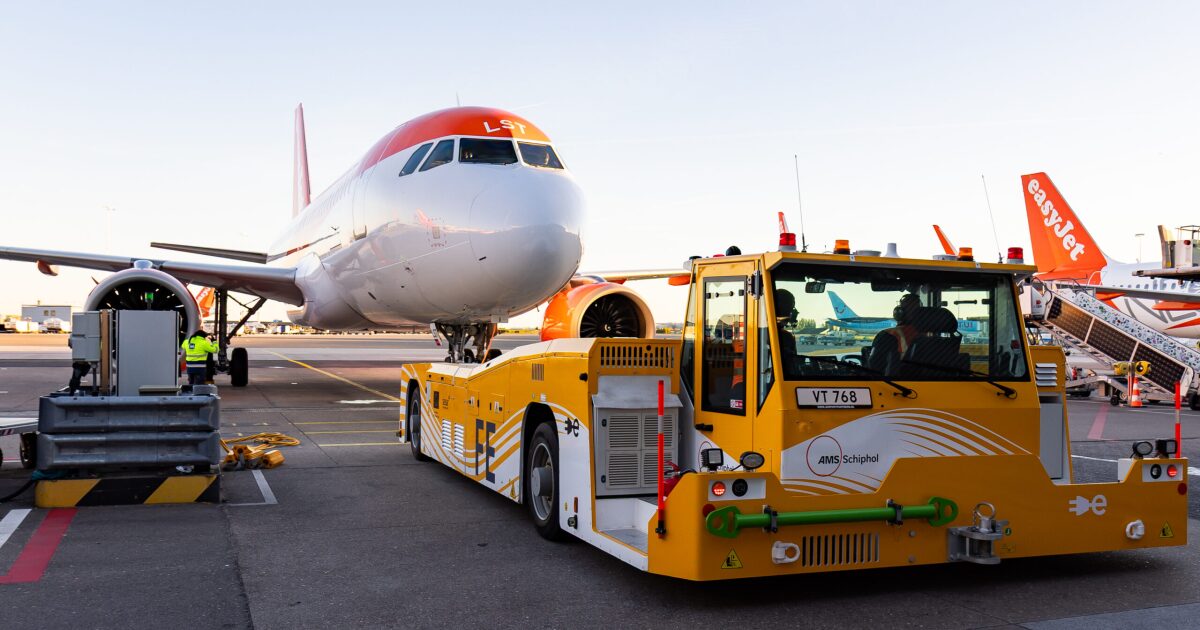
To cut costs and emissions, Amsterdam’s Schiphol Airport is rolling out a pilot program using a semi-robotic ground tug called TaxiBot that allows pilots to taxi airliners around the airport without using their main jet engines.
According to the Royal Schiphol Group, about 68,770,805 passengers pass through Amsterdam Schiphol Airport every year. That puts it fourth in Europe by passenger traffic and 17th worldwide, but it’s worth wondering how many understand all the bumps, whines, lurches, and howls involved in moving an aircraft from the gate to takeoff.
You may hear what sounds like a jet engine running as the doors close, but it’s actually the Auxiliary Power Unit (APU), a small turbine housed in the tail cone that provides electrical power to the aircraft’s systems and compressed air to the main engines. The engines remain offline as the airliner is pushed back from the gate by a vehicle called a ground tug that’s attached to the nose gear.
Smart Airport Systems
As the aircraft moves backward, the pilot starts each of the primary engines and brings them up to a stable idle. Once on the boundary of the runway ramp, the tug stops and disconnects. The nose-gear steering bypass pin is removed, the pilot regains full steering control, and the aircraft begins moving under its own power, taxiing to the runway threshold before lining up for takeoff while passengers wonder what’s taking so long.
So far, so standard procedure. The problem is that powering up the engines, idling them, and then using their massive power just to trundle around the tarmac is scarcely economical. In fact, it burns a surprising amount of fuel for a task that requires very little power, while also generating significant emissions.
It’s a problem that has long been recognized, and there have been a number of attempts to solve it. Most, however, rely on extremely expensive and specialized ground systems that pull airliners around like trams, which tends to defeat the purpose.

Smart Airport Systems
Built by Smart Airport Systems (SAS) in cooperation with TLD and Israel Aerospace Industries (IAI), TaxiBot is a semi-robotic, pilot-controlled towing vehicle designed for “engines-off” taxiing, and it’s now being tested at Schiphol in partnership with EasyJet, Airbus, and Menzies Aviation using a dedicated fleet of EasyJet Airbus A320neo aircraft.
TaxiBot may look like a conventional ground tug, complete with a cab and crew, but the human element is there largely for safety and regulatory compliance. What the new vehicle does is take over the initial pushback operation. However, instead of the pilot starting the engines during pushback and the tug disconnecting afterward, TaxiBot remains attached to the nose gear via a specialized pivoting clamping platform.
Here’s the clever bit. Instead of starting the engines during pushback, the pilot leaves them off while the electric-powered TaxiBot tows the aircraft across the airport. The pilot remains in control, steering via the cockpit tiller and pedals. This setup uses the aircraft’s existing control interfaces and requires no structural modifications to the airframe or avionics. More importantly, the engines only need to be started shortly before reaching the active runway threshold. That potentially reduces taxi-related emissions by up to 80%, according to the developers. Once the plane is in position, TaxiBot disconnects and the aircraft proceeds with takeoff as normal.
All while passengers continue wondering what’s taking so long and why airline seats are so uncomfortable.
Source: Smart Airport Systems

