


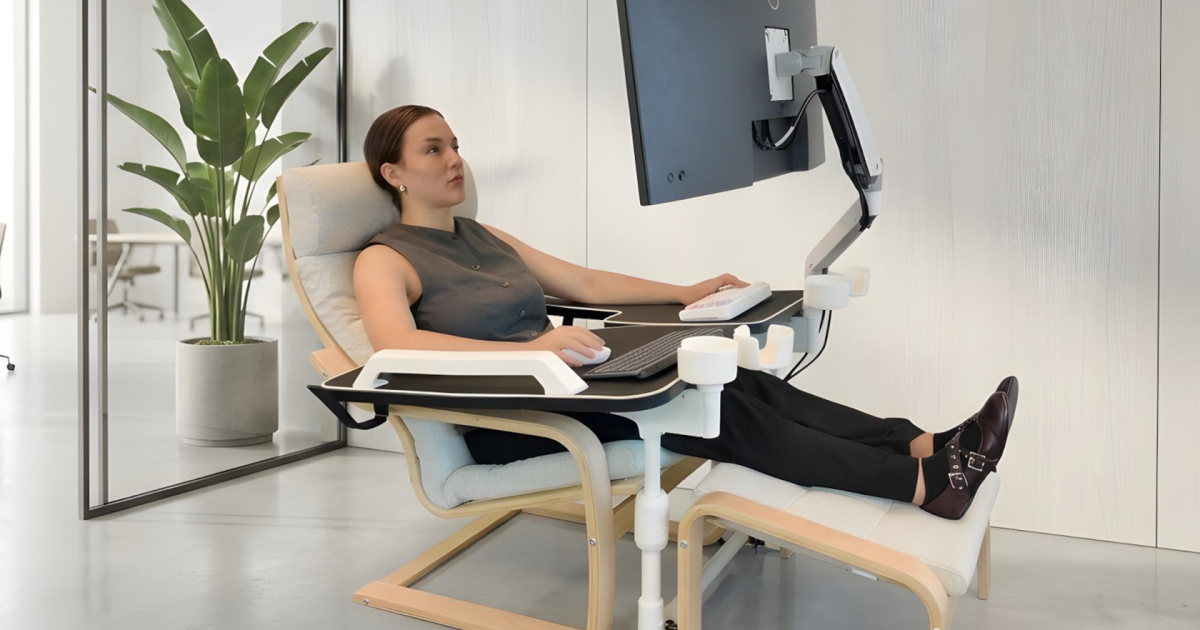
The office chair has had a pretty good run, but a German inventor reckons it’s time we gave the sofa a promotion. His Saloon Desk turns an ordinary couch or armchair into a fully fledged workstation, complete with independently adjustable desktops that swing out of the way like a pair of saloon doors. And the cleverest part? You don’t even have to move your keyboard when nature, or the doorbell, calls.
We’ve got a long history of drooling over outrageous workstation chairs here at New Atlas. Back in 2012, the $40,000 Emperor workstation had us positively salivating. But while that mechanical marvel brought the armchair into the office, the Saloon Desk takes the opposite approach – bringing the office to your favorite armchair.
The Saloon Desk straddles your existing furniture on a hefty steel frame, with two cantilevered work surfaces extending in from either side. Each adjusts independently for height and tilt, allowing you to position your keyboard, mouse and other equipment exactly where you want them. VESA mounting points accommodate monitors and accessories, while the whole arrangement can be positioned in front of your living room TV.
But getting into and out of it is where things get interesting.
Saloon Desk
The desktops swing upwards and outwards with a fingertip, allowing you to stand up without climbing over your equipment. A steel sheet hidden beneath each mouse mat provides a magnetic mounting surface for keyboards, joysticks and other peripherals, while a removable magnetic rail stops your mouse making a break for the floor.
Everything stays exactly where you left it, even when the surfaces are flipped out of the way.
Of course, you want to put your feet up. A conventional footstool can leave you effectively barricaded into your chair, which is one reason powered recliners and sofas with integrated footrests are so appealing. Weatherstone has even experimented with a hinged IKEA Poäng footstool that swings aside, although that’s currently a DIY modification.
It’s a deceptively simple solution to a problem that has occupied inventor Paul Weatherstone for considerably longer than you might imagine.
The story began eleven years ago, when he modified one of those wheeled hospital tables normally used for serving meals in bed. He cut the surface down to keyboard depth, added a wooden support beside his sofa, connected his computer to the television and discovered the joys of working with his feet up.
There was just one problem: DHL.
German delivery drivers, Weatherstone explains, tend to ring the doorbell only once (you are not alone Germany!). Miss it, and you can spend the afternoon hunting down your parcel. His improvised workstation made getting up quickly something of an obstacle course.
That seemingly trivial annoyance eventually led to 27 prototypes and three and a half years of intensive development of the current design.
Early attempts involved mechanical catches, levers and increasingly elaborate folding mechanisms. Each introduced another problem, whether it was manufacturing complexity, unwanted movement or simply getting in the way.
Even keeping a monitor perfectly upright proved surprisingly troublesome. Conventional VESA mounts allowed the screen to gradually drift out of alignment, presenting yet another engineering headache that took considerable experimentation to overcome.
The breakthrough came when he abandoned mechanical restraints in favour of magnets.
“The whole desktop is a sheet of steel, hidden under the mouse mat,” Weatherstone told New Atlas. “Anything magnetic – the keyboard, a joystick, and the little rail I designed so the mouse can’t shoot off onto the floor – simply sticks.”
The resulting desk weighs a substantial 75 lb (34 kg), with heavy steel feet and a crossbar providing stability without attaching anything to the sofa itself. The surfaces tilt through 15 degrees, and the frame accommodates everything from conventional office chairs to wide recliners.

Saloon Desk
Weatherstone took the design to Gamescom 2025, where more than 400 visitors tried it. The gamers were interested, although many considered even €500 expensive. The surprises came from elsewhere.
Taller and larger visitors appreciated having a workstation that could accommodate their proportions. A care-home operator saw potential for residents needing accessible surfaces for tablets, medication and everyday activities.
In a separate experiment, conversations with the AbleGamers charity inspired Weatherstone to adapt an IKEA Poäng footstool into a hands-free gaming controller. Fitted with six inputs – including infrared trip-beams – it uses a Teensy microcontroller to present itself to a computer as a standard gamepad. It’s an intriguing direction for a product originally conceived as a comfortable place to use a PC.

Saloon Desk
The Saloon Desk’s Kickstarter campaign offers early backing tiers starting at €499 (approx. US$580), while the eventual small-batch retail price estimate is €1,199 (around US$1,390). It’s reached its funding target, with initial deliveries expected in February 2027.
There’s something wonderfully appealing about an invention that began with a modified hospital tray, survived 27 prototypes and ultimately found its answer in a handful of magnets.
All because he wanted to answer his doorbell.
Sources: Saloon Desk, Kickstarter

