


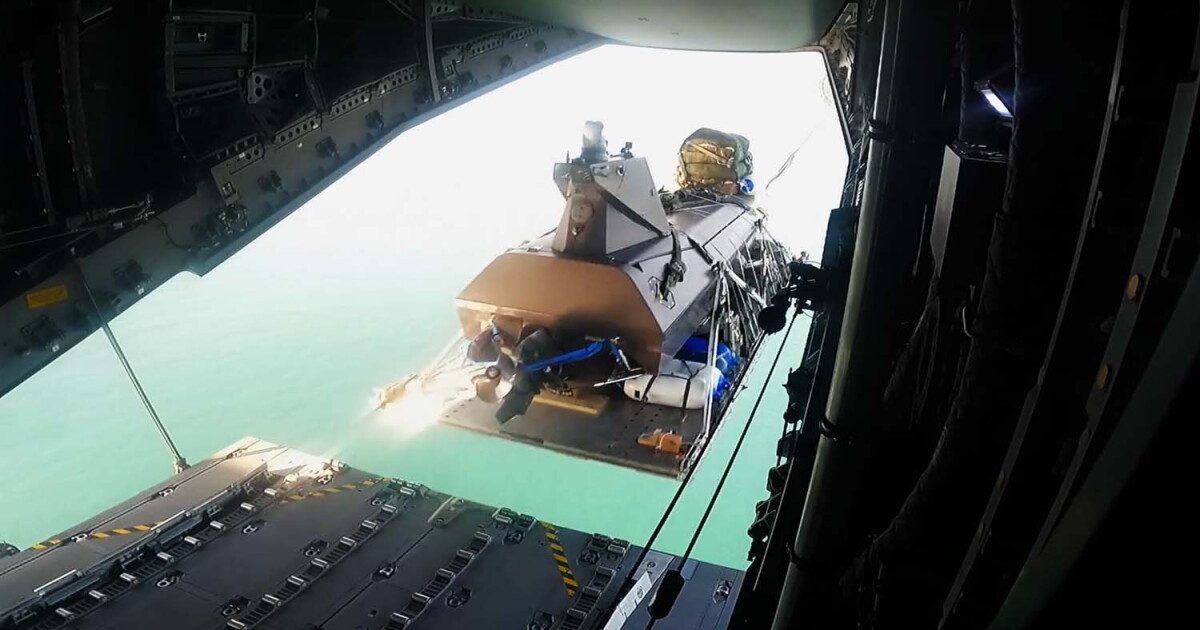
In a world first, the Royal Air Force airdropped an autonomous drone boat from a military transport aircraft. Part of the Royal Navy’s Project Beehive, a Kraken Technologies K3 SCOUT vehicle was parachuted from an Airbus A400M cargo plane over the North Sea.
On July 8, 2026, a new chapter in military drone warfare was written as a K3 SCOUT Uncrewed Surface Vessel (USV) underwent a historic extracted-load airdrop. The drone was pulled out the rear of an A400M transport after a drogue parachute was deployed at an altitude of 1,300 ft (396 m) into waters reaching up to Sea State 4, where waves reach a height of 8 ft (2.4 m).
The autonomous vessel was set on a parachute platform made by Capewell, called the Universal Maritime Craft Aerial Delivery System (UMCADS). This is a reconfigurable airdrop pallet with a parachute and an IN-Release system, which is an electro-mechanical release mechanism designed to handle synchronized load disconnecting, freeing the boat from the platform immediately upon impact with the water.
Royal Navy
During the tests, four live airdrops were successfully conducted over the course of six days using the transport operated by the RAF.
The exercise is another example of how drones are revolutionizing warfare as forces like the Royal Navy move from all-conventional platforms to a hybrid fleet of extremely complex crewed ships that leverage a larger network of land, sea, and air drones to engage with overwhelming enemy defenses.
However, this involves much more than building thousands of drones and the systems to control them. It also means integrating autonomous boats into the Navy as a whole, which is part of Project Beehive’s core mission. To do this, the Ministry of Defence has contracted with Kraken Technologies to supply a fleet of 20 high-speed K3 SCOUTs and their ground control systems. More importantly, Beehive is looking at how to quickly deploy the boats to contested areas where they are most needed – in this case, through tactical airdrops.

Royal Navy
With a length of about 28 ft (8.4 m) and a beam of 6 ft (1.93 m), the glass-fiber boat is designed to be fully autonomous for missions lasting up to 30 days. While its inboard diesel engine gives it an operational cruising speed of 25 knots (29 mph, 46 km/h) and a range of 650 nautical miles, the craft can sprint up to a maximum speed of 55 knots (63 mph, 102 km/h). In addition, it boasts a modular design for a variety of sensor payloads and can be configured for electronic warfare, reconnaissance, or advanced strike missions.
“Project Beehive was set up to allow the RN to rapidly learn lessons and develop the skills necessary to effectively operate Uncrewed Surface Vessels,” said Captain Adam Ballard of Project Beehive. “One of the limitations of small Uncrewed Surface Vehicles is their ability to self-deploy and so we are actively looking at concepts for deployment from motherships or ‘mother aircraft’. The recent air dispatch trials that Kraken have conducted show the potential of this capability to rapidly deploy globally.
“Since the earliest aircraft carriers and seaplane tenders we have become accustomed to air power deploying from maritime power. We are now moving to a future where maritime power can be deployed from air power.”
Source: Royal Navy

