


I got my Himalayan 411 in 2019. Back then I didn’t even know what I was going to do with my life, let alone what I was going to do with a 441-lb (200-kg) adventure motorcycle. Boy, did I not have a clue.
I rode across the length and width of my country, rode the trusty old tractor of a bike from the Himalayas to the coast, and from the tropical forests to dried-up river beds, and not once did I ever stop and think “wrong motorcycle.” But that’s not to say the OG Himalayan didn’t have its flaws.
It’s freakishly heavy for a bike its size, had some of the poorest fit and finish I’ve seen on steel pipes, and it is extremely clumsy when you do want to get up on a freeway and let it rip. But, boy, is it fun … and forgiving … and a motorcycle that won’t just die down. And don’t forget the Himalayan 411 kick-started the whole adventure motorcycling segment in India, with ripple effects we now see across the entire motorcycling industry.
A few years later, Royal Enfield gave us its bigger sibling … the Himalayan 450.
Now, while it wasn’t a particularly massive jump in displacement (411cc to 452cc), it was, in all due fairness, a step up in every department. Power? A proper 40 hp and 30 lb-ft (40 Nm) of torque, courtesy of a new liquid-cooled motor. A six-speed gearbox, slipper clutch and ride-by-wire throttle. An entirely new chassis, far more sophisticated suspension, better brakes and a whole lot of modern equipment on board – all of which meant the 450 was a far more capable, composed and versatile machine.
Royal Enfield
But there was still a very visible gap. One that enthusiasts have been crying out for ever since the original 411 came out: a proper, twin-cylinder middleweight Himalayan. After all, Royal Enfield always had the recipe ready courtesy of its 650cc parallel twin motor.
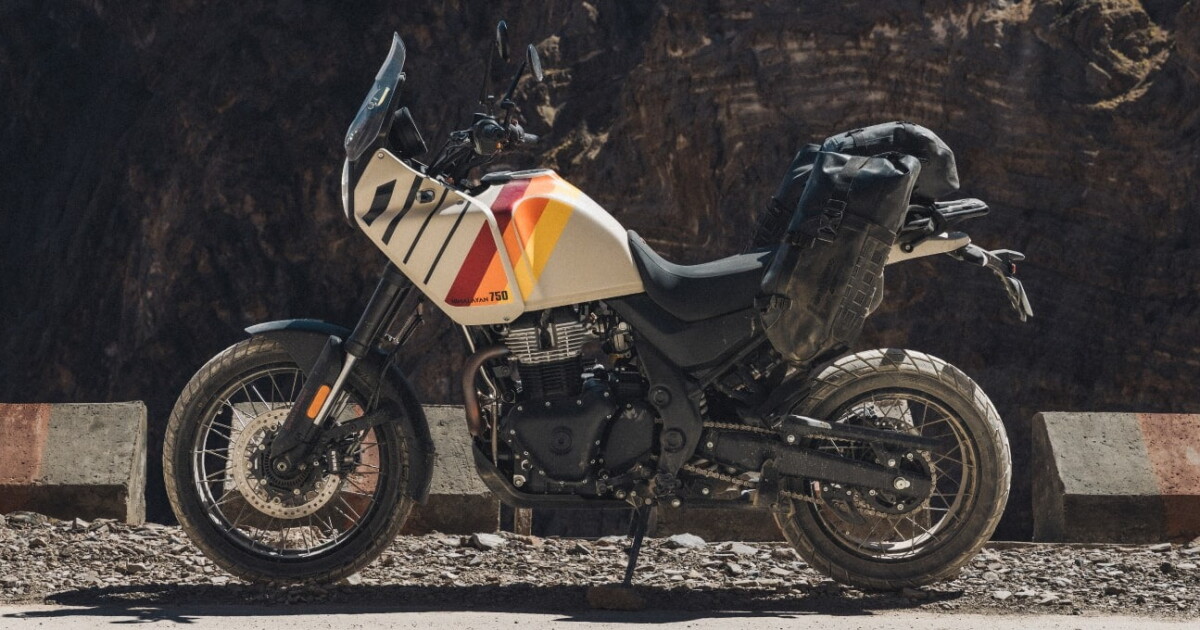
Now, in 2026, after months of teasers and spy shots and what was effectively Royal Enfield’s poorest-kept secret, years of collective prayers have been answered with the Himalayan 750. It’s here, it’s fresh, and it’s everything (almost) that the audience asked for.
Starting with the most important bit: the motor. The Himalayan 750 is powered by a 743cc, air/oil-cooled parallel-twin engine. That means you still don’t get liquid cooling. That means no radiator. And thereby, no plumbing to worry about when you’re throwing the motorcycle around in the mountains. It’s a relatively uncomplicated setup, much like its younger siblings that came before.
That motor produces 54 hp at 7,000 rpm and 46.5 Ib-ft (63 Nm) of torque at 5,000 rpm, with 90% of it available from as low as 3,500 rpm. That’s particularly useful when the going gets rough. You can chug along at low speeds, crawl over obstacles and make your way up tricky sections without constantly working the gearbox or worrying about keeping the engine on the boil.

Royal Enfield
Beyond the engine, the 750 brings a 4.5-gallon (17-liter) fuel tank and a 32-inch (813-mm) seat height. A new box-section spine chassis uses the engine as a stressed member.
Suspension duties come in the form of fully adjustable 43-mm Showa USD forks offering 7.5 inches (190 mm) of travel. A Showa linkage-type monoshock with remote preload adjustment and rebound damping delivers 6.9 inches (175 mm) of travel at the rear. Braking is also improved with dual front discs – the first Royal Enfield to get this – utilizing twin 280-mm floating rotors, backed by a 255-mm rear disc.
But perhaps the biggest change that tells us the direction Royal Enfield wants to take with the bigger Himalayan is the wheel sizes. As opposed to a 21-inch front wheel found on most adventure bikes, RE has opted for a 19-inch front wheel backed by a 17-inch rear. The setup, however, will be offered with both cast-alloy or tubeless spoked wheels.
Look at the design, and you’ll instantly realize it looks bigger, broader, and considerably more road-focused. All owing to that sculpted fuel tank, sharper bodywork, and a front end that brings more than a passing resemblance to the Husqvarna Norden 901.

Royal Enfield
The tall stance helps retain some adventure-bike DNA, but there’s a newfound sense of polish to the overall design. There’s one thing most people wouldn’t deny. It’s that the 750 certainly looks more contemporary and arguably more premium than its predecessors, although I do wonder if all that visual sophistication comes at the expense of the original Himalayan’s wonderfully uncomplicated, go-anywhere charm.
The electronics suite is quite a departure from the OG Himalayan’s traditionally no-nonsense approach as well. You get five riding modes – Road, Road Sport, Rain, Trail and Custom – each tweaking the engine response, cornering ABS and traction-control intervention to suit the conditions. A six-axis IMU keeps tabs on the motorcycle’s movements, feeding information to the various rider aids.
There’s also cruise control, tire-pressure monitoring, an immobilizer, self-cancelling indicators and emergency brake-light functionality. All of this is presented through a 4-inch TFT display that brings navigation, smartphone connectivity, music controls and Royal Enfield’s Wingman 2.0 connected-bike platform into the mix.
That’s a fair bit of technology for something wearing the Himalayan name. And while all of it makes sense on a long-distance touring motorcycle, I can’t help wondering whether we’ve wandered a little too far from what made the original Himalayan so appealing.

Royal Enfield
And then, there’s the touring hardware. The Himalayan 750 gets separate rider and passenger seats, a five-position adjustable windscreen offering 2.4 inches (60 mm) of movement, and a payload capacity of nearly 430 lb (195 kg). Royal Enfield has also teamed up with GIVI for an integrated luggage setup that doesn’t require a separate mounting rack.
Put all these pieces together, and you begin to understand the motorcycle’s intended personality. This isn’t necessarily a stripped-back adventure machine built to be thrown around on trails. RE clearly wants to position it as a middleweight ADV that’s more interested in eating up miles on long tours as opposed to purely conquering gnarly off-road trails.
On the pricing front, however, Royal Enfield might have a rather compelling argument. With a UK MSRP of £6,999 (roughly US$9,400 at current exchange rates), the Himalayan 750 looks remarkably competitive for the hardware on offer. There’s a lot of motorcycle for the money, clearly.
You know, if you’d go back in time and tell the 2017-me that the Himalayan 411 would only be the beginning and that we’d get a twin-cylinder sibling down the years, I wouldn’t believe you. But the 2026-me can’t believe it has taken Royal Enfield this long to finally get it here.

Royal Enfield
One can’t help but wonder: is it too late?
Source: Royal Enfield

