


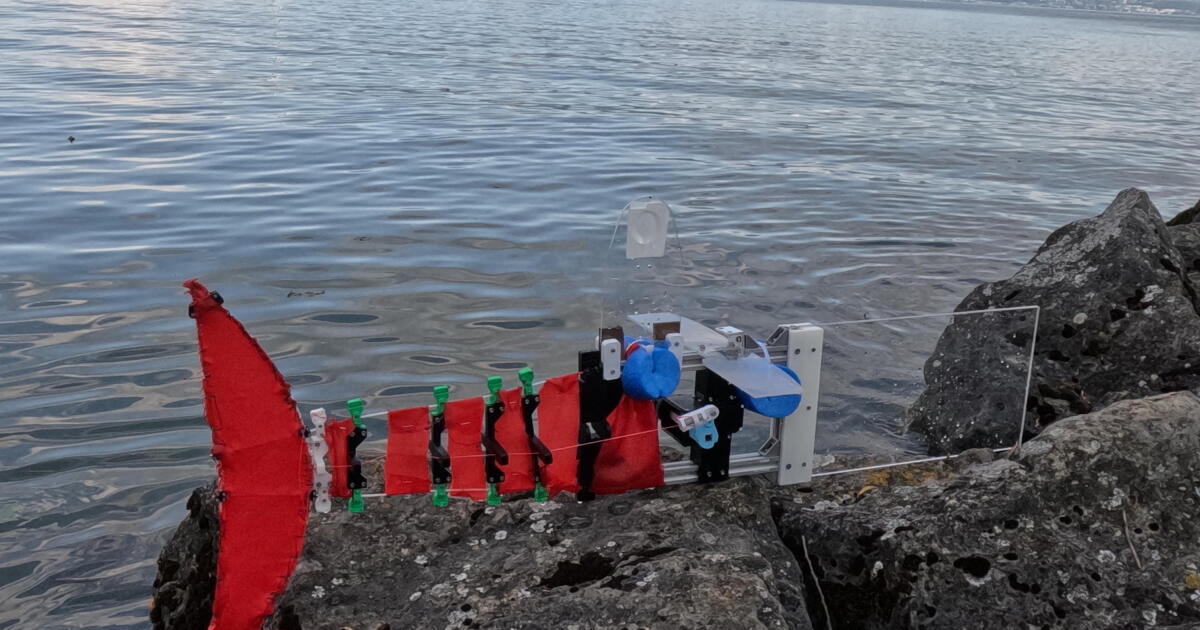
Nature is undoubtedly the smartest engineer. Scientists have borrowed ideas from armadillos, elephants and birds to build robots capable of doing things that conventional man-made machines struggle with. Now, researchers at New York University’s Tandon School of Engineering have turned to fish.
They built a robotic device called ScaFi that looks and moves like a fish, but this design isn’t just about looking cool.
Underwater robots are widely used to explore water bodies, map the seafloor, monitor coral reefs, measure water quality, and study aquatic animals. Traditionally, many of these devices have relied on propellers, which cause some issues. Spinning blades get tangled in vegetation, stir up sediment, and simply scare away the fish researchers are trying to observe.
ScaFi takes a different approach.
Instead of pushing through the water with a propeller, it moves forward by bending its body – just like a real fish. All the electronics and motor sit in the front section of the robot. Its flexible tail is made of fiberglass rods and fabric. A single motor pulls two tendons that cross near the end of the tail.
As the motor pulls the tendons, the tail bends into an S-shape, creating the side-to-side motion that quietly moves the whole device forward. We’ve seen similar functionality in devices such as the Tunabot and the BIOSwimmer.
ScaFi, a robotic fish
That’s not even the most innovative feature, however: the robot can also be easily scaled up or down in size without having to be completely rebuilt from scratch.
Why is that important? Water bodies that researchers need to explore are all different sizes and depths. As you can imagine, a robot designed for a shallow creek isn’t going to be very effective in a deep lake. Making an underwater robot bigger or smaller typically means redesigning the whole thing pretty much from scratch. But there has to be a more efficient way of doing it, and that’s what ScaFi is designed to address.
The clever part is that the base of ScaFi – motor and cross-tendon mechanism – stays the same regardless of the robot’s size. The only thing that needs to change is the diameter of the rods that form the tail. Basically, instead of reinventing the entire robot, engineers can simply attach its main part to a tail of different sizes and lengths.
The team built three versions of ScaFi – 0.6, 1.1, and 2.9 meters long (1.2, 3.6 and 9.5 ft). Then they took the prototypes into real water: the smallest robot swam in creeks 15 to 30 cm (5.9 to 11.8 in) deep, the medium-sized one was tested in a Swiss stream, and the largest got to explore Lake Geneva.
The experiments were quite successful, but they also raised new questions by showing that the size affected how the robots move. The smaller ones were more agile, and their swimming patterns were closer to those of real fish. The largest robot was less agile and, predictably, less energy-efficient. It needed a more powerful motor, but it also proved to be more stable in currents.
Overall, the swimming motion scaled up pretty well, and all three robots managed to keep swimming even after a GPS dropout.
The same approach could potentially be applied to other robots, not just those designed for underwater exploration. The next big challenge to solve is keeping them equally energy-efficient across different sizes.
Source: New York University

