


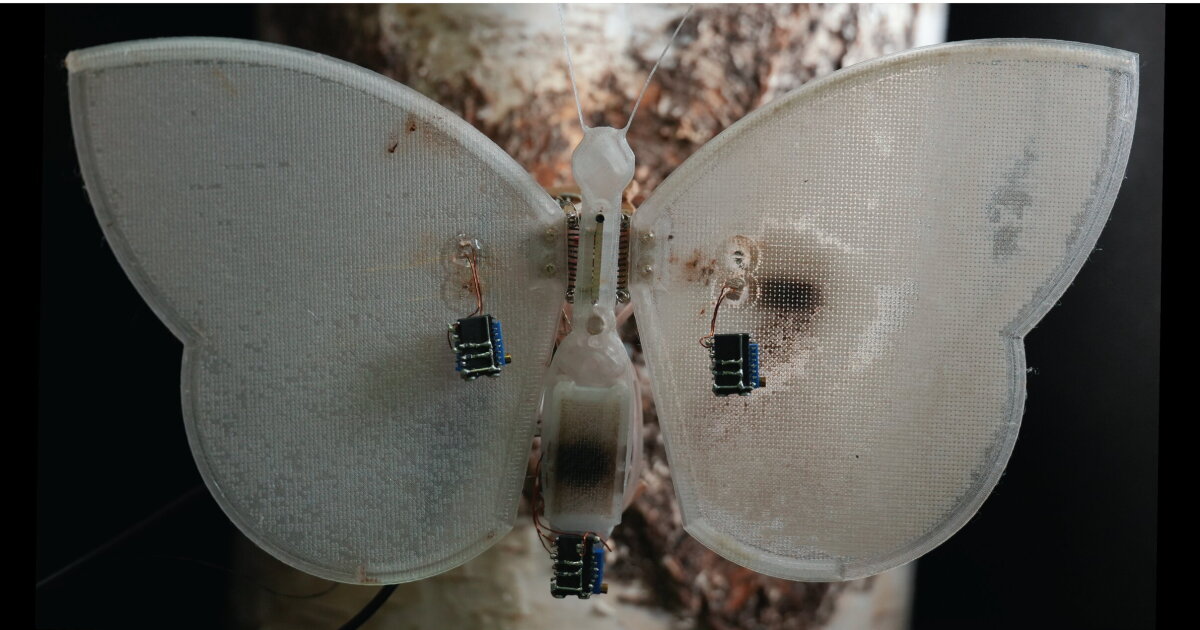
Robots usually leave the factory with every sensor they’ll ever have bolted on. But what if they could grow new ones when needed? Scientists have now built a moth-shaped robot that uses chemicals in its artificial blood to do just that.
Software can change how a robot uses its hardware, but it can’t add a sensor that isn’t there. This robo-moth can. Built by engineers at the University of Tartu in Estonia and the Italian Institute of Technology (IIT), it carries chemicals in its artificial blood that soak into its 3D-printed body when the team shines ultraviolet light on it, turning that patch of plastic into a brand-new sensor.
That kind of self-construction is pretty useful when robots are sent where nobody can predict what they’ll need, from collapsed buildings to other planets.
“You can, of course, use a ready-made photodiode, but you’d have to know quite precisely where to put it,” says Kadri-Ann Pankratov, a PhD student at the University of Tartu and first author of the study published in Advanced Science. “Growing the receptor on site means the environment itself can pattern the robot, based on what is actually happening at that time.”
The moth’s body is 3D-printed from see-through plastic and laced with tiny veins. A small pump pushes about 3 ml (0.1 fl oz) of liquid through them, and some of it seeps about a hundredth of a millimeter into the surrounding plastic. That liquid carries pyrrole, a chemical that turns into an electrically conductive plastic called polypyrrole when it’s hit by UV light, with help from a light-activated additive. Using a stencil, the team picked which patch of the wing to light up, and that patch turned black.
Kadri-Ann Pankratov, Leonid Zinatullin, Hans Priks, Adele Metsniit, Urmas Johanson, Tarmo Tamm, Alvo Aabloo, Edoardo Sinibaldi, Indrek Must
Gold wires threaded through the body when it was printed pick up the change, so the robot grows the sensing material, not the wiring. From then on, whenever UV light hits the patch, its electrical resistance drops for a moment, and a small onboard chip responds by blinking an LED or flapping the wings.
The sensor still worked after four months in storage, and it grew more sensitive with every exposure as leftover pyrrole went on reacting, although it takes about five minutes to settle back after each flash of UV.
Still, the robo-moth is just a prototype, and it comes with a set of limitations that keep it far from the real world, at least for now. It can’t fly, and its wings are bent by a wire of nitinol, a shape-memory alloy heated by an external power supply. Powering the wings with batteries would be doable, but the real benefit would come from energy stored in the blood itself, Pankratov told me by email. The team has run initial tests to power the onboard microprocessor from reagents in the fluid.
The paper also notes that the researchers, not the robot, decided when to fill the veins, and a stencil they set, not the surroundings, decided where the sensor formed. The reaction can’t be undone either.
According to Pankratov, the real limit isn’t how many sensors the moth can grow, but how much of its body both the fluid and the light can reach. Fresh precursors can be pumped in through the veins, and one day they might be partly gathered from the environment.
Robots that have the ability to build or mend parts of themselves have been around for quite a while. In 2022, Cornell engineers showed a soft robot with optical sensors that detected damage and healed itself, and IIT’s FiloBot 3D-prints its own body as it climbs. In 2025, Cornell’s robot blood also stored energy for soft jellyfish and worm bots.
The Tartu moth uses its circulation to add a function it never had. The same veins could carry other chemicals, possibly reversible ones. “The benefit of having an on-board circulatory system would be that it can indeed be flushed and reused with the same mixture or something different entirely,” explains Pankratov. That may be necessary outside the lab. “In 10 years, I hope artificial robot blood and circulatory systems will be an obvious choice for some applications, with several material systems as the state-of-the-art setup.”
You can watch the robot’s circulatory system at work, and see it flap its wings in response to UV light, in videos released by the team.
Source: Estonian Research Council via EurekAlert

