


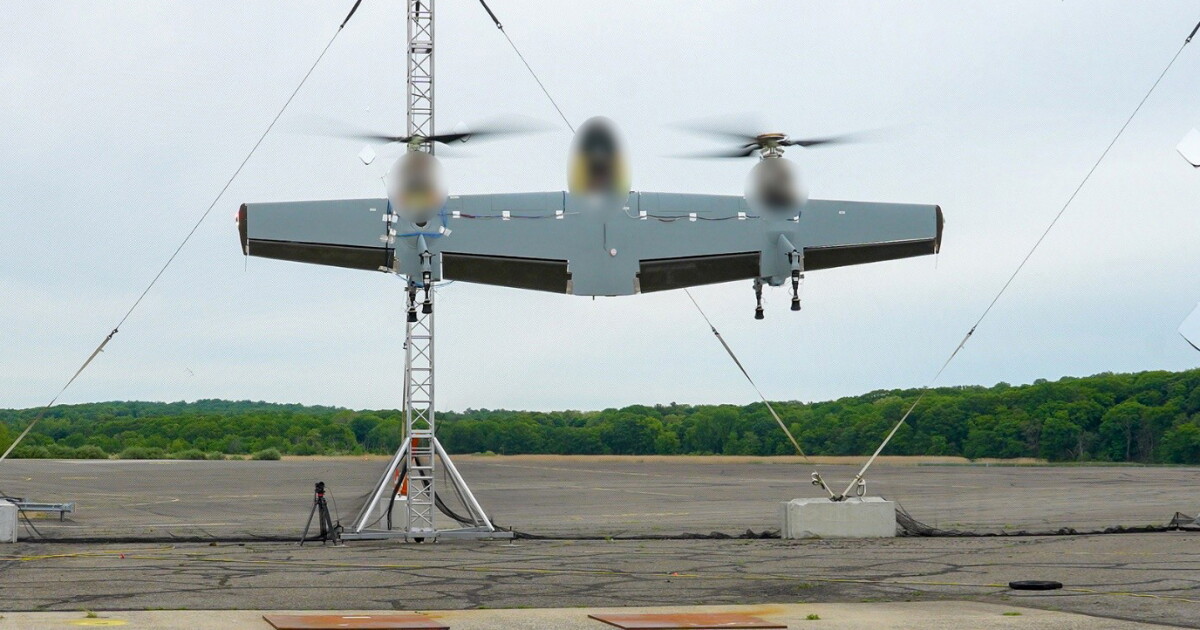
A radically new concept in VTOL aircraft design has made its debut with the first flight of Sikorsky’s Nomad 100 rotor-blown wing prototype. Announced during the Farnborough International Airshow, the milestone marks the official takeoff of the Nomad family.
Developed by Lockheed Martin subsidiary Sikorsky under DARPA’s Early VTOL Aircraft Demonstration (EVADE) program, Nomad is intended to bridge the gap between fixed-wing and rotorcraft using the blown-wing principle to deliver the best of both worlds.
VTOL capability offers obvious advantages – most notably the ability to operate from constrained spaces like ship decks or open fields that lack anything in the way of runway facilities.
Unfortunately, there are some pretty heavy trade offs that come with being able to take off and land vertically, including penalties in terms of speed, payload, and range compared to fixed-wing craft, which can carry more while traveling faster and farther. But they also need runways or, in the case of drones, catapults and recovery nets.
A rotor-blown wing overcomes these limits by using proprotors to force air over the wings to generate lift during vertical flight, hover, and transition into forward flight. Once flying level, it enjoys the payload, speed, and range benefits of a fixed-wing craft.
The Nomad 100 serves as the prototype for a scalable family of autonomous drones, ranging in size up to the equivalent of a Black Hawk helicopter. These are designed to be used for various military applications, including reconnaissance, maritime patrol, light attack, and resupply.
The initial flight test validated the rotor-blown wing configuration, demonstrated runway-independent operation in unprepared areas, and proved the ability of the autonomous MATRIX onboard system to manage flight dynamics—allowing operators to focus entirely on mission execution.
The purpose of the first flight was to validate the rotor-blown wing configuration, demonstrate the ability to take off from and land on unprepared areas without specialized support equipment, and prove the ability of the autonomous MATRIX onboard systems to manage complex flight dynamics – allowing the remote pilot to concentrate on mission operations.
“Nomad 100’s ongoing flight testing reflects our commitment to advancing autonomous technology while delivering safe and reliable mission capabilities that equip customers to fill critical operational gaps,” said Rich Benton, vice president and general manager, Sikorsky. “Nomad will serve as part of a crewed-uncrewed team complementing missions anywhere from austere forward operating bases to ship decks and unimproved landing zones.”
Source: Lockheed Martin

