


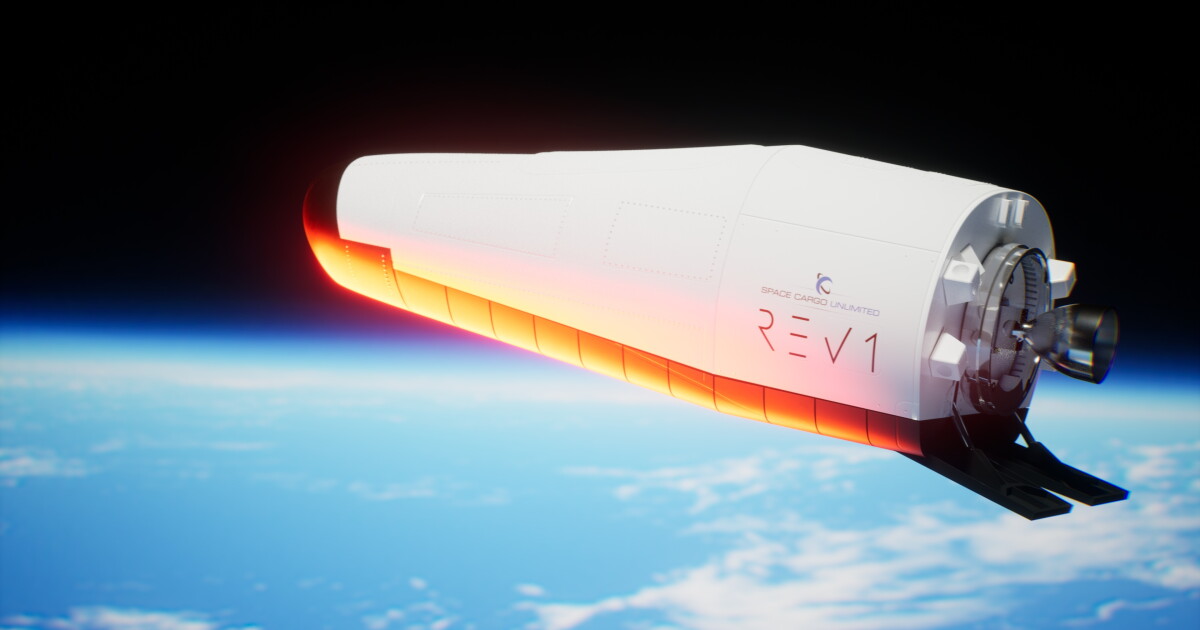
Like their counterparts on Earth, factories in space need a reliable delivery system. Whatever products they make in orbit will have to survive the trip home, and the vehicle carrying them should be able to go back and forth without ending as a streak of light in the upper atmosphere. Now, Luxembourg-based Space Cargo Unlimited (SCU) wants to do exactly that with REV1, a reusable orbital factory designed to bring about 2,200 lb (1 tonne) of cargo back to Earth, then fly again.
But why bother going all the way to space to fabricate things? Without gravity, warm fluid doesn’t rise and heavier particles don’t sink, so crystals and materials can grow more evenly.
Drugmaker Merck has already put that idea to the test. In a 2019 paper, its researchers reported that crystals of the cancer drug Keytruda (pembrolizumab) grown aboard the International Space Station came out all roughly the same size, about 39 micrometers across. Grown on Earth, they split into two sizes, around 13 and 102 micrometers. Merck then used those findings to grow similar crystals back in its labs.
That’s exactly the kind of customer SCU is after. The company says about 40% of the more than 150 customers and prospects it’s talking to work in life sciences and biotech, with the rest in advanced materials and semiconductors.
Space Cargo Unlimited
SCU unveiled a full-size development model of REV1 at Space Tech Expo Europe in Bremen, Germany. Co-developed with Thales Alenia Space, the vehicle is designed for 42 cu ft (1,200 L) of pressurized space, 2.5 kW of shared continuous power and missions lasting from a few weeks to six months. CTO Achim Schwarzwälder said that the spacecraft will weigh about 8,160 lb (3.7 tonnes) and should fly around 20 times.
REV1 has two parts. An Orbital Module stays up and supplies power and services, while a Re-entry Module brings the payloads down to be retrieved, refurbished and flown again.
SCU says the hardware unveiled in Bremen will help engineers develop the vehicle’s active thermal systems. And Thales Alenia Space is already manufacturing the mechanisms that will slot SCU’s payload system into the structure.
The factory itself is SCU’s own BentoBox, a standardized, modular box that handles power, data, temperature and pressure for the experiments inside, and is designed to let customers watch and tweak their processes in real time.

Space Cargo Unlimited
Today’s version of BentoBox carries up to 220 lb (100 kg) in 8.5 cu ft (240 L) with 100 W of power. The box is designed to travel on any available vehicle, so it should reach space before REV1 does. Its first ride will be inside ATMOS’s Phoenix 2.1 capsule in 2027, then in a 2,200-lb (1-tonne) version aboard SpaceX’s Starfall reentry vehicle no earlier than 2028, and, last on the list so far, on MaiaSpace’s first commercial launch.
SCU isn’t the only one trying to build factories far above our heads. In the US, Varda Space Industries, which launched what we called the world’s first space factory in 2023, has already brought eight of its capsules back to Earth. Those are small, though, and single-use. REV1 is designed for a much bigger load, and to last up to 20 trips.
But the company still has a long way to go. Back in 2022, SCU said REV1 would start operating in late 2025. Now it’s targeting flight readiness in 2030, “subject to development and qualification milestones.” The company hasn’t picked a launcher yet, and how REV1 will touch down is still unclear, although its website mentions a runway landing.
Also, the business itself is still up in the air, but only figuratively speaking. “I can say very confidently that there are no products that are manufactured in space that are sitting back down on the ground that you or I could go buy,” Varda’s Eric Lasker told Aerospace America last year.
SCU, which has raised €40 million so far, doesn’t pretend otherwise. “Our ambition is to bring space closer to industry and, ultimately, create value for the customers of our customers,” said CEO Nicolas Gaume. “We know how hard that is, and we approach it with humility and determination.”
Source: Space Cargo Unlimited

