


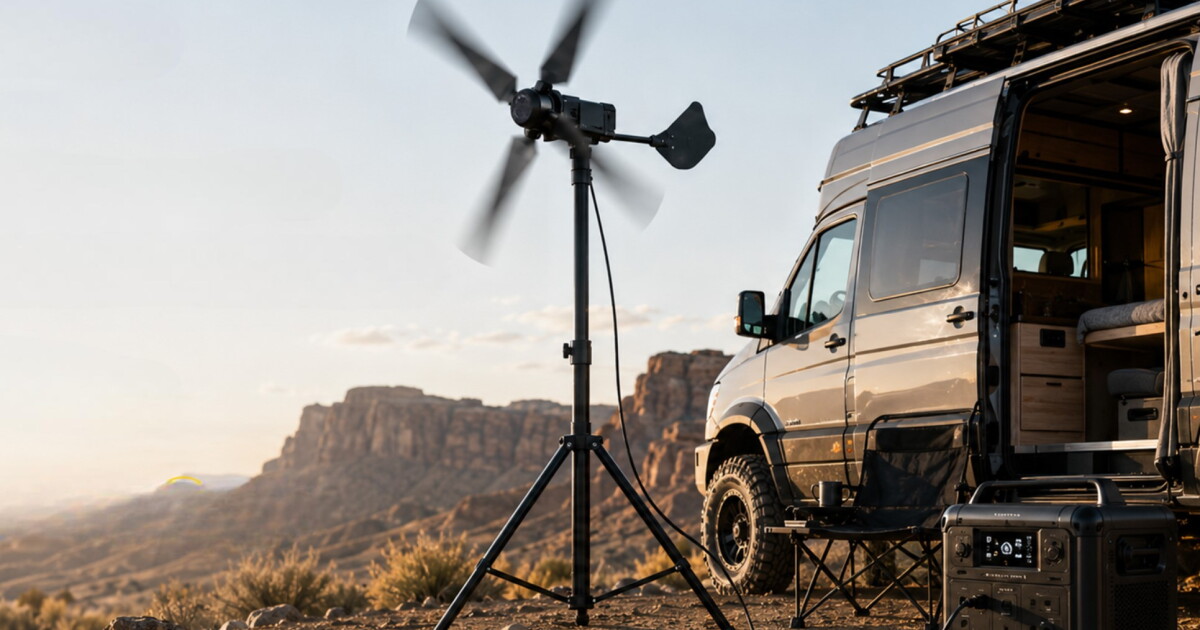
Portable solar panels have long been a favorite of the off-grid camping and backpacking community. They are light, silent, and increasingly efficient.
But solar power has an obvious, inescapable weakness: it requires the sun. When night falls, cloud cover rolls in or you are camping in wintry conditions, your solar array becomes as useful as a high-tech paperweight.
A new Denver-based startup called Ventyra is aiming to solve this solar gap by looking to the skies for a different energy resource. The company has launched a crowdfunding campaign for the Ventyra R1: a compact, ultra-portable wind power system designed for weight-conscious adventurers.
VENTYRA R1 — Portable Wind Power System for Off-Grid Freedom
Small-scale wind generators are not a completely new idea but they have traditionally been bigger units that are more likely to be for marine installations or off-grid cabins. Trying to hike with one of these turbines usually meant lugging around heavy mounting poles and complex external charge controllers.
Ventyra has scaled the hardware down to true backpacking proportions. The full kit weighs just 2.2 lb (1 kg). The foldable tripod and four-blade turbine collapse down to fit inside a standard multi-day hiking pack.
Rather than requiring you to completely detach the blades or assemble the rotor head using screws or tools in the field, the R1 uses a clever flexible four-blade geometry. The blades fold inward, flat alongside the main generator housing, minimizing the risk of losing small components in the backcountry.
Ventyra/Kickstarter
When packing up, the legs collapse parallel to the main body, so the entire unit forms a slim profile that slides into the side pocket or main compartment of a standard backpack. To deploy the R1 system, you unfold the tripod legs, set the unit onto stable ground and open the turbine blades until they click into their operational configuration. The turbine automatically finds the optimum direction to face to harness the wind.
Despite the small size, the R1 claims respectable 75-W peak power output. It sends its generated electricity via a XT60 cable into a power hub (not supplied) with standard USB ports, allowing users to plug electronics, power banks and headlamps into the system.
The turbine boasts an exceptionally low start-up wind speed. It cuts in at just 6.7 mph (3 m/s), which is a gentle breeze that merely rustles leaves. You don’t need to stand on a stormy coastal cliff to start trickling power back into your devices. If you did stand it some serious wind, however, the structure and its supports look a little flimsy. We suspect that a gale would send the lightweight device off on its own windborne adventures.
The R1 joins a sparse but competitive niche of portable wind tech that we’ve covered over the years, like the Micro Wind Turbine from way back in 2016, the Wind Catcher, and the much more recent Shine 2.0. The R1’s backpacking ethos, weight and output stand comparative to any of them.

Ventyra/Kickstarter
However, engineers have raised a few worries. The R1 currently lacks waterproof certification. In fact, the creators recommend dismantling it during heavy downpours to keep the powerhub entirely dry.
An extra problem might be that the real-world ground wind is very turbulent. Achieving a steady 50-W output generally requires a more consistent high-altitude airflow that the tiny ground-level camping tripod might rarely encounter.
This appears to be Ventyra’s first product. The creators describe themselves as a group of designers, engineers and outdoor explorers trying to make clean energy highly portable for everyday backcountry adventures.
Hardware startups like this frequently face supply chain and manufacturing delays before their first batch ships.
The R1 has recently gone live on Kickstarter, where pledge levels currently start at US$179 – representing a 40% saving on the expected retail price. Crowdfunding campaign always carry and element of risk, but the campaign page shows pre-production testing in progress and a working prototype in action. The project is already fully funded, and if all goes to plan, shipping is estimated to start from December.
Source: Kickstarter
Note: New Atlas may earn commission from purchases made via links

