


It’ll likely be a while before we have humanoid robots taking over our household chores, but what you can count on sooner is seeing more robots in industrial settings, like factories and warehouses.
Robots already move pallets and bins of goods across warehouse floors, replacing forklifts. There are also articulated arms involved in packaging tasks, and even assembly operations.
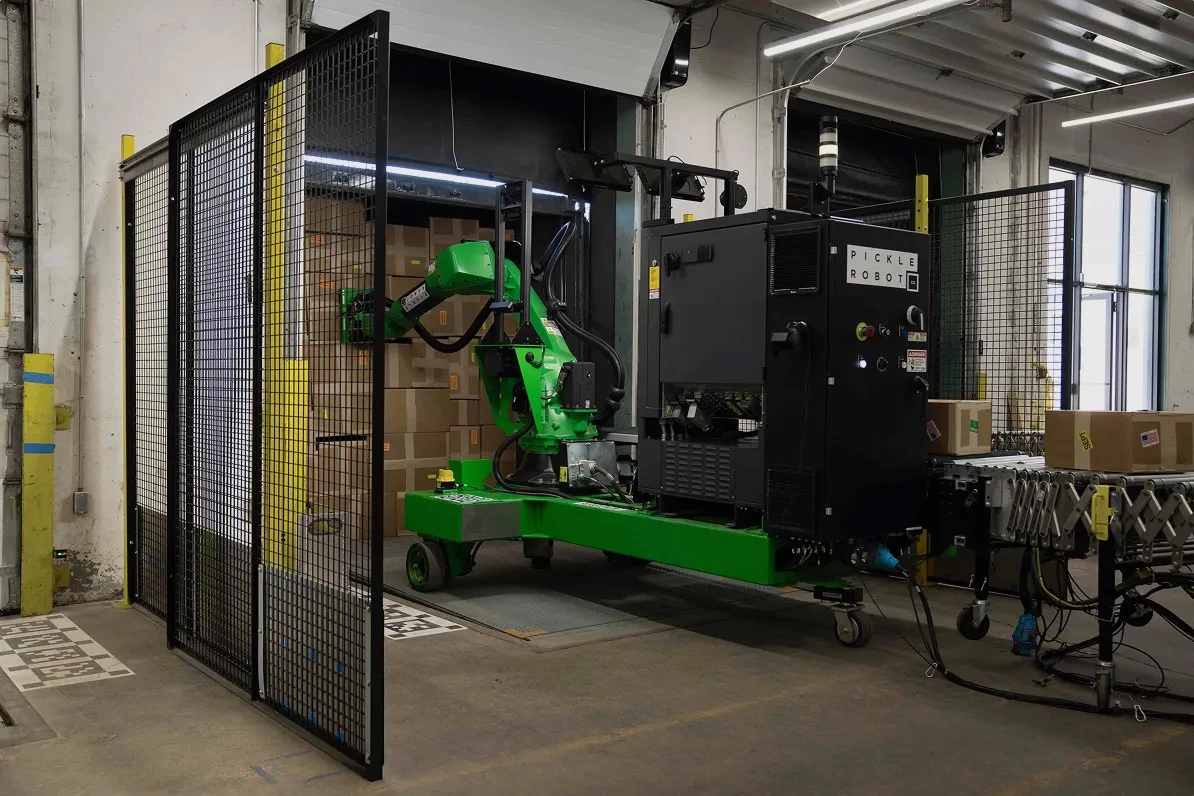
A startup founded by Massachusetts Institute of Technology (MIT) alumni wants these bots to do some heavy lifting, literally. Pickle Robot Company’s robot systems feature AI smarts, cameras, sensors, and enormous single-armed machines to unload shipping containers filled with cases weighing up to 50 lb (22.5 kg) each.
A Day in the Life at Pickle Robot
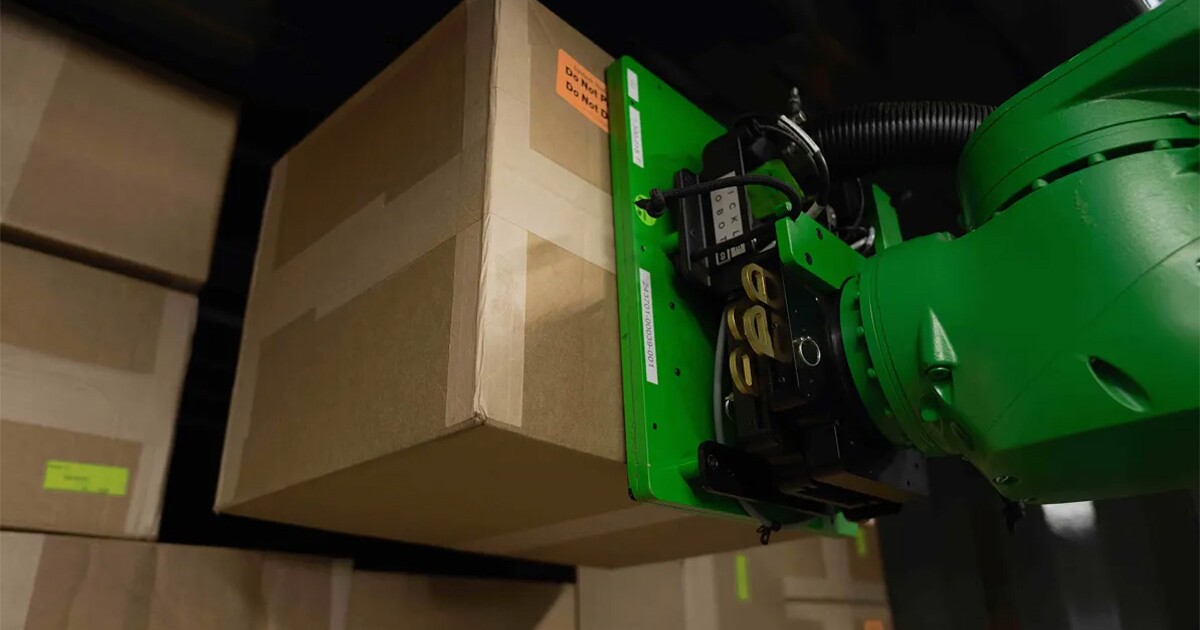
What’s interesting about these robots is how they operate: instead of grabbing boxes with pincers that might damage their contents, Pickle’s robot arms are fitted with a high-contact-area pneumatic-suction system to securely grip cases of different sizes from a container or truck, and place them safely onto a conveyor belt.
That allows the robot arm to handle packages ranging from 5-in (13-cm) cubes to 24 x 30-in (61 x 76-cm) boxes, and unload as many as 1,500 of them per hour. And its vacuum-powered gripping system allows it to grasp packages located anywhere in a shipping container, even those near the ceiling or close to the container walls. It’s been in the works for several years now, so Pickle has had time to work out the kinks in how the robot functions and how much human oversight it requires.
Pickle Robot Company
The idea is to negate the need to involve workers in repetitive tasks, which can get exhausting in warm weather, and lead to injuries and high employee turnover. A typical shipping container holds between 800-1,200 cases each, and that can be draining and difficult even for experienced workers. The AI powering Pickle robots works with an array of sensors and cameras to tackle complex loading paths, and also to develop custom models for customers’ specific needs.
The leadership team at Pickle includes folks who were behind Google’s attempt at building a modular smartphone, and the Charlestown, Massachusetts-based firm has grown to 130 employees since it was founded in 2018. Its primary offering is the aforementioned customized US$30,000 robot arm from German firm Kuka, along with a steel frame to support it, the camera and sensor suite, and software to manage the robot’s operations.
Pickle Robot Company
Pickle says it’s already working with the likes of UPS, Yusen Logistics, and Randa Apparel; one of its robots has been at work in the lattermost’s fulfillment center since mid-October, and has unloaded more than 1.5 million lb (0.7 million kg) of packaged clothing and accessories.
Having closed a $50 million Series B funding round last November, the company’s next moves involve building out a software platform to integrate with third-party hardware like humanoid robots and self-driving forklifts, and to develop a two-armed robot thereafter.
Source: MIT News

