


After reviewing Oukitel’s insane 20,000-mAh WP61 Plus monster of a phone a few months ago, I kind of knew what to expect: something huge. The WP61 made my Samsung Galaxy S22 feel like a saltine cracker.
Recently, Oukitel sent over two new rugged phones for me to tinker with: the WP68 Air and WP500 Ultra. While I wouldn’t exactly call them dainty, both feel like steps towards something actually pocketable and useful for daily normal use. Not just worksite beaters. Plus, neither one has made my wrists hurt.
The WP68 Air is the “slim” version, a rugged phone with an 8,000-mAh battery and an infrared night vision camera. The WP500 Ultra is the thicker, heavier beast – it still packs a walloping 10,000-mAh battery – but instead of an IR camera, it has a totally legit thermal camera. And both will fit in your pocket without needing a belt to keep your pants up.
JS @ New Atlas
Per usual, before I started playing with either phone, I routed them through a local DNS query logger on my Raspberry Pi (tin-foil hat and all) to watch how often they “phone home” (or elsewhere). I like knowing what’s happening on the back end.
The good news: compared with the WP61 Plus that I recently reviewed (which was addled with bloatware linking back to the motherland), the WP500 Ultra and the WP68 Air were pretty quiet. Oddly quiet, in fact.
I still saw the usual Android/Google noise … and there’s a lot of it – one could even go so far as to say that Google is the one spying on us the most, and not be wrong … but I didn’t see the same weird and unnecessary app traffic that made the WP61 feel like it was working for the Chinese version of the KGB. So little, in fact, that I didn’t even root the phone to rip out a bunch of suspect “warez” like I had to do with the WP61. They both seem to be running on mostly straight-up Android 16 with only a few extra “tools” apps, like a plumb bob, level, protractor, and even a decibel reader. Stuff I’d actually use!
Also peculiar, they each have slightly different launchers. I’m not sure why Oukitel made that decision. For example, the WP68 Air doesn’t have an app drawer. Like, at all. Anything and everything that’s installed on the phone is on your home screen(s), like it or not. The WP500 has an app drawer. Either way, I tend to not stick with stock launchers anyway. I prefer Nova Prime. So that’s an easy fix.
Oukitel WP68 Air:
The WP68 Air is the smaller, lighter of the two. And by smaller, basically only the thickness. “Air” is only “Air” relatively, as it’s considerably larger than my S22. Even the iPhone 17 Pro Max isn’t as big. The WP68 Air is a 309.5-g rugged phone measuring 7.02 × 3.28 × 0.47 inches (178.4 x 83.2 x 11.9 mm). That isn’t small … but compared with the WP61 Plus, I’d feel comfortable calling it “Air.” It, like the WP500 Ultra, even comes with its own clear plastic case.

JS @ New Atlas
The headliner specs on it are an 8,000-mAh battery, 45-W fast-charging, a MediaTek Dimensity 7025 CPU, 12 GB of RAM, 512 GB of internal storage, and microSD expansion up to 2 TB. That’s a solid load for an everyday carry. It’s not “flagship” fast, but it was fast enough for normal phone stuff: web, YouTube, maps, messaging, email. It does get a little stuttery when trying to watch 4K-quality video, though. Mind you, the screen isn’t even 4K.
Aside from the CPU, the screen is where the corners have been cut to allow such an affordable price point. It’s ginormous at 6.88 inches, and sure, it runs at 120 Hz, but it’s only 720 x 1640 with a listed 450-nit typical brightness. Again, not exactly flagship territory. If you’re coming from an AMOLED Samsung like I am, you’ll definitely notice the difference, but even so, it’s not a deal-breaker.

JS @ New Atlas
Camera-wise, the WP68 Air gives you a 64-MP main camera, a 32-MP selfie camera, an 8-MP IR night-vision camera, and a 2-MP macro camera. The IR camera is the fun one. It’s not a thermal camera like the WP500, but it legit sees in the dark using IR, but only about 10 feet (3 m) out, so don’t expect to see what it is in the bushes at the edge of your campsite making that scary, scary noise. You’ll have to wait until it’s almost at your tent before you’ll see it in the pitch black. That being said, the image quality on all the cameras is lacking for someone like me, who made a living for nearly twenty years taking photos.
Oukitel WP500 Ultra:
The WP500 Ultra is the one I keep picking up, and honestly, I’ve considered making it my daily … I’ll get to why I haven’t in a minute.
It’s still a brick, period, but not brick enough to fight off bears in the woods like the WP61. It weighs 414.3 g and measures 6.98 × 3.25 × 0.90 inches (177.2 x 82.6 x 22.9 mm), which means it’s probably not for you if you wear skinny jeans. That being said, if you’re a cargo pants kinda person, it’s totally manageable. Slightly unwieldy, but like I mentioned before, my wrists don’t hurt using it. Although I’m a one-handed phone user and Swype with just my right thumb and the weight of the phone does dig into my pinky after a while.

JS @ New Atlas
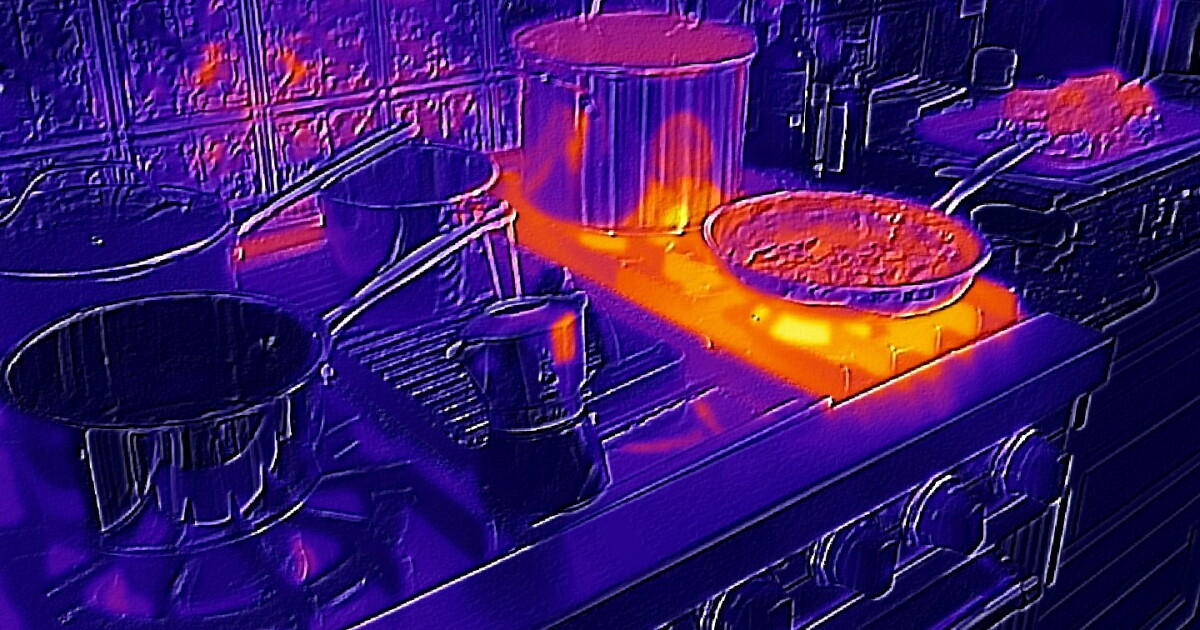
The WP500 Ultra has a 640 × 512 px thermal camera. Not IR, not monochrome, but an actual thermal imaging camera. There’s a ton of work-like uses for thermal, but outside of work, thermal is just fun. It has a million parameters that you can set for temperature and things I don’t fully understand, but the gist is that it’s relative thermal, meaning, if you have something really hot (like a stove being used for cooking), it’ll show the hottest objects in proper yellow/red/white hot, and everything else around it as cold blue.
Flip around and point it at the cook, and it’ll show them hot. When I cruised around my house with it, stuff like my Ecobee thermostat would show up warm against a cool wall, or at my desk, my USB hub and laptop fan ports would show up hot, relative to everything else. It’s pretty fun, and also kind of enlightening. I didn’t realize my USB hub ran warm … I touched it right after, and sure enough, it was. It’ll even register your handprints on a cold surface. That’s neat.

JS @ New Atlas
For actual work duty, thermal means checking AC vents, electrical panels, chargers, window leaks, roof/attic hot spots, garage/shop equipment, and whatever else you may have never realized could be hot. Cars, bikes, tools, batteries, it’s actually rather useful. And fun.
Spec-wise, the Ultra has a little more juice than the Air, with a MediaTek Dimensity 8300, 12 GB of RAM, 1 TB of storage, a 10,000-mAh battery, 45-W fast-charging, a 6.78-inch FHD+ 120-Hz display, a 108-MP main camera, Android 16, is IP69K, and MIL-STD-810H. There’s also a physical switch on the side dubbed “privacy” that kills GPS, camera, and mic all at once. WP500 Ultra Tin Foil Edition? Maybe.
That privacy switch is either a great idea or blind trust, depending on how many layers of tin are in your foil hat. I am cynical … I have the internet, after all. But I do like the idea. Physical controls for electronic things are always more reassuring than hoping the software does what it says it does.
Like the WP61, the WP500 Ultra also has a camp light that’s pretty dang bright for a phone. I can’t find any lumen numbers, not even from Oukitel’s spec sheets they’ve sent me, but can confirm: it’s bright.

JS @ New Atlas
My thoughts on both:
The fairly inexpensive US$319.99 WP68 Air is for people who want big battery life and rugged durability without needing an exo skeleton to help carry it.
The $849.99 WP500 Ultra is the one for people who want the rugged-phone thing but also want legit tools, more battery life, and trust Oukitel’s privacy switches. But we’re creeping towards flagship pricing with this one.
The WP61 Plus I previously reviewed is the phone you want in an apocalypse, where you could even reverse charge your other stuff. Huge battery, huge light, walkie-talkie, you know, SOS stuff. The WP68 Air and WP500 Ultra are basically birds of a feather, just not as chonky.

JS @ New Atlas
If trying to compare the Oukitels against my Galaxy S22 daily driver that I’ve had for the last 3-4 years, yet struggle to give up (because I’m too cheap to buy a newer Galaxy):
Neither Oukitel wins outright. The S22 is easier to pocket, lighter, snappier (not by much), has a better screen, better cameras, better video, and is fully supported in the Play Store. There are some apps I have on the Samsung that aren’t compatible with the Oukitels.
I would totally switch over to the WP500 Ultra if the camera actually took good images – 108 MP sounds great with its 16 MB file size images if all you know is more MP = more better. But I’m a photographer at heart, and quality photos matter to me. The WP series is adequate, at best, but not up to my standards. If it weren’t for that, I’d switch. But, for the sake of full disclosure, when the Pixel 4 came out, I switched purely because of the camera … and I hated it. That lasted all of a month before I went back to the Galaxy S series.

That being said, the Oukitels absolutely crush my S22 on battery life (and every other phone I’ve had). My S22 has a 3,700-mAh battery. The WP68 Air has 8,000 mAh. The WP500 Ultra has 10,000 mAh. That’s the difference between “My phone is about to die (sad face).” and “I accidentally left my charger in another county, but I’ll be back in a few days, so it’s fine.” Realistically, it’s USB-C, which are a dime a dozen. I was just being hyperbolic.
I can use the Air normally for a solid three days without worrying about charging it. I can use the WP500 for about four. I can use my S22 for about 12 hours before I’m looking to plug it in.
All in all, they’re pretty great if you can get past the camera quality. If that doesn’t matter to you and you want a phone that’ll take a lickin’, will last you days between charges, and has IR or thermal cameras, then they’re tops … if you like orange.
Product pages: WP68 Air and WP500 Ultra
New Atlas may receive commission if you purchase through our links. This does not affect our reviews as our opinions remain our own.

