


We’ve already seen robots that can swim like fish, stick to walls like geckos, and grab objects like elephants. Now, engineers at the University of Washington are building a new type of robot inspired by … the flea.
Why a flea of all insects? Because of the way it jumps.
Most flying insects have to constantly spend energy to stay in the air. Fleas don’t. Instead, they store energy and release it in a powerful jump that can be up to 50 times their body height. This is a very energy-efficient way to move around, and energy-efficiency matters a lot in robotics.
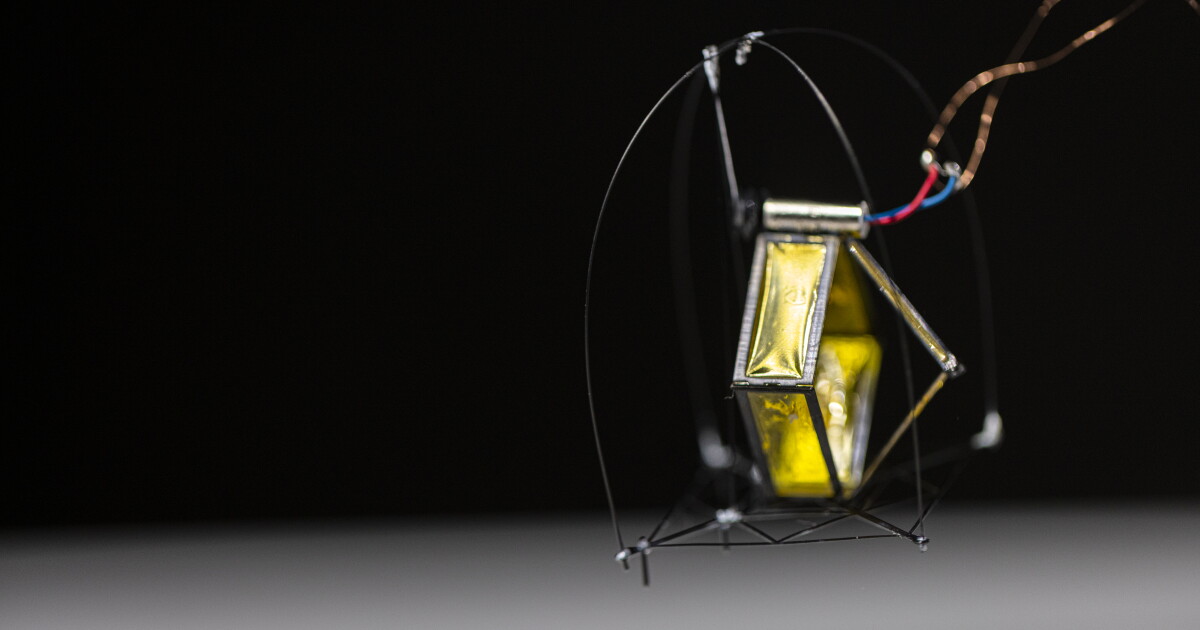
The researchers named their new project DirectHop, which gives away the main idea: it’s a hopping robot. It fits in the palm of a hand, weighs just 1 gram, has a tiny electric motor, three folding legs, and a protective cage. Fitting all of that into such a tiny body sounds complex, but that wasn’t even the hardest part. The real challenge was figuring out how to control the height and the distance of the robot’s jumps.
Mark Stone/University of Washington
Most existing hopping robots use a spring-loading mechanism, which has an “all-or-nothing” problem: they are designed to release a fixed amount of energy, making the height and distance of each jump very difficult to adjust.
DirectHop takes a different approach. By changing the electric current going to its motor, researchers can precisely control how much energy goes into each jump. DirectHop is able to jump higher than a standard stair, which is pretty impressive for a robot its size. But what’s even harder to achieve is actually the opposite: making very small, controlled jumps. The new mechanism can successfully handle those as well.
The interesting part is that the robot doesn’t actually jump by pushing off with its legs like insects or frogs do. Instead of pushing off the ground, the motor essentially pulls the robot upward, with a pulley and two strings helping to launch it.
Once the jumping problem was tackled, the next challenge was landing. As you can imagine, the robot doesn’t always land perfectly on its three feet. That’s where the motor helps again. It shifts the robot’s center of gravity, making it twitch until it rolls back onto its feet.

Mark Stone/University of Washington
The protective cage also helps with awkward landings. It’s made from flexible carbon fiber rods 0.25 mm in diameter. It might not be obvious at first glance, but its curved shape was inspired by box turtles, which can easily roll themselves upright. In lab tests, DirectHop was able to right itself in about 90% of cases.
The current prototype has quite a few limitations. It doesn’t carry its own battery and instead gets power through wires. It also has no sensors to detect how high it needs to jump or determine its own orientation, so it fully relies on human operators.
The research team is already working on improvements, including onboard solar cells and a battery, retractable feet to adjust the jumping angle and minimize bad landings, plus a camera and electronics for navigation. The ultimate goal is to create an independent robot-explorer.
In the future, the researchers estimate that each robot could cost around US$10. Instead of sending one expensive robot to do a job, a swarm of cheaper hopping ones could monitor water and soil, inspect oil refineries, and explore other locations that are difficult to reach.
You can see DirectHop in action here.
Source: University of Washington

