


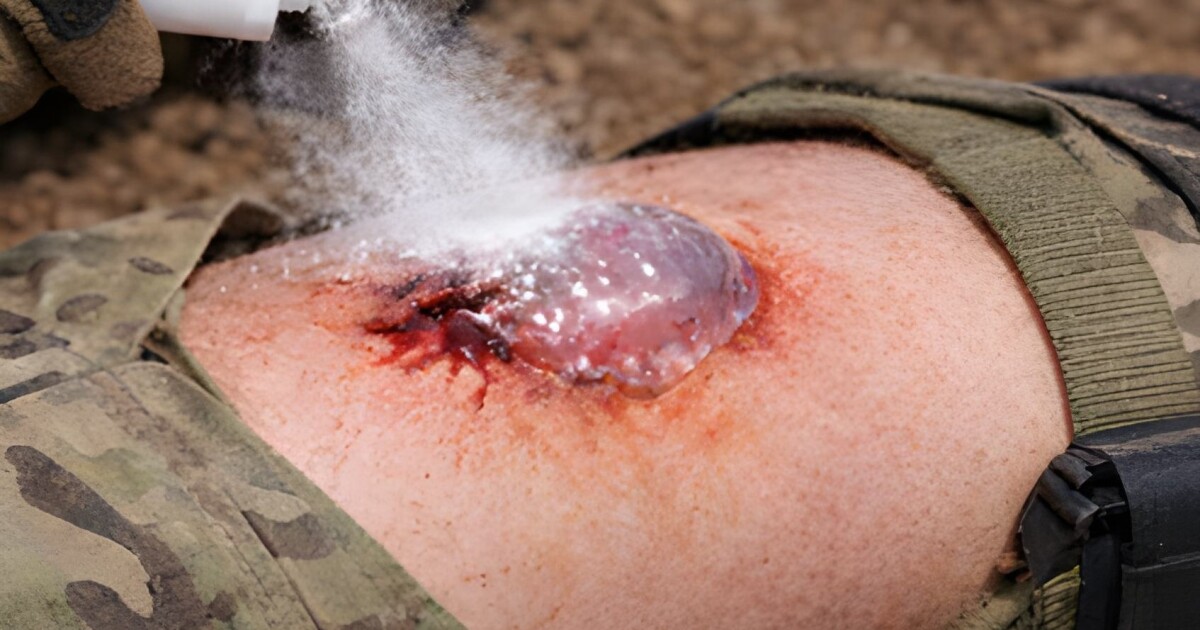
Researchers have developed a spray-on powder that turns into a wound-conforming gel when it comes in contact with blood. The breakthrough has the possibility of dramatically improving wound care in combat and other life-threatening situations.
When soldiers are wounded in battle, stopping visible bleeding is of paramount importance. In fact, bleeding is the leading cause of death in the first few hours after injury, and death from bleeding is the number one cause of potentially survivable deaths in combat situations. Yet stopping a bleed can be trickier than it sounds if the wound is particularly deep or jagged.
Seeking a solution to treating such injuries, researchers at the Korea Advanced Institute of Science and Technology (KAIST), one of whom is an Army Major, developed a powder that reacts with cations (particles with a positive electrical charge) like calcium in blood to turn into a gel state in just one second, sealing even deep and irregular wounds instantly.
The substance is made from three natural ingredients: alginate, a substance extracted from brown seaweed; gellan gum, a natural thickener made from bacteria through fermentation; and chitosan, a powder made from the exoskeletons of crustaceans and insects as well as from fungal cell walls.
The alginate and gellan gum turn from a powder into a gel in the presence of blood immediately upon contact. The chitosan, which has a positive charge, attracts negatively charged red blood cells and platelets, causing them to clump and stop bleeding. The powder has been named with an initialism based on its ingredients plus an “L” indicating a link between them all: AGCL.
The powder’s ingredients also exhibit antibacterial action and showed a cell viability rate of over 99% in animal tests, so it helps with tissue regeneration. Furthermore, when the gel forms, it can hold more than seven times its own weight in blood, which means it can handle even extreme bleeding situations. AGCL can maintain its properties for two years, even when kept at room temperature, and can handle high humidity and other extreme environments well.
In tests using mice, after surgical damage to the liver, AGCL was able to perform significantly better than other current anti-bleeding agents, with normal liver function returning just two weeks after its application.
While primarily developed for treating battlefield wounds, the researchers say that AGCL can naturally be used in standard emergency medicine and surgical applications.
“The core of modern warfare is minimizing the loss of human life,” said Ph.D. candidate and KAIST researcher Kyusoon Park. “I started the research with a sense of mission to save even one more soldier. I hope this technology will be used as a life-saving technology in both national defense and private medical fields.”
The research has been published in the journal Advanced Functional Materials.
Source: KAIST

