


Keeping homes warm in winter is becoming extremely expensive, and many existing methods aren’t always efficient. In the US alone, tens of millions of people struggle with energy costs and often have to cut back on basic expenses, including food, just to be able to afford heating. With ongoing fossil fuel dependency and climate change, traditional heating methods are not only costly but also environmentally harmful.
Among long-term solutions, replacing windows and doors with better-insulated ones can partially address the issue. However, while this may work for homeowners, it doesn’t make much sense for renters to invest in someone else’s property.
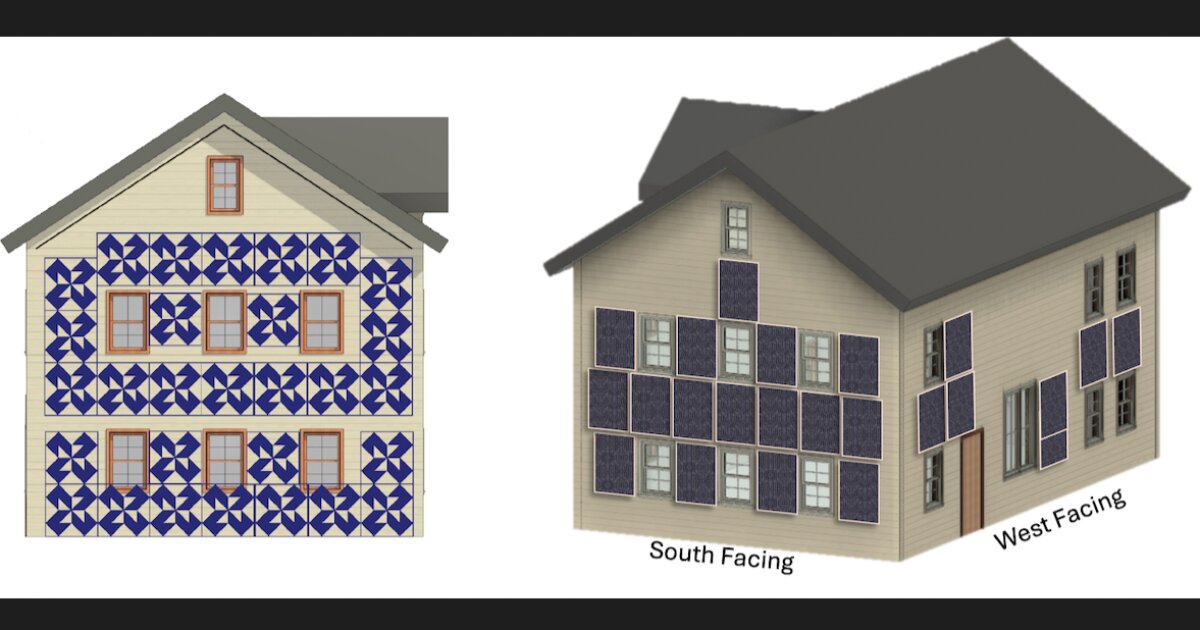
Researchers at the University of Massachusetts Amherst (UMass Amherst) have come up with an unexpected solution. They drew an interesting analogy: what if warming a house could be as simple as wearing a sweater? Based on this idea, they developed a system called a photothermal “skin” for buildings. It basically consists of removable fabric panels that can be attached to the outside walls, and can reportedly increase indoor temperatures by about 4.8 °C (8.64 °F) on average in a day.
The original concept resembled a patchwork blanket, but the team ultimately designed separate detachable panels that are much easier to install.
The key innovation here is a special coating on those panels made from a conductive polymer called PEDOT-Cl. This coating acts like a “photothermal dye” – when sunlight hits it, the material absorbs the light and converts it into heat (similar to what metal does), which then warms up the air inside the building. These coated panels work like an extra layer of clothing for a house and can be applied to pretty much any fabric, even the most inexpensive thin one – something umbrella-like.
Umbrella fabric was actually used in lab testing, and the results were very promising. Heating energy use in residential homes could theoretically be reduced by about 15%, and by up to 23% in large apartment buildings. For comparison, even the most expensive home renovations may only reduce energy costs by approximately 2%.
The final goal for the research team is to mass-produce rolls of this special coated fabric that people could buy at a local hardware store. Using simple materials like 2×4 wooden beams, they could build frames, stretch the fabric over them, and install the panels in a single afternoon as a simple DIY project (well, maybe not that simple, but definitely relatively quick and affordable). Those panels would be lightweight and easily removable, making them especially useful for renters – detach them and take them with you when moving to a new place.
Because the coating essentially behaves like a dye, it can also be designed to blend with different architectural styles to match the aesthetics of a certain area.
This brings us a step closer to a simple and effective solution for lowering heating bills in a sustainable and affordable way. However, before this technology becomes widely available, the scientists still need to conduct more real-world testing and collect data to confirm how well it performs on actual buildings.

