


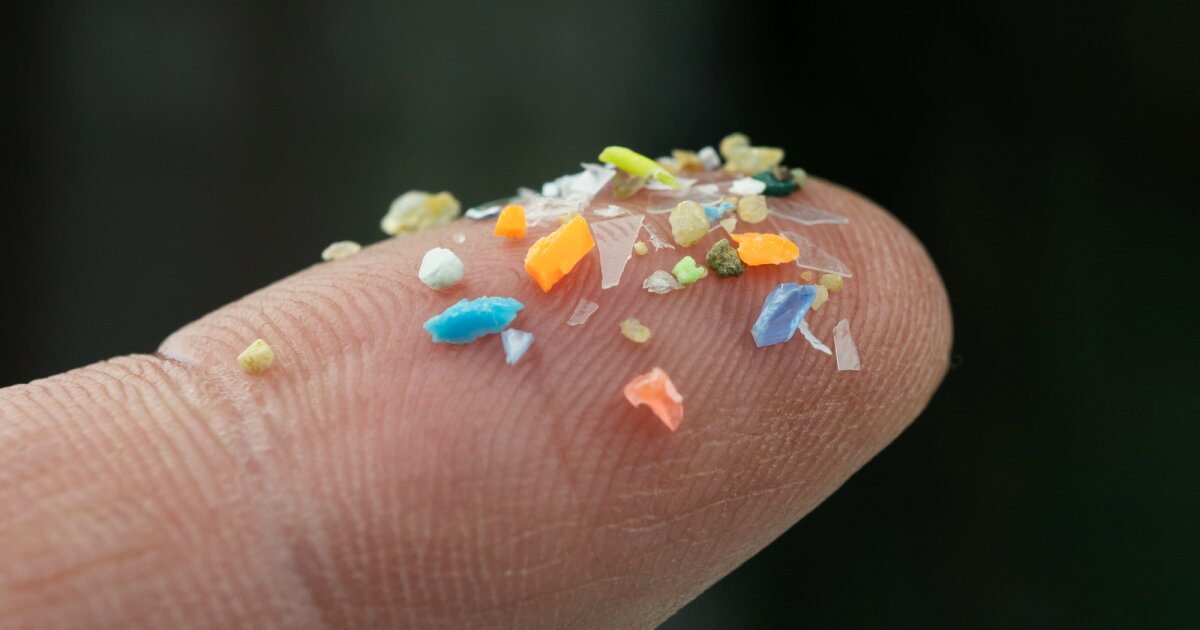
Microplastics are everywhere, visible as small specks in water samples, tissue biopsies, and post-mortem examinations.
Now scientists can actually see them inside living bodies.
Researchers from University College London (UCL), the University of Birmingham, and Kingston University are using a laser-based imaging technique to map these tiny particles deep within the tissues of mice without surgery. This offers a fresh perspective on the movement of microplastics through the body and their long-term effects on human health.
The technique, known as photoacoustic imaging, directs pulses of laser light into tissues. This light is absorbed by microplastics, each of which has a unique absorption fingerprint, and generates tiny high-frequency sound waves. This is detected by ultrasound detectors and used to create a detailed map showing where microplastics are within the body.
In experiments, mice were injected with a controlled amount of microplastics – around half a milligram per experiment, “which to visualize would look like a small shake of very fine salt,” Stephen Patrick, a lecturer in medical imaging at UCL, told Refractor.
Patrick and his team were able to precisely track how the particles moved through living tissue over months rather than days, which more closely resembles their journey in the human body. They could see where the particles accumulate, how long they persist, and whether they contribute to diseases affecting the brain, blood vessels and other organs.
“The method relies on pigments in the microplastics, typically those introduced into consumer plastics to provide a colour,” says Patrick.
Bear et al., Advanced Science, 2026
Black, grey, green, and blue microplastics are most easily detectable, so researchers tested the method on microplastics from standard consumer plastic items “including black biro pen lids (the sort you might chew), and green lids to squash bottles, which have been shown to release microplastics when you twist them on and off the bottle,” Patrick adds.
“If you knew the typical spread of microplastics colours found in the body, then you could more accurately extrapolate the amount there based on the visible fraction.”
The technique can only provide an underestimate for now, and has so far detected common microplastics such as polypropylene, typically found in food containers and coffee cups, and polyethylene, which is found in single-use plastic bags.
There is growing concern over the effect microplastics are having on the human body. They have been found in the blood, organs, and tissues, and have been linked to cancer, heart attacks, and reproductive problems.
But until now, it’s been difficult to study these tiny plastic pieces inside living tissue. Existing methods typically rely on biopsies or analysis of tissue after dissection, but this limits what researchers can observe over time.
The microplastics also need to be chemically labelled, which can change their behaviour and limit how realistically they can be studied. Chemical-based techniques can “confuse fats in the body for microplastics, with high polyethylene content found in brains likely being contaminated from a similar signal from fatty acids,” says Patrick.
“While fats don’t give a photoacoustic signal at the wavelengths we have been using to detect microplastics, we need to do further work to confirm that there are not similar signal-contaminating pigments in the body that could be misinterpreted.”
The new approach has been validated for detecting individual microplastics down to around 45 microns, which is smaller than the width of a typical human hair.
“Below this, we have not yet validated the technique, but current unpublished results suggest these should be detectable (even nanoplastics) at concentrations reported to be found in the body in previous studies (in the order of low mg/mL concentration). For even smaller concentrations, this may be a challenge,” says Patrick.
Patrick believes the accuracy of the technique can be improved with “a few tricks and clever ways of collecting and processing signals,” as the initial work “used a fairly simple set up with minimal image processing so we can definitely go beyond what we have shown so far in terms of detecting small particles, and detecting very small amounts.”
An ideal future clinical study, Patrick says, would validate the photoacoustic measurements against other independent measures, “for example on tissue or biopsy-based analysis in a patient cohort that was expecting to have tissue removed anyway for other procedures related to diagnosis and treatment of specific diseases.”
He said this sort of validation “would be necessary before the technique could be used on its own as a measure of microplastic content in patients.”
Future studies may include the general mechanisms of transport, retention, and clearance throughout the body, and how these depend on microplastics size, shape, and underlying disease, and how this relates to vascular disease and liver cirrhosis.
Neurodegeneration is another area of interest, particularly whether microplastics act as seeding sites for the formation of beta-amyloid or alpha-synuclein protein aggregates associated with Alzheimer’s and Parkinson’s diseases, respectively.
The study has been published in Advanced Science.
Fact-checked by Mike McRae

