


So, you need to inspect pipelines – either because you work for an oil company or you’re an environmental monitor trying to prevent ecological disasters. How do you do it?
Well, you can’t possibly drive or walk the length of a pipeline which could stretch thousands of kilometers, so do you use an airplane? They’re too expensive, not only to build and operate, but even to launch and land because they require lengthy, protected runways. While helicopters and other VTOLs don’t need runways, like airplanes they require expensive crews and fuel. So what are you supposed to do?
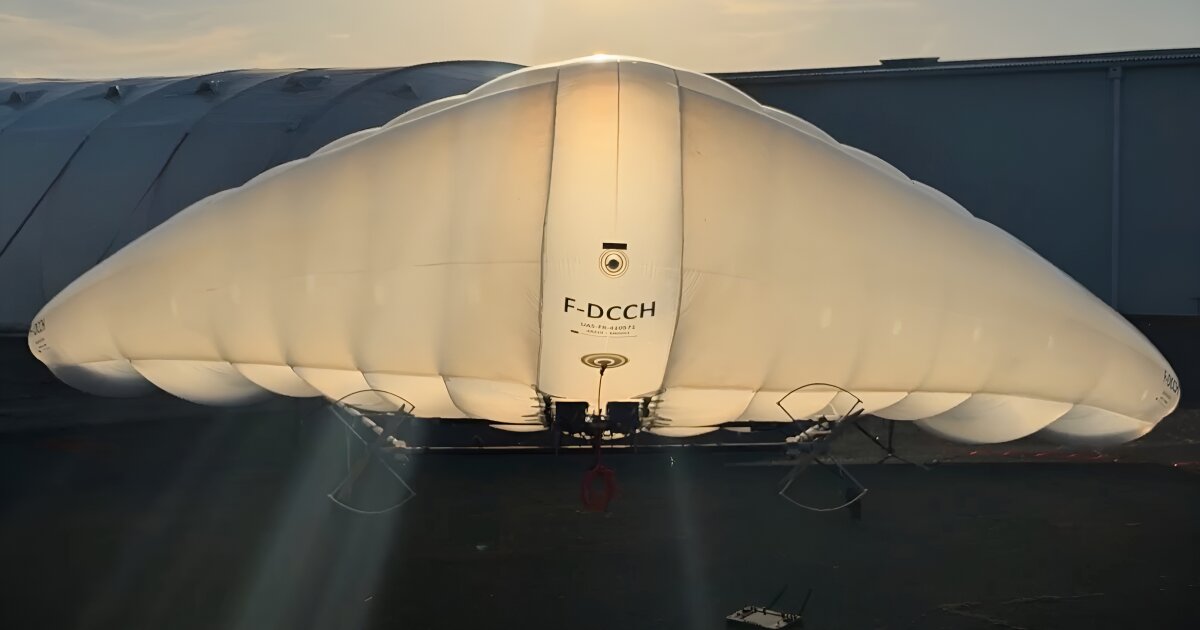
You use a drone. And because you want to save money and harness maximum efficiency, you use an inflatable, fixed-wing drone that combines the looks of a stealth bomber, a hang glider, and the Baymax robot from Big Hero 6.
Celeste Ecoflyers
But why not just use standard, rigid-bodied, propellor-lift VTOL drones? According to French startup Celeste Ecoflyers, rotary systems “trade endurance for convenience.” Furthermore, because the company’s dAS10 is inflatable, users can store it in its convenient flattened form, inflate it quickly without an extensive crew (as this time-lapse video demonstrates), and then launch it for flights that company claims will last hours instead of minutes. The following video from the first launch on May 7th of this year, however, shows only a couple of seconds of lift.
First lift-off of the CELESTE dAS10 prototype – Le Havre, France — 7 May 2026
The dAS10 is the work of Celeste Ecoflyers CEO, founder, engineer, and licensed ULM flight instructor Olivier Manette, who also holds a PhD in Computational Neuroscience. According to Celeste’s homepage, the drone can conduct autonomous flights at a cruising speed between 60 and 80 km/h (37.5 – 50 mph) surpassing 10 hours per sortie, carry payloads up to 5 kg (11 lb), and be effective for low-altitude surveillance and relays. Initial commercial test deployments are scheduled for Q4 of 2026.
Because Manette’s goals for the dAS10 are to make “aerial operations safer, more affordable, and significantly more sustainable,” Celeste Ecoflyers is seeking infrastructure operators as its first customers. Whether those customers operate pipelines or energy grids, Celeste argues that if they need to conduct aerial inspections, the dAS10 will increase efficiency while saving money. Future clients could include logistics operators and those surveilling maritime regions with limited terrestrial infrastructure.

Celeste Ecoflyers
According to Celeste Aero’s website, the “going rate” for a helicopter ride to inspect a pipeline is US$2,500 per hour, not including a pilot, fuel, and lost time for refueling. Other limitations include bad weather and pilot shortage, which cancel as many as 25% of flights. Clearly, the time has arrived for new approaches.
Because the dAS10 is inflatable, laypeople might understandably mistake the drone for a small blimp. However, the company’s official communications bristle at such a description. According to DefenceBlog.com, Celeste Ecoflyers states that “Celeste isn’t a blimp. It’s a fixed-wing aircraft […] Lift is aerodynamic, not buoyancy. What’s pneumatic is the wing structure itself: a pressurized textile envelope replacing the rigid skin and spars, which is what makes the airframe deployable, field-repairable, and gives it an unusual radar signature for an 8-meter platform.”

Celeste Ecoflyers
Although fixed-wing drones aren’t new, Celeste Ecoflyers’ new system arises from a recent convergence of increased crew and compliance costs, new European regulations permitting extended autonomous flights, and improvements in pneumatic structural materials. As the company website says, five years ago, such conditions didn’t exist. Now, because they do, Celeste Ecoflyers may have its own flight path to success.
Source: Celeste Ecoflyers

