


Your mother was wrong. Sorry.
You’re not special. Neither am I. Nor is our planet, our Sun, or our galaxy. The cosmological principle is clear – the entire Universe is more or less the same in all directions.
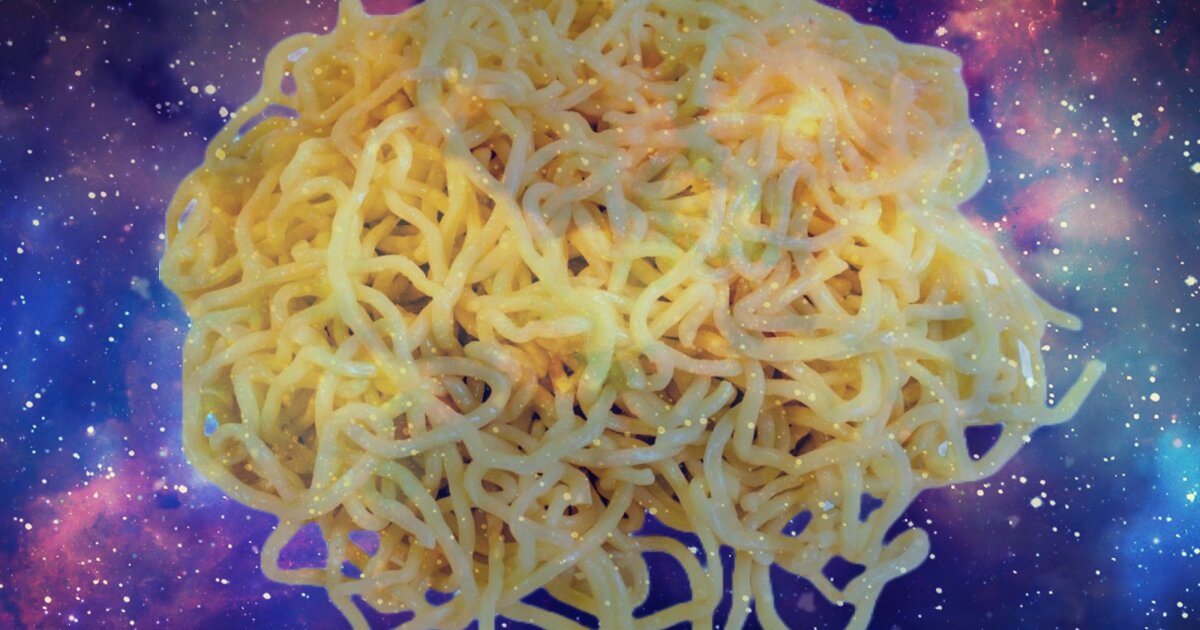
A recent discovery could challenge this cornerstone of cosmology, with physicists Francesco Sylos Labini from the Enrico Fermi Center for Study and Research in Italy and Marco Galoppo from the University of Canterbury finding our Universe looks a little too much like noodles for anybody’s liking.
Applying a statistical tool that measures correlations between objects at varying distances to the largest 3D map of the Universe created to date, the researchers determined that the distribution of galaxies over the largest scales has persistent structures billions of light-years in length.
“These results provide direct evidence that directional coherence persists to larger scales than predicted in the standard framework, challenging the assumption of large-scale isotropy,” the two write in their study.
Isotropy describes the uniformity of structural characteristics over a given area. It’s like seeing the wood for the trees – the smear of greenery from a distance one sees when they look beyond the individual oaks, the mushrooms, and the decaying squirrels.
The Universe is the wood. Sure, there are trees, birds, and flowers, but as a whole, our cosmos looks like a patch of the Amazon rainforest as seen from the edge of space.
Or so we assume. It’s not just an assumption without consequence, either. It is a philosophical foundation of cosmology, one that provides us with the premise that nothing we see in space is from a particularly privileged position.
The principle founds what is known as the lambda cold dark matter cosmological model, which takes a solid chunk of dark energy for spacetime expansion, adds a generous dollop of dark matter for binding, and then sprinkles on just a touch of the shiny stuff – ordinary baryonic matter we see as stars and galaxies.
Interpreted through a lens of general relativity, the model explains everything we can see as a vast, relatively featureless expanse.
What we think we can see could be wrong, of course. By some accounts, our velocity through space may be unusual enough to skew observations. Our galaxy could be surrounded by far more emptiness than is typical.
Or, as Sylos Labini and Galoppo now suggest, the big bowl of cosmic soup could be more noodly than we ever thought possible.
Their study asked a simple question – what is the likelihood of finding one galaxy within a certain distance of another, in a given direction? They applied their analytical tool to tens of millions of galaxies mapped by the Dark Energy Spectroscopic Instrument and found correlations.
Whether it’s some artefact of statistics or a bona fide representation of some kind of cosmic rivers coursing through the Amazonian greenery of our Universe, time will tell.
For now, the cosmological principle continues to be a handy way of explaining everything we can see. Even if it does mean you’re not really all that special. Sorry mom.
This research was published in Nature.
Source: Science Magazine
Fact-checked by Bronwyn Thompson

